Dresden Codex

Definition and stakes

Cyrus Thomas,  Aids to the Study of the Maya Codices

“ Another characteristic and easily recognized deity, which, it is true, is comparatively rare in the Dresden manuscript, but occurs with extraordinary frequency in other codices, and whose sign it is not hard to find, is the god whose face is crossed [surrounded] by peculiar parallel lines, representations of whom are given in the Cortesian Codex (p. 11, below) and Dresden Codex (p. 13, middle) . The deity is always male and is found in the Dresden Codex five times, Cortesian Codex eighteen times, Manuscript Troano twenty times, and Codex Peresianus five times. ”
Source: Gutenberg

Cyrus Thomas,  Aids to the Study of the Maya Codices

“ Copy of lower division of Plate 65, Dresden Codex.
A remarkable series of figures and written characters runs through the lower division of Plates 65 to 69 of the Dresden Codex, apparently devoted entirely to the representation of incidents in the life of the culture hero Kukulcan, or deity mentioned on a subsequent page as the “long nosed god” or “god with the snake-like tongue,” or to ceremonies to be performed in honor of this deity. Over the figure are three lines of written characters, as shown in Fig. 378, which is a copy of the lower division of Plate 65.
”
Source: Gutenberg

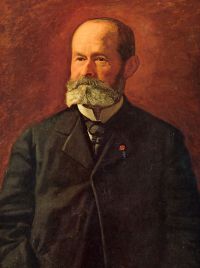
Portrait of Daniel G. Brinton Daniel G. Brinton,  Essays of an Americanist

“ One opinion he defends must not be passed by in silence. It is that the Dresden Codex is not one, but parts of two original manuscripts written by different hands.
252It appears that it has always been in two unequal fragments, which all previous writers have attributed to an accidental injury to the original. Dr. Förstemann gives a number of reasons for believing that this is not the correct explanation, but that we have here portions of two different books, having general similarity but also many points of diversity.
”
Source: Gutenberg

Get perspective with Kwize: daily news enlightened by great literature