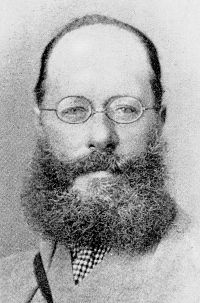
“ I am in a position to know that the whole book was composed and illustrated by Lord Derby himself. In fact, there is no such a person at all as Edward Lear." "Yet," said the other lady, "some friends of mine tell me they know Mr. Lear." "Quite a mistake! completely a mistake!" said the old gentleman, becoming rather angry at the contradiction; "I am well aware of what I am saying: I can inform you, no such a person as 'Edward Lear' exists!" ”
Edward Lear
Definition and stakes
Edward Lear (1812–1888) was a British artist, poet, and illustrator renowned for his literary nonsense, particularly his limericks, which he popularized. Beyond his whimsical verse, Lear’s work spanned ornithological illustration, landscape painting, and musical composition.
Authors like John William Cousin highlighted his travelogues and artistic dedication, while William Sloane Kennedy humorously noted his playful persona. His absurd creations, blending vivid imagery and inventive language, remain celebrated for their linguistic ingenuity and enduring charm, reflecting a unique fusion of creativity and eccentricity that continues to captivate readers.
Quotes about “Edward Lear”
William Sloane Kennedy, John Greenleaf Whittier: His Life…
“ Whittier used sometimes to come up from Amesbury with a whole bevy of little misses about him, and at the hotel the wee folk hailed him as one of those dear old fellows whom they always love at sight. It is said that Edward Lear—the friend of Tennyson, and author of "Nonsense Verses" for children—used to make a hobby-horse of himself in the castles of Europe, and treat his little friends to a gallop over the carpet on his back. ”
“ Lear did not know where Knowsley was, or what it meant; but the old gentleman was the thirteenth Earl of Derby. The successive Earls of Derby have been among Lear's kindest and most generous patrons. He went to Knowsley, and the drawings in the "Knowsley Menagerie" (now a rare and highly-prized work among book collectors) are by Lear's hand. At Knowsley he became a permanent favorite; and it was there that he composed in prolific succession his charming and wonderful series of utterly nonsensical rhymes and drawings. Lear had already begun seriously to study landscape. ”
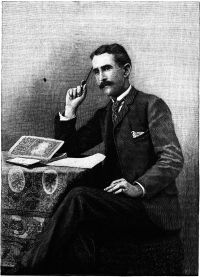
John William Cousin, A Short Biographical Dictionary of English Literature… (1910)
“ Lear, Edward (1812-1888) .—Artist and miscellaneous author, b. in London, and settled in Rome as a landscape painter. He was an indefatigable traveller, and wrote accounts, finely illustrated, of his journeys in Italy, Greece, and Corsica. ”
“ When English winters began to threaten his health, Lord Derby started a subscription which enabled him to go to Rome as a student and artist, and no doubt gave him recommendations among Anglo-Roman society which laid the foundations of a numerous clientèle. It was in the Roman summers that Lear first began to exercise the taste for pictorial wandering which grew into a habit and a passion, to fill vivid and copious note-books as he went, and to illustrate them by spirited and accurate drawings ”
“ The Moon was shining slobaciously from the star-bespangled sky, while her light irrigated the smooth and shiny sides and wings and backs of the Blue-Bottle-Flies with a peculiar and trivial splendor, while all Nature cheerfully responded to the cerulean and conspicuous circumstances. ”
“ Though the sky be dark, and the voyage be long, Yet we never can think we were rash or wrong, While round in our sieve we spin." Far and few, far and few, Are the lands where the Jumblies live: Their heads are green, and their hands are blue; And they went to sea in a sieve. ”
Edward Lear,
The Jumblies, and Other Nonsense Verses
“ THE JUMBLIES. THE OWL AND THE PUSSY-CAT. THE BROOM, THE SHOVEL, THE POKER AND THE TONGS. THE DUCK AND THE KANGAROO. THE CUMMERBUND. THE DONG WITH A LUMINOUS NOSE. THE NEW VESTMENTS. CALICO PIE. THE COURTSHIP OF THE YONGHY-BONGHY-BÒ. INCIDENTS IN THE LIFE OF MY UNCLE ARLY. THE JUMBLIES. I. They went to sea in a Sieve, they did, In a Sieve they went to sea: In spite of all their friends could say, On a winter’s morn, on a stormy day, In a Sieve they went to sea! And when the Sieve turned round and round, And every one cried, “You’ll all be drowned!” They cried aloud, ”
Frederick Forest, Iron Hand, Chief of the Tory League…
“ The house to which I have directed you is the residence of Thomas Lear, and—”At the last-mentioned name, the stranger started back with a look of surprise.“Then you are Imogene, the daughter of old Lear, the Tory?” he exclaimed.These words were uttered in a much different key. A strong, manly voice had taken the place of the weak, wheezing tone of the old man. The hot blood mantled the brow of Imogene, as she quickly retorted to this seemingly insulting language:“Though Thomas Lear should be a supporter of the king’s cause, his daughter, at least, should be free from insult. ”
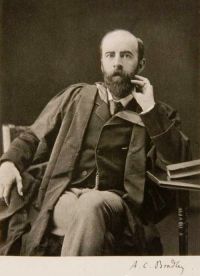
A. C. Bradley,
Shakespearean Tragedy
(1912)
“ And in these respects King Lear, though the most terrible of these works, does not differ in essence from the rest. Its keynote is surely to be heard neither in the words wrung from Gloster in his anguish, nor in Edgar’s words ‘the gods are just.’ Its final and total result is one in which pity and terror, carried perhaps to the extreme limits of art, are so blended with a sense of law and beauty that we feel at last, not depression and much less despair, but a consciousness of greatness in pain, and of solemnity in the mystery we cannot fathom. ”
Charles Lamb and Mary Lamb, Tales from Shakspeare — King Lear (1831)
“ Lear, king of Britain, had three daughters; Gonerill, wife to the duke of Albany; Regan, wife to the duke of Cornwall; and Cordelia, a young maid, for whose love the king of France and duke of Burgundy were joint suitors, and were at this time making stay for that purpose in the court of Lear. The old king, worn out with age and the fatigues of government, he being more than fourscore years old, determined to take no further part in state affairs, but to leave the management to younger strengths, that he might have time to prepare for death, which must at no long period ensue. ”
Charles Lamb,
Tales from Shakespeare — King Lear
(1908)
“ And he cursed his eldest daughter Goneril so as was terrible to hear; praying that she might never have a child, or if she had, that it might live to return that scom and contempt upon her which she had shown to him: that she might feel how sharper than a serpent's tooth it was to have a thankless child. And Goneril's husband, the duke of Albany, beginning to excuse himself for any share which Lear might suppose he had in the unkindness, Lear would not hear him out, but in a rage ordered his horses to be saddled, and set out with his followers for the abode of Regan, his other daughter. ”
Frederic Leake, Historic Bubbles
“ Edward the Black Prince governed it as viceroy and held his court at Bordeaux. Edward had been on the point of becoming brother-in-law to Pedro who had been affianced to Edward’s sister Joan as I have already related, and Pedro induced him to undertake to recover for him the throne of Castile. Edward insisted on a preliminary contract by which Pedro was to pay the cost of the expedition if successful. He then{195} put his legions in motion. Henry called Du Guesclin to his side. The knight, probably the best soldier in Europe after Edward, was averse to a battle. ”
Various, Graham's Magazine, Vol. XX, No… (1842)
“ As he spoke, Edward had extended his hand as if to raise the young girl from his feet, but instead of this he laid it among the rich tresses of her hair, where it rested pale and caressingly lighted up by his own princely gift of jewels, and sinking to his seat again he bent forward and addressed the wondering girl in a low and earnest voice, smiling as he spoke, and faintly blushing as he saw that his words made the warm color deepen and glow in the cheek that had a moment before looked so cold and pale. ”
Anonymous, Strive and Thrive; or, Stories for the Example and Encouragement of the Young
“ Edward's thoughts went back to the mill-pond, and he saw, in imagination, Henry Lee struggling in the hole in the ice, and saw how easy it would have been for him to have gone to his assistance, and rescued him from his perilous situation, instead of running away, frightened out of his wits, screaming for others afar off to do what was needed to be done at the moment. He felt, painfully too, that his playfellow would have been drowned, had not George Williams, with true bravery, gone instantly to his aid. It was a moment of self-reproach and mortification. ”
Charles Lamb,
Tales from Shakespeare — King Lear
(1908)
“ Lear blessed himself in having such loving children, as he thought; and could do no less, after the handsome assurances which Regan had made, than bestow a third of his kingdom upon her and her husband, equal in size to that which he had already given away to Goneril. ”
Various, Chambers's Journal of Popular Literature…
“ Some honours—none of them of any value in a money point of view—were now awarded to Edward. The Linnean Society having discovered his genius and talent, unanimously elected him an Associate in 1866. Immediately afterwards, the Natural History Society of Aberdeen unanimously admitted him a member; and in 1867 he received the diploma of the Glasgow Natural History Society. 'Although Banff,' says Mr Smiles, 'possessed an "Institution for Science, Literature, and the Arts, and for the encouragement of native genius and talent," the members did not even elect Edward an honorary member. ”
Abby Sage Richardson,
Stories from Old English Poetry…
(1899)
“ Surely Nature could not produce another monster such as she. When she answered this with more bitter insults, he cursed her with a curse so terrible, that one can hardly imagine how she could have heard it and not fallen on her knees and called on God for mercy. Lear then left her castle gates with all his train, and set out for Regan’s palace. Just before this happened, the Earl of Kent, whom Lear had banished, fearing his old master would need some trusty friend, had returned in disguise to Britain. ”
J. Adelard René, Wanderings of French Ed
“ When they arrived at the great metropolis of the West, Edward offered to see Miss King to her home, while the Russian was to wait at the station until his return.When Edward came back, his friend asked him: "Did she cry when you left her?""Ben, I don't like to hear you speak this way about her. No; I won't permit any joking about it.""All right, Ed, but what do you know about her?""I know that she is a good girl, and that she is not making sport of me.""How do you know it?""She told me so.""Oh! la! la! la! She told you so, eh? Don't you know that women can say anything?" ”
Harry Stillwell Edwards,
Sons and Fathers
“ I am now rich beyond the comprehension of your economical German mind, and surely I may be allowed, in the interests of science, of my ward and myself to spend from the abundant store. I look for you early. In the meantime, I will be careful in my experiments. Come at once! The mind has an independent memory and you can demonstrate it."Edward knew that there was more on that concluding sentence than in the rest of the letter and exchange combined, and half-believing it, he stated it as a prophecy. ”
Elizabeth Cleghorn Gaskell,
The Moorland Cottage
“ After dinner, when Mr. Buxton and the twoyoung men were left alone, Edward launched out still more. He thought hewas impressing Frank with his knowledge of the world, and the world's ways.But he was doing all in his power to repel one who had never been muchattracted toward him. Worldly success was his standard of merit. The endseemed with him to justify the means; if a man prospered, it was notnecessary to scrutinize his conduct too closely. The law was viewed in itslowest aspect; and yet with a certain cleverness, which preserved Edwardfrom being intellectually contemptible. ”
Red and White: A Tale of the Wars of the Roses
“ Leger, with a courtesy.St. Leger was a good-looking man of some five and twenty years, with light hair, which, in accordance with fashion, he wore very long, and cut quite straight all round."That is well. I would fain do thee some grace for thy service," said Edward, rising, and calling another of his squires to attend him, he lounged out of the room.King Edward IV. was the handsomest man of his age. "A more beautiful person," says Comines, "never did mine eyes behold." ”
English Critical Essays: Nineteenth Century
“ The contemptible machinery by which they mimic the storm which he goes out in, is not more inadequate to represent the horrors of the real elements, than any actor can be to represent Lear: they might more easily propose to personate the Satan of Milton upon a stage, or one of Michael Angelo’s terrible figures. The greatness of Lear is not in corporal dimension, but in intellectual: the explosions of his passion are terrible as a volcano: they are storms turning up and disclosing to the bottom that sea, his mind, with all its vast riches. ”
J. Castell Hopkins, The Life of King Edward VII
“ Probably no wiser monarch ever reigned over a nation." To the New Brunswick press the local Premier, Hon. Douglas Hazen, said: "King Edward's reign was a comparatively short one, but the verdict of history will undoubtedly be that he was one of the wisest and greatest rulers that ever sat upon a throne. He took a most keen and active interest in all his country's institutions, endeavouring at all times to promote the well-being of his subjects and to show his appreciation of the British Dominions beyond the Seas." ”
J. Castell Hopkins, The Life of King Edward VII
“ King Edward the Seventh, in a sixty years' tenure of the difficult position of Heir to the British Throne, built into the history of his country and Empire a record of which he and his people had every reason to be proud. He had for many years the responsibilities of a Royal position without the actual power; the public functions of a great ruler without the resources usually available; the knowledge, experience and statecraft of a wise Sovereign without Regal environment. ”
Samuel Smiles, Life of a Scotch Naturalist: Thomas Edward…
“ The bone in question is now one of the most cherished relics of the Banff Museum.BANFF MUSEUM. [373] CHAPTER XVIII. CONCLUSION. Edward’s labours were now drawing to a close. He had fought the fight of science inch by inch, until he could fight no more. He had also fought the fight of honest poverty—a great triumph and a great glory.The honest man, though e’er sae poor,Is king o’ men, for a’ that. It is said that the man who can pay his way is not poor. Edward could always do that. He was in no man’s debt. He had lived within his means, small though they were. ”
J. Castell Hopkins, The Life of King Edward VII
“ It may be added that the surviving children of King Edward and Queen Alexandra at the time of the King's death were his successor—George Frederick Ernest Albert, Prince of Wales; Princess Louise, Duchess of Fife, who was born in 1867 and married in 1889; Princess Victoria, who was born in 1868 and was unmarried; Princess Maud, Queen of Norway, who was born in 1869 and married in 1896 to Charles, then Crown Prince of Denmark. King Edward's only surviving brother was H. R. H., the Duke of Connaught, who was born in 1850. ”
Red and White: A Tale of the Wars of the Roses
“ Some chroniclers say that Edward dashed his gauntleted hand in the face of his young cousin. Others assert that he merely flung a sign to those around him. Either action was well understood. Hastings, the King's faithful servant, and Thomas Grey, his step-son, the affianced of Anne of Exeter, hurried Prince Edward out of his presence to the next tent, where the Dukes of Clarence and Gloucester were standing. ”
Various, Punch, or the London Charivari…
“ At the moment when Edward first caught my horrified eye a particularly well-groomed young gentleman of about his own age caught Edward's eye in turn. Edward paused to survey this silken wonder with interest. Then, as if prompted thereto by the sight, he snatched off his hat and, casting it upon the ground, kicked it vigorously across the grass.The removal of the hat was the last straw, for Edward's hair is provocatively red. My friend of the B.O.F. advanced towards him with the intention of exerting authority and restoring discipline. Edward turned at the sound of a stern voice. ”
J. Castell Hopkins, The Life of King Edward VII
“ King Edward's life as a devotee of duty, as a sportsman in the best sense of the word, as an ardent and discriminating patron of the arts, as a good business man at the head of a great business community, possessed of intuitive shrewdness in the management of men and difficult situations, as a keen social reformer with "no self apart from his people," was then dwelt upon. It would be impossible in any limited space to analyze the views of the British press. The Times declared that "his people loved him for his honesty and kindly courtesy. ”
G. Mercer Adam, An Algonquin Maiden: A Romance of the Early Days of Upper Canada
“ Edward rose and left the room.To leave the room in a region upon which unpicturesque prosperity has not yet descended is equivalent to leaving the house, and that is exactly what the young man did. Of course there was a loft above that was reached by a perilously steep pair of stairs; but he was not a cur to creep away into a kennel. He went out and battled with the pitiless storm, a fiercer storm beating within his breast than that which raged without. ”