General Court of Massachusetts

Definition and stakes

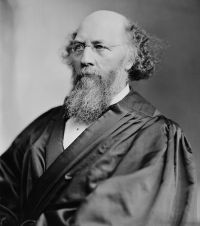
Portrait of Stephen Johnson Field Stephen Johnson Field Randall v. Brigham — Opinion of the Court

The Superior Court of Massachusetts is a court of general jurisdiction, and is empowered by statute to admit attorneys and counsellors to practise in the courts of the State, upon evidence of their possessing good moral character, and of having devoted a prescribed number of years to the study of the law, in the office of some attorney in the State, and to remove them 'for any deceit, malpractice, or other gross misconduct.'
Both the admission and the removal of attorneys are judicial acts. It has been so decided in repeated instances.
Source: Wikisource

Rhode Island v. Massachusetts…

The ambitious pretensions of Massachusetts to an extension of her jurisdiction over New Hampshire and Maine, the territorial rights to which were in Mason and Gorges, arose out of the fact, that, after 1636, the inhabitants of New Hampshire, being destitute of the powers of government, petitioned the General Court of Massachusetts to be taken under their government and protection. Massachusetts refused to grant these petitions for a number of years. She had erected her bound-house three miles north of the Merrimack proper.
Source: Wikisource

Joseph McKenna Mutual Loan Company v. Martell…

Certain general principles, however, must be taken for granted. It is certainly the province of the state, by its legislature, to adopt such policy as to it seems best. There are constitutional limitations, of course, but these allow a very comprehensive range of judgment. And within that range the Massachusetts statute can be justified. Legislation cannot be judged by theoretical standards. It must be tested by the concrete conditions which induced it; and this test was applied by the supreme judicial court of Massachusetts in passing on the validity of the statute under review.
Source: Wikisource

Get perspective with Kwize: daily news enlightened by great literature