“ He had come to no sort of understanding with Klaus Heinrich, but questioned him when it occurred to him to do so, in a free and friendly way without causing him any embarrassment. And Klaus Heinrich's by no means apropos answers seemed to enchant Doctor Ueberbein, to inspire him with warm enthusiasm. “Ha, ha,” he would cry and throw his head back laughing. “Oh, Klaus Heinrich! Oh, scion of princes! Oh, your innocency! The crude problems of life have caught you unprepared! Now then, it is for me with my experience to put you straight.” ”
Quotes about “Klaus Heinrich”
“ Because, Klaus Heinrich, I see in your existence the clearest, most express, and best-preserved form of the extraordinary in the world. I have become your tutor that I might keep your destiny alive in you. Reserve, etiquette, obligation, duty, demeanour, formality—has the man whose life is surrounded by these no right to despise others? Ought he to allow himself to be reminded of humanity and good nature? No, come along, let's go, Klaus Heinrich, if you don't mind. They're tactless brats, these little Stavenüters. ”
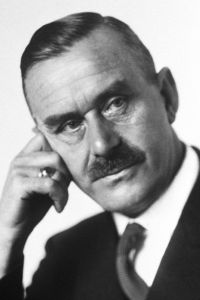 Thomas Mann,
Royal Highness
(1916)
Thomas Mann,
Royal Highness
(1916)
“ More than once Klaus Heinrich showed in his face the look of pained bewilderment which he had noticed on a previous occasion on the face of the good sister, and yet he felt convinced that it was not Imma Spoelmann's intention to wound his feelings, that she did not consider him humbled because he was not successful in standing up to her, that she rather let his poor answers pass, as if she considered that he had no need of a sharp wit to defend him—it was only she who had. ”
Thomas Mann,
Royal Highness
(1916)
“ I've got a matter of some importance to discuss with you—I might come with you to the Hermitage, but I can't bear the evening air." Klaus Heinrich clapped his heels together as he an swered: "No, Albrecht, you mustn't think of it! I'll drive to the Schloss with you if you like. I am of course at your disposal." ”
Thomas Mann,
Royal Highness
(1916)
“ But Klaus Heinrich for the first time noticed his photograph in the shop window. It was hanging next those of artists and great men, men with lofty brows, with a look of the loneliness of fame in their eyes. People were satisfied with him on the whole. He gained dignity with years, and self-possession under the pressure of his exalted calling. But the strange thing was that his longing increased at the same time: that roving inquisitiveness which Schulrat Dröge was not the man to satisfy, and which had impelled him to chat with the lackeys. ”
Thomas Mann,
Royal Highness
(1916)
“ Look you," he said, leaning back and crossing one leg over the other, while he stroked his beard up from underneath his chin, "look you, Klaus Heinrich, a man who has my intellectual aspirations will not be able to help searching for and clinging to whatever is out of the ordinary in this drab world of ours, wherever and however it appears—he cannot help being put out by such a slovenly song, by such a sheepish abjuration of the exceptional, of the lofty and of the miserable, and of that which is both at once. ”
Thomas Mann,
Royal Highness
(1916)
“ And this characteristic the Knüppelsdorf of to-day proved that it possessed by raising a memorial to his, Klaus Heinrich's, beloved father, and it would be with unusual pleasure that he would report to his gracious brother the dazzling and hearty reception which he, as his representative, had here experienced.... The veil fell, the massed choirs of the "Wreath of Harmony" again did their best. And Klaus Heinrich stood smiling, under his theatrical tent, with a feeling of having exhausted his store of knowledge, happy in the certainty that nobody dare question him further. ”
“ That was his way of greeting Klaus Heinrich. He was an alien, an invalid, and a man apart as regards wealth. He was forgiven and nothing further was expected of him—Klaus Heinrich recognized the fact, and took pains to recover his self-control.“You are at home here in a sense,” added Mr. Spoelmann, cutting the conversation short, and a passing gleam of malice played round his clean-shaven mouth. Then he gave the others an example by sitting down. It was the chair between Imma and Klaus Heinrich, opposite the Countess and the veranda door, which the butler pushed under him. ”
Thomas Mann,
Royal Highness
(1916)
“ Klaus Heinrich also visited the fair Southern lands, incognito, under a romantic-sounding title. There he would sit, alone, perhaps for a quarter of an hour, dressed in a suit of irreproachable cut, among other foreigners on a white restaurant terrace looking over a dark-blue sea, and it might happen that somebody at another table would notice him, and try, in the manner of tourists, to engage him in conversation. What could he be, that quiet and self-possessed-looking young man? People ran over the various spheres of life, tried to fit him into the merchant, the military, the student class. ”
Thomas Mann,
Royal Highness
(1916)
“ You're a Sunday child. Everything turns out trumps for you.... I wish you luck," he said, raising the lids from his lonely-looking, blue eyes. And it was clear at this moment that he loved Klaus Heinrich. "I wish you happiness, Klaus Heinrich—but not too much, and that you may not repose too comfortably in the love of the people. I have already said that everything turns out trumps for you. ”
“ I'm all right, Klaus Heinrich, your eyes don't deceive you, and it would be ungrateful of me not to acknowledge my good fortune. You see, I know quite well that many people in the country are disappointed by my marriage and say that I have ruined myself, and demeaned myself, and so on. And such people are not far to seek, for brother Albrecht, as you know as well as I do, in his heart despises my dear Philipp and me into the bargain, and can't abide him, and calls him privately a tradesman and shopkeeper. ”
Thomas Mann,
Royal Highness
(1916)
“ The starveling became a sleek man, the hovel a homely cottage, dirty gutter-children changed into chaste little maidens and boys in Sunday clothes, their hair plastered with water, a poem on their lips, and the perspiring citizen in frock-coat and top-hat was moved to emotion by the consciousness of his own worth. But not only he, Klaus Heinrich, saw the world in this light, but it saw itself too, as long as his presence lasted. A strange unreality and speciousness prevailed in places where he exercised his calling ”
Thomas Mann,
Royal Highness
(1916)
“ Herr von Knobelsdorff plunged straight into the middle of things, and spoke about Prince Klaus Heinrich's visits to Schloss Delphinenort. Albrecht knew of them. A subdued echo of the events which kept the city and the country on tip-toe had penetrated even into his loneliness; he knew, too, his brother Klaus Heinrich, who had "rummaged" and gossiped with the lackeys, and, when he knocked his forehead against the big table, had wept for sympathy with his forehead—and in effect he needed no coaching. ”
“ At this time Klaus Heinrich usually had his tea, but this time he only gave a passing thought to it, and nobody outside dared to disturb a conversation whose importance was shown by its duration. Klaus Heinrich listened and listened. He scarcely realized how much affected he was. But how could the other bring himself to say all that to him? He had not called him “Royal Highness” one single time during the interview, he had to some extent forced him, and grossly ignored the fact that he was “born to be king.” ”
Thomas Mann,
Royal Highness
(1916)
“ When Klaus Heinrich was two years old, another birth took place in the Grimmburg, and a princess came into the world. Thirty-six guns were allotted to her, because she was of the female sex, and she was given the name of Ditlinde at the font. She was Klaus Heinrich's sister, and it was a good thing for him that she appeared. She was at first surprisingly small and weak, but she soon grew like him, caught him up, and the two became insepar able. They shared each other's lives, each other's views, feelings, and ideas : they communicated to each other their impressions of the world outside them. ”
“ Klaus Heinrich's heart, as he thought of this, filled with sympathy.It was nearly seven o'clock when he asked for his carriage to be called—slightly uneasy about his long stay, in view of the Court and the public. His departure evoked a fresh and terrifying demonstration on the part of Percival, the collie. Every alteration or interruption in a situation seemed to throw the noble animal off his moral balance. ”
Thomas Mann,
Royal Highness
(1916)
“ Behind the glass and gilded window-frames sat Imma Spoelmann in veil and wreath, with an old Court lady as lady of honour at her side. Her dress of shimmering silk glittered like snow in the sunshine, and on her lap she held the white bouquet which Prince Klaus Heinrich had sent her an hour before. Her strangely childlike face was as pale as an ocean-pearl, and a smooth wisp of dark hair fell across her forehead under the veil, while her big black eyes threw glances of pleading eloquence over the close-packed throng. ”
Thomas Mann,
Royal Highness
(1916)
“ He saw Imma Spoelmann sitting in a languid pose in her red-gold dress at the table, with a look as of a spoilt child on her face; sitting in comfortable assurance, and uttering remarks with a sting in them, such as were good coin in the United States, where clearness, hardness, and a ready wit were essentials of life. And why? Klaus Heinrich could understand now, and never a day passed that he did not try to realize it better. ”
Thomas Mann,
Royal Highness
(1916)
“ That common man, whose spirit otherwise cleaved to the dust, who gave a thought to nothing, not even to every-day politeness, beyond what was purely utilitarian, and had come here too with a definite object in view—he felt in his heart that there was something higher than business and his business in particular, and he left the Schloss elevated, purified, with eyes dim with emotion and the smile still on his flushed face. That was the way in which Klaus Heinrich gave free audiences, that the way in which he exercised his exalted calling. ”
Thomas Mann,
Royal Highness
(1916)
“ Klaus Heinrich agreed, so they left the park and trotted across country to reach the high-road which led to their goal to the north-west. In the town gardens they were greeted with surprise by a few promenaders, whose greetings Klaus Heinrich acknowledged by raising his hand to his cap, Imma Spoelmann with a grave and rather embarrassed inclination of her dark head in the three-cornered hat. By now they had reached the open country, and were no longer likely to meet people. Now and then a peasant's cart rolled along the road, or a crouching bicyclist ploughed his way along it. ”
Thomas Mann,
Royal Highness
(1916)
“ And then it happened that something gave way in Klaus Heinrich's bosom, and poured out in a stream of confession : he told Herr von Knobelsdorff the whole story. He told it as one tells when the heart is full and everything comes tumbling out all at once through the lips; according to no plan, no chronological order, and with undue emphasis on unessentials, but with a burst of passion, and with that concreteness which is the product of passionate observation. ”
Thomas Mann,
Royal Highness
(1916)
“ Klaus Heinrich was rather crestfallen over this explanation, and loath to give up the common belief in the connexion between the lumber-room and the fortunes of his house. Thus they conversed, and the Countess too took part, now sensible, now confused; Klaus Heinrich took considerable pains not to rebuff or chill her by his manner, and addressed her as "Frau Meier" whenever she appeared to think it necessary for her protection against the plots of the wicked women. ”
Thomas Mann,
Royal Highness
(1916)
“ Klaus Heinrich left the Hermitage shortly before five o'clock. As the weather was sunny, he had ordered the dog-cart, and the open brown-varnished vehicle, clean and shining, if not over-new or smart to look at, came slowly up the broad drive of the Schloss, at a quarter to five, from the stables, which with their asphalt yard lay in the right wing of the home farm. ”
“ Schulrat Dröge was a born pedagogue. His index-finger, with its folds of dry skin and gold stoneless signet-ring, followed the line of print when Klaus Heinrich read, waiting before going on to the next word until the preceding one had been read. He came in a frock-coat and white waistcoat, with the ribbon of some inferior order in his button-hole, and in broad shiny boots with brown upper-leathers. He wore a pointed grey beard, and bushy grey hair grew out of his big, broad ears. ”
“ He saw the dull haughtiness of his blue eyes, the furrows which, proudly and morosely, ran from nostril down to his beard, and were often deepened or accentuated by weariness and boredom.... Nobody dared to address him or to go freely up to him and speak to him unasked—not even the children: it was forbidden, it was dangerous. He answered, it is true: but he answered distantly and coldly, a look of helplessness, of gêne, passed over his face, which Klaus Heinrich was quite able to understand.Papa made a speech and sent his petitioners away; that is what always happened. ”
“ He wears himself out, he's quite thin under his glossy coat, you can feel all his ribs. For I'm afraid he'll never grow to be old, but will fall an early victim to consumption. The street curs persecute him, they go for him in every street, but he jumps clear of them, and if they succeed in joining issue with him, he distributes a few bites with his splendid teeth which the rabble don't forget in a hurry. One must love such a compound of chivalry and virtue.”Imma agreed, in words which were the most serious and grave which Klaus Heinrich had ever heard from her mouth. ”
Thomas Mann,
Royal Highness
(1916)
“ Klaus Heinrich was a little afraid of Herr Martini. "Oh dear, Doctor Ueberbein," he said when he met his tutor one day, "what subject am I to tackle him on? He's sure to be a wild, brazen-faced fellow." But Doctor Ueberbein answered: "Anything; but, Klaus Heinrich, you need not worry! He's a very decent fellow. I know him, I'm rather in with his set. You'll get on splendidly with him." So Klaus Heinrich received the poet of the "Joy of Life," received him at the "Hermitage," so as to give the business as private a character as possible. ”
“ Yonder he lived, with his physician, his electric organ, and his collection of glass, behind the pillars, the bow windows, and the chiselled festoons of the schloss which had risen from its ruins at a nod from him. He was hardly ever seen: he was always in bed with poultices. But people saw his daughter, that curious creature with the whimsical features who lived like a princess, had a countess for a companion, studied algebra, and had walked in a temper unimpeded right through the guard. People saw her, and they sometimes saw Prince Klaus Heinrich at her side. ”
“ Now you have to rummage alone, and God grant, Klaus Heinrich, that it won't bring you any horrible experience.”“I really believe, Ditlinde, that every experience is fine, whether it be good or bad. But my present experience is splendid.”At half-past five the Prince left the “Hermitage” again, in his dogcart, which he drove himself, with a groom at his back. It was warm, and Klaus Heinrich was wearing white trousers with a double-breasted coat. Bowing, he again drove to the town, or more precisely to the Old Schloss. ”
Thomas Mann,
Royal Highness
(1916)
“ But what was the use of rummaging if at the first serious adventure one intended to pass on in dignity and dudgeon? And the man was honest, and had nothing wicked about him: that Klaus Heinrich could see when he forced himself to raise his eyes. He simply said: "You come with us, that's the best way. I will willingly show you where you must turn off to get to an exit." And they went on. "Thanks!" said the man. "Ever so many thanks for your kindness! Heaven knows I should never have thought that I should live to walk about the Old Schloss one day with your young Highnesses. ”
