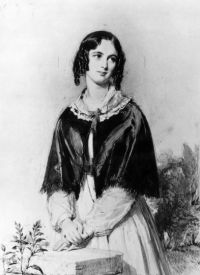
“ Yes, I always say so,’ Mrs. Gradgrind cried, with unexpected quickness. ‘And that reminds me. I—I want to speak to you, my dear. Sissy, my good girl, leave us alone a minute.’ Louisa had relinquished the hand: had thought that her sister’s was a better and brighter face than hers had ever been: had seen in it, not without a rising feeling of resentment, even in that place and at that time, something of the gentleness of the other face in the room; the sweet face with the trusting eyes, made paler than watching and sympathy made it, by the rich dark hair. ”
Louisa Gradgrind
Definition and stakes
Quotes about “Louisa Gradgrind”
“ Louisa crying to him that she forgave him, and loved him still, and that he would one day be sorry to have left her so, and glad to think of these her last words, far away: when some one ran against them. Mr. Gradgrind and Sissy, who were both before him while his sister yet clung to his shoulder, stopped and recoiled.For, there was Bitzer, out of breath, his thin lips parted, his thin nostrils distended, his white eyelashes quivering, his colourless face more colourless than ever, as if he ran himself into a white heat, when other people ran themselves into a glow. ”

Charles Dickens,
Hard Times
(1854)
“ You have been so careful of me, that I never had a child’s heart. You have trained me so well, that I never dreamed a child’s dream. You have dealt so wisely with me, father, from my cradle to this hour, that I never had a child’s belief or a child’s fear.’Mr. Gradgrind was quite moved by his success, and by this testimony to it. ‘My dear Louisa,’ said he, ‘you abundantly repay my care. Kiss me, my dear girl.’So, his daughter kissed him. ”
Charles Dickens,
Hard Times — Book the Second, Chapter IX
(1854)
“ Louisa, holding her hand, could feel no pulse; but kissing it, could see a slight thin thread of life in fluttering motion.‘You very seldom see your sister,’ said Mrs. Gradgrind. ‘She grows like you. I wish you would look at her. Sissy, bring her here.’She was brought, and stood with her hand in her sister’s. Louisa had observed her with her arm round Sissy’s neck, and she felt the difference of this approach.‘Do you see the likeness, Louisa?’‘Yes, mother. I should think her like me. But - ’‘Eh! Yes, I always say so,’ Mrs. Gradgrind cried, with unexpected quickness. ‘And that reminds me. ”
Kate Dickinson Sweetser, Ten Girls from Dickens
“ Still, as I have said already, I am disappointed.""I wish I could have made a better acknowledgment, sir, of your kindness to a poor forlorn girl who had no claim upon you, and of your protection of her." said Sissy, weeping."Don't shed tears," added Mr. Gradgrind, "I don't complain of you. You are an affectionate, earnest, good young woman, and we must make that do.""Thank you, sir, very much," said Sissy, with a grateful curtsey."You are useful to Mrs. Gradgrind, and you are serviceable in the family also; so I understand from Miss Louisa, and indeed, so I have observed myself. ”
“ Gradgrind proceeded, in the same depressed and propitiatory manner, ‘I appear to myself to have become better informed as to Louisa’s character, than in previous years. The enlightenment has been painfully forced upon me, and the discovery is not mine. I think there are—Bounderby, you will be surprised to hear me say this—I think there are qualities in Louisa, which—which have been harshly neglected, and—and a little perverted. ”
L. Mühlbach, Louisa of Prussia and Her Times…
“ Where should there be room and the necessary comforts for a queen?” “If you cease to be king,” said Louisa, smiling, “it follows, as a matter of course, that I cease to be a queen. If you are nothing but a soldier, I am merely a soldier’s wife, and it behooves a soldier’s wife to accompany her husband into the camp. Oh, Frederick, do not say no!—do not deprive me of my greatest happiness, of my most sacred right! Did we not swear an oath at the altar to go hand in hand through life, and to stand faithfully by each other in days of weal and woe? And now you will forget your oath? ”
D. H. Lawrence,
The Prussian Officer
“ She could scarcely conceive him as human. Mechanically, under the influence of habit, he groped in the black water, fished out soap and flannel, and handed them backward to Louisa. Then he remained rigid and submissive, his two arms thrust straight in the panchion, supporting the weight of his shoulders. His skin was beautifully white and unblemished, of an opaque, solid whiteness. Gradually Louisa saw it: this also was what he was. It fascinated her. Her feeling of separateness passed away: she ceased to draw back from contact with him and his mother. There was this living centre. ”
D. H. Lawrence,
The Prussian Officer
“ Then Miss Louisa took her place. It was no good Miss Louisa’s trying to adopt to Mr Massy an attitude of queenly service. She was unable to regard him save with aversion. When she saw him from behind, thin and bent-shouldered, looking like a sickly lad of thirteen, she disliked him exceedingly, and felt a desire to put him out of existence. And yet a deeper justice in Mary made Louisa humble before her sister. They were going to see Mr Durant, who was paralysed and not expected to live. Miss Louisa was crudely ashamed at being admitted to the cottage in company with the little clergyman. ”
The Atlantic Monthly — A Few Scenes from a True History
“ Noble's wealth increased, the wish grew stronger to place Louisa in the midst of as much elegance as had surrounded her in childhood. When the house at Pine Grove was unoccupied, they often went out there, and it was his delight to see her stand under the Gothic arch of trees, a beautiful _tableau vivant_, framed in vines. It was a place so full of heart-memories to her, that she always lingered there as long as possible, and never left it without a sigh. In one place was a tree her father had planted, in another a rose or a jessamine her mother had trained. ”
Lucy Ellen Guernsey, The school-girls' treasury (1870)
“ The truth was that Louisa had not learned to see that she was in fault. She was "unlucky," she thought: "it always happened so." She was sure that she was always ready to do anything that was wanted of her, and she could not understand why her mother should go for baby's medicine herself, instead of sending her, and why Aunt Maria would not let her put into the post-office box the letter which carried the news that baby was at last out of danger."Miss Louisa, will you watch these cakes for me while I run out and pick the beans for dinner?" said Mary the cook, one day. ”
Kate Dickinson Sweetser, Ten American Girls from History
“ To play on the Common was her great delight, for she was a born investigator, and there she met children of all classes, who appealed to her many-sided nature in different ways. Louisa was never a respecter of class distinctions—it did not matter to her where people lived, or whether their hands and faces were dirty, if some personal characteristic attracted her to them, and from those early days she was unconsciously studying human nature, and making ready for the work of later years. ”
E. Phillips Oppenheim,
The Unfamiliar Triangle
(1922)
“ Louisa, however, elbowed me out and half pushed, half conducted me along an entry, with a high wall on either side, a slimy place with the swish of waves distinctly audible. At the extreme end she pushed open a door on the left-hand side. We found ourselves in a café of the poorest class, with sanded floors and iron tables. A woman, fat and with a hideous face, stood behind the bar; whenever I desire to think of something horrible, I think of the stealthy, vicious faces of the men who first glared and then leered at us as we crossed the threshold. ”
D. H. Lawrence,
The Prussian Officer
“ She did not hesitate, however, but by mechanical walking found herself descending the hill towards Old Aldecross. In the valley that was black with trees, the colliery breathed in stertorous pants, sending out high conical columns of steam that remained upright, whiter than the snow on the hills, yet shadowy, in the dead air. Louisa would not acknowledge to herself whither she was making her way, till she came to the railway crossing. ”
Lucy Ellen Guernsey, The school-girls' treasury (1870)
“ Louisa is almost a woman now, and if she cannot be trusted for so long a time as that, what will she ever be good for?"At last Cousin Frances consented to go, but the gave Louisa many charges about Milly."Be sure you keep her in sight all the time, and do not let her run about the grounds. It rained hard last night and the grass is very wet."Louisa promised, and Cousin Frances went away. For the first half hour Milly played contentedly upon the veranda with her dolls and books and her pet rabbits, while Louisa worked at the sofa cushion she was making for Aunt Wentworth's birthday. ”
Eva Annie Madden, Two Royal Foes
“ And then Ludwig had taken little Carl on his knee and told him a nice little story of Queen Louisa, of when she had gone with her husband on his Huldigung, the journey German sovereigns take to receive the oaths of allegiance in their provinces and cities.In the village of Stargard, in Pomerania, Ludwig related, the good people who had arranged the welcome had dressed little girls in white that they might strew flowers before the new young Queen, and the quick eye of the Queen noticed that, as there were nineteen, one must walk alone.She turned to the grown people. ”
W. Pett Ridge, Erb — Chapter 7 (1903)
“ On one of her visits to Bermondsey she had met Louisa, white-faced and twitching as a result of her work, had gone to Louisa's employer, and had made him shake in his very shoes by denouncing him and all his works, had demanded for Louisa a fortnight's holiday, which the employer, anxious enough to conciliate this emphatic young titled person, and fearful of being sent to the Tower, at once conceded; sent Louisa, with sister Alice for company, away to the country house at Penshurst where the better side of Alice's nature detached itself, and she became an attentive nurse. ”
Baroness Emmuska Orczy Orczy, The Heart of a Woman
“ And Louisa counted herself one of the strong ones of this earth. Just think of her name. Have you ever known a Louisa who gushed? who called herself the happiest woman on earth? who thought of a man—just an ordinary man, mind you—as the best, the handsomest, the truest, the most perfect hero of romance that ever threw a radiance over the entire prosy world of the twentieth century? ”
D. H. Lawrence,
The Prussian Officer
“ The ragged fringe of pinks hanging over the garden brim behind her was whitened now with snow-flakes, that in summer held white blossom to Louisa’s face. It was pleasant, she thought, to gather flowers that stooped to one’s face from above. She knocked again. Peeping in, she saw the scarlet glow of the kitchen, red firelight falling on the brick floor and on the bright chintz cushions. It was alive and bright as a peep-show. She crossed the scullery, where still an almanac hung. There was no one about. “Mrs Durant,” called Louisa softly, “Mrs Durant.” ”
Charlotte M. Yonge,
Dynevor Terrace; Or, The Clue of Life…
“ Poor Louisa had little wisdom by nature, and her education had been solely directed to enable her to shine in the world, not to render her fit for the companionship of a man of domestic tastes, accustomed to the society of superior women. There was nothing to fall back upon, nothing to make a home, she was listless and weary whenever gaiety failed her—and he, disappointed and baffled, too unbending to draw her out, too much occupied to watch over her, yielded to her tastes, and let her pursue her favourite enjoyments unchecked. ”
Charles Dickens,
Hard Times — Book the Third, Chapter I
(1854)
“ Louisa understood the loving pretence, and her heart smote her.‘May I try?’ said Sissy, emboldened to raise her hand to the neck that was insensibly drooping towards her.Louisa, taking down the hand that would have embraced her in another moment, held it in one of hers, and answered:‘First, Sissy, do you know what I am? I am so proud and so hardened, so confused and troubled, so resentful and unjust to every one and to myself, that everything is stormy, dark, and wicked to me. ”
Agnes Mary Frances Duclaux,
Margaret of Angoulême, Queen of Navarre
(1886)
“ Such a hatred as hers, altering the whole course of Europe for many years, deserves to be explained. Louisa was a violent hater; nor was this the first shock that her private spite had given to the public weal of France. She had already hated the House of Foix: Madame de Chateaubriand, the King's almost royal mistress, and her brothers Lautrec and Lescun, the Viceroys at Milan. In order to secure the disgrace of Lantrec, Louisa had intercepted the money which the King had finally despatched to pay the Swiss troops in the Milanese. Louisa embezzled the money, and the mercenaries revolted. ”
J. H. Merle d'Aubigné, History of the Reformation in Europe in the Time of Calvin…
“ On the 20th of September, Louisa, feeling a little better, left Fontainebleau for Romorantin; but she had hardly reached Grez, near Nemours, when her failing voice, her labouring breath, and her words so sad 'that no one could listen to them, gave her daughter a sorrow and vexation impossible to describe.' [187] 'It is probable that she will die,' wrote Margaret to the king. Louisa, notwithstanding her weakness, still busied herself with affairs of state; she wished to die governing. Deep sorrow filled her daughter's heart. ”
“ Bede Greatorex was tall and showy, and there her beauty ended. As Louisa Joliffe, she had exercised a charm of manner that fascinated many, but she kept it for rare occasions now; and, they, always public ones. She had no children, and her whole life and being were wrapt in fashion, frivolity, and heartlessness. The graver duties of existence were wholly neglected by Louisa Greatorex: she seemed to live in ignorance that such things were. She never so much as glanced at the solemn thought that there must come a life after this life ”
“ How far I am from wishing to complain or interfere unnecessarily, you must know, Louisa; but I declare that this incessant strain of entertaining people will drive me crazy. It is telling upon my nerves. It is telling in a different way upon my father.""I shall entertain people every day, when I am not engaged out myself," said Mrs. Bede Greatorex. "Take a house for me away, in Hyde Park, or Belgravia; or I'd not mind Portland Place ”
Baroness Emmuska Orczy Orczy, The Heart of a Woman
“ But Louisa, though a modern product of an ultra-modern world, was an absolutely ordinary woman—just a commonplace, sensible creature who thought and felt in a straight and essentially wholesome manner. Though she had read Tolstoi and Dostoyefsky and every Scandinavian and Russian crack-brain who has ever tried to make wrong seem right, black appear white, and animalism masquerade as love, yet she had never been led away from her own clean outlook on life.She loved Luke and would have given—did in fact give—her whole life to him: but she loved him without analysis or thought of self. ”
Eliza Fowler Haywood,
The Fortunate Foundlings
“ It is hard to say whether Louisa herself, or the ladies who were present, were most astonished at this behaviour; every one looked one upon another without speaking for some time: at last Louisa, who wanted not spirit, and on this occasion testified an uncommon presence of mind,--if I have seemed otherways than what I am, madam, said she, it was your commands obliged me to it:--I never yet forgot myself, and shall as readily resume what distance you are pleased to enjoin me. ”
Eliza Fowler Haywood,
The Fortunate Foundlings
“ Louisa readily complied with this advice, not only because she imagined it might be of service for the recovery of her health, but also as it furnished her with a pretence for leaving mrs. C----ge's house, to which she was determined to return no more as a boarder. The good woman with whom she had lodged at first recommended her to a friend of her's at Windsor, where she immediately went, and was very kindly received.CHAP. IV.Louisa becomes acquainted with a lady of quality, part of whose adventures are also related, and goes to travel with her. ”