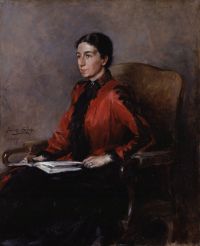
“ Manisty, did you leave Mr. Neal and Mrs. Burgoyne?''I will show you,' he said, unwillingly. 'They are in a part of the garden you don't know.'Her eye was bright, a little hostile. She moved resolutely forward, and Manisty followed her. Both were conscious of a hidden amazement. But a minute, since he had spoken that word, looked that look? How strange a thing is human life! ”
Quotes about “Manisty”
“ And while Manisty, intoxicated with his own phrases, and fluencies, was alternately smoking and declaiming, Neal with his grey hair, his tall spare form, and his air of old-fashioned punctilium, would sit near, fixing the speaker with his pale-blue eyes,—a little threateningly; always ready to shatter an exuberance, to check an oratorical flow by some quick double-edged word that would make Manisty trip and stammer ”
“ Often he had felt himself the shipwrecked sailor sinking in the waves, while Manisty as the cool spectator was hobnobbing with the wreckers on the shore. But nothing of this affected his love for the man. He loved him as Vanbrugh Neal had loved him; because of a certain charm, a certain indestructible youth and irresponsibility at the very heart of him, which redeemed half his errors.'Ah! my dear friend,' Manisty was saying as they neared the top of the hill—with his largest and easiest gesture; 'of course you must go to Bonn; you must do what they want you to do. ”
“ He watched them meet. He saw Lucy's quick change of attitude, the return of hardness and composure. Manisty approached her. They discussed some arrangement for the journey, in the cold tones of mere acquaintance. Not a sign of intimacy in manner or words; beyond the forced intimacy of those who have for the moment a common task.When the short dialogue was over, Manisty mumbled something to Brooklyn to the effect that Father Benecke had some dinner for him at the house at the foot of the hill. But he did not wait for the young man's company. ”
“ And, all the time, during the night hours when she was thus wrestling down her heart, Manisty was often pacing the forest paths, in an orgie of smoke and misery, cursing the incidents of the day, raging, doubting, suffering—as no woman had yet made him suffer. The more truly he despaired, the more he desired her. ”
“ The words stumbled on the girl's tongue, but her effort, the hot feeling in her young face became her.—Miss Manisty thought to herself, 'Oh, we shall dress, and improve her—We shall see!'—'One has first to settle whether it was worth while. What does a new nation matter? Theirs, anyway, was made too quick,' said Manisty, rising in answer to his aunt's signal. ”
“ And all that time Italy has been like that cauldron—you remember?—into which they threw the members of that old man who was to become young. There has been a bubbling, and a fermenting! And the scum has come up—and up. And it comes up still—and the brewing goes on. But in the end the young strong nation will step forth. Now Mr. Manisty—oh! I like Mr. Manisty very well!—but he sees only the ugly gases and the tumult of the cauldron. He has no idea—''Oh! Manisty,' said the young Count, flinging away his cigarette; 'he is a poseur of course. His Italian friends don't mind. ”
“ Rome is very full, and there will be a great demonstration—fifty thousand people or more. Would you like to come?'Miss Foster looked up, hesitating. Manisty, who had turned to go back to his room, paused, struck by the momentary silence. He listened with curiosity for the girl's reply.'One just goes to see it like a spectacle?' she said at last, slowly. 'One needn't do anything oneself?'Miss Manisty stared—and then laughed. 'Nobody will see what you do in such a crowd—I should think,' she said. 'But you know one can't be rude—to an old old man. If others kneel, I suppose we must kneel. ”
“ Miss Manisty, who was already suffering from the heat, was not going. The fact did not improve Manisty's temper. Three is no company—that we all know.If Lady Mary, indeed, had only planned this luncheon because she must, Manisty was going to it under a far more impatient sense of compulsion. It would be a sickening waste of time. Nothing now had any attraction for him, nothing seemed to him desirable or important, but that conversation with Lucy Foster which he was bent on securing, and she apparently was bent on refusing him. ”
“ And as he walked away, escorted by Manisty, a gardener crossed the avenue, who also at sight of the tall red-sashed figure fell on his knees and did the same. The Cardinal gave him an absent nod and smile, and passed on.'Ah! j'étouffe!'—cried Madame Variani, throwing herself down by Miss Manisty. 'Give me another cup, chère Madame. Your nephew is too bad. Let him show us another nation born in forty years—that has had to make itself in a generation—let him show it us! Ah! ”
“ She had written to Uncle Ben, and to the Porters. To-morrow she must break it to Aunt Pattie that she could not go to Vallombrosa, and must hurry back to England. The girl's pure conscience was tortured already by the thought of the excuses she would have to invent. And not a word, till Mr. Manisty was safely started on his way to that function at the Vatican which he was already grumbling over, which he would certainly shirk if he could. ”
D. M. Moir, The Life of Mansie Wauch
“ My own father, that is to say, auld Mansie Wauch with regard to myself, but young Mansie with reference to my granfather, after having run the errands, and done his best to grannie during his early years, was, at the age of thirteen, as I have heard him tell, bound a prentice to the weaver trade, which from that day and date, for better for worse, he prosecuted to the hour of his death:—I should rather have said to within a fortnight of it, for he lay for that time in the mortal fever, that cut through the thread of his existence. Alas! as Job says, “How time flies like a weaver’s shuttle!” ”
 E. Phillips Oppenheim,
The Long Arm of Mannister — I. The Noxious Gift
(1908)
E. Phillips Oppenheim,
The Long Arm of Mannister — I. The Noxious Gift
(1908)
“ Everywhere you are suspected—shunned. Every pair of with a sob of fear. Locked doors are useless. There is a knock! You must open! A waiter perhaps, but the sweat is on your forehead, you are shaking like a leaf. The man thinks you are mad. Everywhere you are suspected—shunned. Every pair of eyes that meets yours seems to carry behind them the knowledge that you are running away. Oh, Hell! It is Hell, Hell!" "This," Mannister declared, with a pleasant smile, "is most interesting. You have had quite an experience, my dear Sinclair, and you speak of it most eloquently. ”
D. M. Moir, The Life of Mansie Wauch
“ I saw her give him one of the apples; and, hearing him say, with a loud gaffaw, “Where is the tailor?” I took to my heels, and never stopped till I found myself on the little stool by the fireside, and the hamely sound of my mother’s wheel bum-bumming in my lug, like a gentle lullaby.Every noise I heard flustered me, but I calmed in time, though I went to my bed without my supper. When I was driving out the gaislings to the grass on the next morn, who was it my ill fate to meet but the blacksmith. “Ou, Mansie,” said Jamie Coom, “are ye gaun to take me for your best man? ”
E. Phillips Oppenheim,
The Long Arm of Mannister — V. The End of John Dykes…
(1908)
“ I have not often seen him as bad as this, sir, but he is never quarrelsome. He will be all right when he wakes up!" "You say that he is well known down here," Mannister remarked. "Do you mean that he lives in Brighton?" "He lives at this hotel most of his time," the waiter answered, "although he goes up to London most days." "I think," Mannister said, regarding the sleeping man, "that I know him by sight. Is his name John Dykes?" "That is it, sir," the waiter assented, "Mr. John Dykes. I have heard that he is a partner in a book-making firm." ”
 Charles Rann Kennedy,
The Servant in the House
Charles Rann Kennedy,
The Servant in the House
“ MANSON. As a man might know his own soul, sir—As they say in India. His work has been mine, so to speak.VICAR. Bless me, you will know him better than I do. I have never seen him since I was quite a little lad.MARY [with prodigious solemnity] . Just you think, Manson! He's my uncle—my own father's brother! [MANSON is now up stage between the two.] MANSON. Your brother, sir?VICAR [fervently] . I am grateful to God for it, Manson: he is. ”
E. Phillips Oppenheim,
The Long Arm of Mannister — VI. A woman Intervenes
(1908)
“ She leaned forward toward Mannister, and there was something almost tragic in her expression. "How do you dare, sir," she exclaimed, "to come here and to mention to me that man's name!" "Because," Mannister answered, "I thought that it would interest you to know that to-night he is dining at the Café des Ambassadeurs with Mademoiselle de Fleurier." She sprang to her feet and dashed to the ground the book which she had been reading. "It has come to that, then!" she exclaimed fiercely. "He will dine in public with her!" "It has come to that," Mannister answered. ”
F. M. Holmes, The Island House: A Tale for the Young Folks
“ The girls disappeared hastily from the window, and Mansy cried again: "You are never going to get into that bath, Master Alfy, surely!" "Oh! I can manage it," he replied briskly, "if you can send it down to the tree. Tell them to put a pole or something in it, dear Mansy, for me to paddle it with." "You must be quick, Alfy, and get us some provisions," urged Mansy, "or I don't know what we shall do. We shall get starved!" Alfy laughed in the gaiety of his heart. He was a merry, cheerful, plucky little lad, who could not talk religion, but strove to act it. ”
E. Phillips Oppenheim,
The Long Arm of Mannister — I. The Noxious Gift
(1908)
“ Mannister said, "when surely everything was against you, you can win again now when she is alone in the world, and the poor remnants of her honour are in your keeping. At any rate you must try. Remember that it is for your life that you plead. Come." The two men approached the camp side by side, Mannister leading his horse by the bridle, tall, slim, debonair; Sinclair hobbling by his side, bent and broken, with dulled eyes and wandering footsteps. The woman leaned forward to watch them coming. Her lips were parted, a tinge of colour had come back to her cheeks. ”
E. Phillips Oppenheim,
The Long Arm of Mannister — IX. At the End of the Journey
(1908)
“ Mannister answered. "We flutter around those lights like moths around a candle. We imagine ourselves prisoners, but in our hearts we know that we lack only the will to be free. Once we have made up our minds to break away, then the rest is not so difficult." ”
 Elisabeth Sanxay Holding,
Invincible Minnie — BOOK 4: Chapter 32
(1920)
Elisabeth Sanxay Holding,
Invincible Minnie — BOOK 4: Chapter 32
(1920)
“ He couldn’t eat the coarse and ill-cooked food Minnie put before him. He couldn’t sleep. He dreamed with sick longing of old days, of big, airy rooms, gay little suppers, he remembered his chest of drawers, with piles of clean linen and silk socks, his neckties, his boots. This unhappy slattern, this pale bit of a child, what had they to do with his dreams? They were unreal, didn’t belong to him.He lived in a ghastly solitude; he confided in no one, was in touch with no one. He believed that the human being did not live who could comprehend his anguish. ”
D. M. Moir, The Life of Mansie Wauch
“ The ice being once broken, every thing went on as smoothly as ye like; so, in the long run, we went like lightning from twohanded cracks on the stair-head, to stown walks, after work-hours, out by the West Port, and thereaway.If ever a man loved, and loved like mad, it was me, Mansie Wauch—and I take no shame in the confession; but, knowing it all in the course of nature, declare it openly and courageously in the face of the wide world. Let them laugh who like; honest folk, I pity them; such know not the pleasures of virtuous affection. ”
E. Phillips Oppenheim,
The Long Arm of Mannister — II. Traske and the Bracelet
(1908)
“ She, perhaps, more than any of them, had suffered from nerves when first she had seen Mannister enter the restaurant, but she had had time to get over it, and she was a woman. So she came up to him with outstretched hands and a brilliant smile. ”
E. Phillips Oppenheim,
The Long Arm of Mannister — IX. At the End of the Journey
(1908)
“ Mannister did not reply, for they were still in the suburbs of London, and the great car which he was driving needed all his attention. But soon the tramway lines came to an end, the road broadened, they were passing from suburbanism to the country proper. Mrs. De la Mere leaned back amongst the cushions and half closed her eyes. "After all," she murmured, "I am sure that there is nothing more beautiful than the simple pleasures of life. What is it in the hedges that smells so sweet?" The west wind blew in their faces. Mannister took off his cap and threw it behind to the chauffeur. ”
E. Phillips Oppenheim,
The Long Arm of Mannister — VIII. The Making of Hambledon
(1908)
“ Nevertheless Mannister felt that she was only the wreck of some other woman whose identity might well be lost. "Mrs. Hambledon," Mannister said, "I have known your husband for a great many years. Lately I have made some inquiries concerning his habits and the manner of his life. It is because I am convinced that he is not behaving fairly to you and to his family that I have determined to intervene. I have some influence over your husband—we will call it influence, at any rate. May I ask if you know what his income is?" ”
Marie Manning, Judith of the Plains
“ The horse, with a keener sense than his master, shied slightly as he passed the group of pines where Judith stood; but Peter’s glance was for the open trail, and as she heard him canter by, so close that she could have touched his stirrup with her hand, it seemed as if he must hear the beating of her heart. “Oh, blind eyes, and ears that will not hear, and heart that has forgotten how to beat! Yes, go to that pale, cold girl! You speak one language, and life for you is the way of little things!” ”
E. Phillips Oppenheim,
The Long Arm of Mannister — X. His Last Quest
(1908)
“ Mannister said politely, as they walked thither, "to see you in such indifferent health." Sinclair answered him with a look of hatred, but he did not speak a word until the servant had gone. "Don't tell lies, Mannister," he said then. "I am what you made me. I have never been myself for a single day since you chased me half over the world. Don't tell lies about being sorry for me. You are sorry for no one who stands in your way, or who does you ill. ”
Elisabeth Sanxay Holding,
Invincible Minnie
(1920)
“ High resolves, divine unselfishness, fired her; she wanted to help everyone, not only Minnie and her grandmother, but every single human soul. She felt urged to a mighty destiny....Then the mood ebbed, and left her chilled and lonely. She could hear Minnie in the kitchen directly beneath her; her pleasant voice talking to Michael; sometimes a cough from the old lady. Like a knife her love pierced her, love for everything safe, familiar and homely.In another minute she would have rushed down the stairs to fling her arms round her sister, to tell her she would not, could not, ever leave her. ”
E. Phillips Oppenheim,
The Long Arm of Mannister — I. The Noxious Gift
(1908)
“ Mannister's voice was slower and more deliberate. "Sinclair," he said, "you see there your life. You have done me, as a man, the greatest injury which one man has learnt in nineteen hundred years to inflict upon another. In leaving you alive upon the earth, I make no pretence at forgiving you. To kick you into eternity would be, however, only the caprice of a child. The vengeance of God and man strikes deeper. The woman is yours by right of theft. I leave you together, and I leave you the care of her a charge upon your life. ”
W. A. Wilkins, The Cleverdale Mystery; or, The Machine and Its Wheels…
“ Why, I supposed you never felt a care except when a candidate for the people's suffrages.""But there is greater cause, my friend," and Mannis's voice assumed a tone of sadness. "When a man sees the dearest object of his life before him, yet, like Tantalus, putting forth his hand to grasp it, it recedes, he is unhappy.""I cannot understand you, Mannis," said the Senator. "You speak in parables; be more explicit.""Were I married and quietly settled in life, I should be happy; but the only woman I ever loved I fear will never be mine. Your daughter, my friend, could make me supremely content." ”
