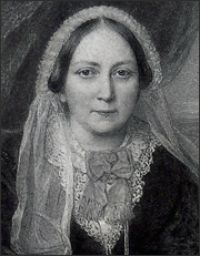
“ Now Miss Carlyle’s “old affair” referred to one sole and sore point—Richard Hare, and so Mr. Carlyle understood it. Lady Isabel unhappily believing that any “old affair” could only have reference to the bygone loves of her husband and Barbara. “You will oblige me by going on with your dinner, Cornelia,” gravely responded Mr. Carlyle. Then—assuming a more laughing tone—“I tell you it is unreasonable to expect me to betray a young woman’s secrets, although she may choose to confide them professionally to me. ”
Quotes about “Miss Carlyle”
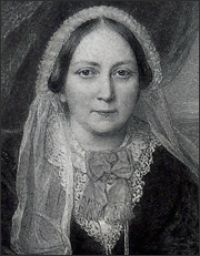 Ellen Wood,
East Lynne — Chapter 24
(1861)
“ A gentle-spirited, high-born lady, as I know she was, could not fail to be driven to desperation; and I know that she has been."Mr. Carlyle turned to his sister. "Can this be true?" he inquired, in a tone of deep agitation.She did not answer. Whether it was the shade cast by the nightcap, or the reflection of the wax taper, her face looked of a green cast, and, for the first time probably in Miss Carlyle's life, her words failed her. ”
Frank Wilson Cheney Hersey, The Harvard Classics Vol. 51 (1914)
“ Carlyle soon appeared, and looked as if he felt a well-dressed London audience scarcely the arena for him to figure in as a popular lecturer. He is a tall, robust-looking man; rugged simplicity and indomitable strength are in his face, and such a glow of genius in it—not always smouldering there, but flashing from his beautiful gray eyes, from the remoteness of their deep setting under that massive brow. ”
Thomas Carlyle, The Works of Thomas Carlyle (1903)
“ With stifled droning clang, the Kreuzthurm clock struck eleven, as Veronica, quite wetted, reached old Liese's house. "Art come, dear! wait, love; wait, love—" cried a voice from above; and instantly the crone, laden with a basket, and attended by her Cat, was also standing at the door. "We will go, then, and do what is proper, and can prosper in the night, which favours the work." So speaking, the crone with her cold hand seized the shivering Veronica, to whom she gave the heavy basket to carry, while she herself produced a little cauldron, a trevet, and a spade. ”
Ellen Wood,
East Lynne — Chapter 15
(1861)
“ Carlyle, so plausibly put, that he began to think it might be all for the best. He had great reverence for his sister's judgment; force of habit is strong upon all of us. Still he did not know."Did you buy that fine piano which has arrived?" angrily asked Miss Carlyle. ”
Ellen Wood,
East Lynne — Chapter 16
(1861)
“ Carlyle's establishment would be a limited one.""My lady perhaps I could put up with that; but I never could stop in the house with—" "that female Guy" had been on the tip of Marvel's tongue, but she remembered in time of whom she was speaking—"with Miss Carlyle. I fear, my lady, we have both got tempers that would slash, and might be flying at each other. I could not stop, my lady, for untold gold. ”
Ellen Wood,
East Lynne — Chapter 47
(1861)
“ Carlyle was away."Will you see her?" whispered Mr. Carlyle as they entered the house."Yes."They went up to the death-chamber, Mr. Carlyle procuring the key. It was the only time that he entered it. Very peaceful she looked now, her pale features so composed under her white cap and hands. Miss Carlyle and Joyce had done all that was necessary; nobody else had been suffered to approach her. Lord Mount Severn leaned over her, tracing the former looks of Isabel; and the likeness grew upon him in a wonderful degree. ”
Thomas Carlyle, The Works of Thomas Carlyle (1903)
“ And then, when she threw all away, and fled to the middle of the room, it peered out again, with long nose, in gigantic bulk, from behind the stove, and snarled and growled: "He will not be thy husband!" "Dost thou hear nothing, sister? dost thou see nothing?" cried Veronica, shivering with affright, and not daring to touch aught in the room. Franzchen rose, quite grave and quiet, from her broidering-frame, and said: "What ails thee today, sister? Thou art throwing all topsyturvy, and jingling and tingling. I must help thee, I see." ”
“ Mr. Carlyle stood confounded, and confused. He drew himself up to his full height, looking every whit as fearless and far more noble than the peer. “My lord, I do not understand you.” “Yet I speak plainly. What is it but a clandestine procedure to take advantage of a guardian’s absence and beguile a young girl into a marriage beneath her?” “There has been nothing clandestine in my conduct toward Lady Isabel Vane; there shall be nothing but honor in my conduct toward Lady Isabel Carlyle. Your lordship has been misinformed.” ”
Ellen Wood,
East Lynne — Chapter 26
(1861)
“ Carlyle was true and faithful to you, and to you alone. Few women have the chance of happiness, in their married life, in the degree that you had. He is an upright and good man; one of nature's gentlemen; one that England may be proud of as having grown upon her soil. ”
“ Carlyle, suppressing all signs of incredulity. “I don’t know; a friend of Afy’s, he said. Archibald, he swore to it in the most solemn manner; and I believe, as truly as that I am now repeating it to you, that he was speaking the truth. I want you to see Richard, if possible; he is coming to the same place to-night. If he can tell his own tale to you, perhaps you may find out a way by which his innocence may be made manifest. You are so clever, you can do anything.” Mr. Carlyle smiled. “Not quite anything, Barbara. Was this the purport of Richard’s visit—to say this?” ”
“ Carlyle, for the love of life! I see you are alone. I’m dead beat, and I don’t know but I’m dodged also.” The tones struck familiarly on Mr. Carlyle’s ear. He drew back mechanically, a thousand perplexing sensations overwhelming him, and the man followed him into the room—a white man, as Lucy called her father. Aye, for he had been hours and hours on foot in the snow; his hat, his clothes, his eyebrows, his large whiskers, all were white. “Lock the door, sir,” were his first words. Need you be told that it was Richard Hare? ”
 Hattie Tyng Griswold,
Home Life of Great Authors
“ Carlyle is one of the many great men who have suffered severely at the hands of their biographers, and from the pen clan in general. When the world knew him alone or chiefly through the lurid splendors of "The French Revolution,"—that book which, as he himself would have expressed it, was a truth, though a truth written in hell-fire,—or through the uncanny labyrinths of "Sartor Resartus," or the subtle analysis of the "Hero-Worship," or the more pleasing pages of his "Burns," or "Milton," or the "Characteristics," it would stand aloof in wonder, in admiration, almost in awe. ”
“ Carlyle. “Then, sir, I beg your pardon a thousand times over. It occurred to me that you probably had not, Mr. Archibald; and I thought I would have said a word to prepare you, before you came upon it suddenly in the paper.” “To prepare me!” echoed Mr. Carlyle, as old Dill was turning away. “Why, what has come to you, Dill? Are you afraid my nerves are growing delicate, or that I shall faint over the loss of a hundred pounds? At the very most, we shall not suffer above that extent.” ”
“ If Carlyle riddled his body with shots for this move, and then kicked him till he died, he’d only get his deserts, and the world would applaud. He oppose Carlyle! I wish I had been a man a few years ago, he’d have got a shot through his heart then. I say,” dropping his voice, “did you know Lady Isabel?” ”
Ellen Wood,
East Lynne — Chapter 15
(1861)
“ Carlyle know, but Miss Carlyle came whisking in again, and said: "The best rooms; those next the library. Should she go up with my lady?"Mr. Carlyle preferred to go himself, and he held out his arm to Isabel. She drew her veil over her face as she passed Miss Carlyle.The branches were not lighted, and the room looked cold and comfortless. "Things seem all sixes and sevens in the house," remarked Mr. Carlyle. "I fancy the servants must have misunderstood my letter, and not have expected us until to-morrow night." ”
“ Carlyle was struck with the wailing pain betrayed in the tone. At that moment a maid entered. “Nurse says the baby is undressed, and quite ready for you ma’am,” she said, addressing her mistress. Mrs. Carlyle rose, but hesitated as she was moving away. “I will have the baby here to-night,” she said to the girl. “Tell nurse to put a shawl round him and bring him down. It is the hour for my baby’s supper,” she smiled, turning to Lady Isabel. “I may as well have him here for once, as Mr. Carlyle is out. Sometimes I am out myself, and then he has to be fed.” ”
Ellen Wood,
East Lynne — Chapter 26
(1861)
“ I put the question to Carlyle—as between man and man—do you listen, Isabel!—whether he had given you cause; and he answered me, as with God over us, he had never given you cause; he had been faithful to you in thought, word and deed; he had never, so far as he could call to mind, even looked upon another woman with covetous feelings, since the hour that he made you his wife; his whole thoughts had been of you, and of you alone. It is more than many a husband can say," significantly coughed Lord Mount Severn. ”
Thomas Carlyle, The Works of Thomas Carlyle (1903)
“ He saw the Archivarius in his damask night-gown, which glittered like phosphorus; he saw the azure room, the golden palm-trees; nay, it now seemed to him as if he must still believe in Serpentina: there was a fermentation, a conflicting tumult in his soul. Veronica handed him a glass of punch; and in taking it, he gently touched her hand. "Serpentina! Veronica!" sighed he to himself. He sank into deep dreams; but Registrator Heerbrand cried quite aloud: "A strange old gentleman, whom nobody can fathom, he is and will be, this Archivarius Lindhorst. Well, long life to him! ”
Sophie Cole, The Lure of Old London
“ Carlyle, a brooch with the portrait of her dog Nero, given by the mistress to "little Charlotte," a sock of Carlyle's with his initials neatly marked in red thread, and two small cardboard boxes, each containing locks of the hair of Thomas Carlyle and his wife. Trivial things, which yet in their haunting intimacy are too sacred, it seems, to be stared at by the curious sightseers.In a corner hangs an etching that deserves a more prominent place, the desolate picture of a funereal cortège wending its slow way against a bleak background of snow and leaden sky.... ”
 Laura Marholm,
Six modern women: Psychological sketches
(1896)
“ Carlyle’s diary and Marie Bashkirtseff’s journal. The contents of both books consist chiefly of the cries of despair which issue from the mouths of two women who feel themselves captured and ill-used, and are consequently tired of life, though they do not know the reason nor who is to blame. Mrs. Carlyle was an imbittered woman, unwilling to complain of, yet always indirectly abusing, that disagreeable oddity, Thomas Carlyle; he was an egotistical boor, who required everything and gave nothing in return, and was certainly not the right husband for her. ”
 Augustine Birrell,
Obiter Dicta
“ Carlyle was, as everyone knows, a hero-worshipper. It is part of his mysticism. With him man, as well as God, is a spirit, either of good or evil, and as such should be either worshipped or reviled. He is never himself till he has discovered or invented a hero; and, when he has got him, he tosses and dandles him as a mother her babe. This is a terrible temptation to put in the way of an historian, and few there be who are found able to resist it. How easy to keep back an ugly fact, sure to be a stumbling-block in the way of weak brethren! Carlyle is above suspicion in this respect. ”
 Leslie Stephen,
Dictionary of National Biography…
(1887)
“ Carlyle's intense and enduring affection for his wife is shown in letters of extreme tenderness and by many unequivocal symptoms. It was unfortunately too often masked by explosions of excessive irritability, and by the constant gloom increased by his complete absorption in his work. From the first, too, it seems to have been less the passion of a lover than admiration of an intellectual companion. Mrs. Carlyle's brilliancy was associated with a scorn for all illusions and a marked power of uttering unpleasant truths. ”
Leslie Stephen,
Dictionary of National Biography…
(1887)
“ The Carlyles thought him ‘one of the most loveable creatures’ they had ever seen; and an unbroken friendship of nearly fifty years was begun. Carlyle corresponded with Mill, who approached him as a philosophical teacher; and their correspondence turned Carlyle's thoughts towards the ‘French Revolution.’ A visit from his brother John, the marriages of his sister Jean to James Aitken, a house-painter of superior abilities, and of his youngest brother James, now farming Scotsbrig, to whom Carlyle made over the debt of 200l. from Alexander, varied the monotony of Craigenputtock. ”
 William J. Long,
Outlines of English and American Literature
“ A CRITICISM OF CARLYLE. Except in his literary essays Carlyle's "rumfustianish growlery of style," as he called it, is so uneven that no description will apply to it. In moments of emotion he uses a chanting prose that is like primitive poetry. Sometimes he forgets Thomas Carlyle, keeps his eye on his subject, and describes it in vivid, picturesque words; then, when he has nothing to say, he thinks of himself and tries to hold you by his manner, by his ranting or dogmatism. In one mood he is a poet, in another a painter, in a third a stump speaker. ”
“ We have each chosen our path in life, and must abide by it; the gulf between us is impassable but the fault was mine. I ought to have avowed my affection, and not have suffered you to throw yourself away upon Mr. Carlyle.” “Throw myself away!” she indignantly uttered, roused to the retort. “Mr. Carlyle is my dear husband, esteemed, respected, and beloved. I married him of my own free choice, and I have never repented it; I have grown more attached to him day by day. Look at his noble nature, his noble form; what are you by his side? You forget yourself, Francis Levison.” ”
Ellen Wood,
East Lynne — Chapter 5
(1861)
“ Carlyle. The house door closed upon her, and Barbara had taken one step from it, when something large loomed down upon her, like a ship in full sail.She must have been the tallest lady in the world—out of a caravan. A fine woman in her day, but angular and bony now. Still, in spite of the angles and the bones, there was majesty in the appearance of Miss Carlyle."Why—what on earth!" began she, "have you been with Archibald for?"Barbara Hare, wishing Miss Carlyle over in Asia, stammered out the excuse she had given Mr. Dill. ”
Ellen Wood,
East Lynne — Chapter 31
(1861)
“ Carlyle's marriage to Barbara Hare.Miss Carlyle made herself into a sort of martyr. She would not go near it; fine weddings in fine churches did not suit her, she proclaimed; they could tie themselves up together fast enough without her presence. She had invited the little Carlyles and their governess and Joyce to spend the day with her; and she persisted in regarding the children as martyrs too, in being obliged to submit to the advent of a second mother. She was back in her old house again, next door to the office, settled there for life now with her servants. ”
“ A more truthful, honorable man than Carlyle does not exist on the face of the earth. When he told me then, in his agony of grief, that he was unable to form even a suspicion of your meaning, I could have staked my earldom on his veracity. ”
Leslie Stephen,
Dictionary of National Biography…
(1887)
“ Carlyle's school duties were thoroughly distasteful. His reserve, irritability, and power of sarcasm were bad equipments for a schoolmaster's work. He kept his pupils in awe without physical force, but his success was the chiefly negative. He saw little society, but was attracted by a Miss Margaret Gordon, an ex-pupil of Irving's, probably the original of ‘Blumine’ in ‘Sartor Resartus.’ An aunt with whom Miss Gordon lived put a stop to some talk of an engagement. ”
Ellen Wood,
East Lynne — Chapter 33
(1861)
“ Carlyle—what sorrow can there be in store for them?" asked Lady Isabel, her voice ringing with a strange sound, which Mrs. Hare noted, though she understood it not."Mrs. Carlyle's lot is bright," she said, a sweet smile illumining her features. "She loves her husband with an impassioned love; and he is worthy of it. A happy fate, indeed, is hers; but she must not expect to be exempted from sorrow. Mr. Carlyle has had his share of it," continued Mrs. Hare. ”
