“ Śankhachúda. I will now follow Garuda. (Looking in front.) Yonder, afar off, I see the enemy of the Nágas, on a pinnacle of Malaya, making new gulleys in the mountain-side, as he rubs his gory beak. The woods around are all uprooted and burnt by the streaks of flaming fire from his eyes, and the ground is hollowed round him by his dreadful adamantine claws. ”
Nagas
Definition and stakes
The theme of “Nagas” has been addressed by authors such as Major John Butler, Harsha, J. P. Mills, Visvanatha Kanakasabhai Pillai and Ethel St. Clair Grimwood. It is often associated with terms like Naga, people, Assam, India and Myanmar.
Quotes about “Nagas”
The Mahabharata of Krishna-Dwaipayana Vyasa Translated into English Prose
“ Seeing him awake, the Nagas began to console and cheer him, saying, "O thou of mighty arms, the strength-giving liquor thou hast drunk will give thee the might of ten thousand elephants! No one now will be able to vanquish thee in fight. O bull of Kuru's race, do thou bath in this holy and auspicious water and return home. Thy brothers are disconsolate because of thee." ”
“ Garuda. Never since my birth has so wonderful a thing been seen by me in my feasts on the lords of the Nágas! Not only is this hero unterrified, but he even appears almost delighted. There is no lassitude seen in him, though most of his blood is drunk up. His face, through its heroic endurance, even when he is suffering the pangs from the tearing of his flesh, seems serene as in ecstacy. Every limb, which is not actually destroyed, bristles with rapture. ”
“ O King Jímútaketu, this shower of ambrosia is caused to fall by the repentant lord of birds, to restore to life Jímútaváhana, and these lords of the Nágas, now only skeletons. (Pointing with a finger.) Do you not see these lords of Nágas? Now they reach Śankhachúda, their heads bright with the rays of their unveiled crest-jewels—now they lick up the very ground in their haste to devour the ambrosia with their two-forked tongues—and now, hurrying along, they plunge into the ocean by tortuous paths, like the waters of the rivers of the Malaya hills. (Addressing the hero.) ”
J. P. Mills, The Lhota Nagas (1922)
“ Most Nagas for instance reap with a reaping-hook, but the Sema, like the Manö and Southern Brè (Karens) of Burma,27 and like the Garos,28 use their hand only, stripping the grain from the stalk straight into the basket, a most painful method if it does save threshing. The use of terraced cultivation forms a very marked point of distinction between Naga tribes. ”
“ See here, rows upon rows of the crests of the slain Nágas, coated thick with oozing brains, splash as they fall from the jaws of the jackalls into the stream of carrion-smelling gore, while the scene is shrouded in awful darkness by the flapping wings of the vultures, their greed increased by the gobbets of raw flesh which fall mangled from their chattering beaks! Śankhachúda. How should I not see? This cemetery, which affords delight to Garuda, with a snake for his daily food, is like the body of Śiva, with its skulls and bones white as the moon. [9] Jímútaváhana. ”
Donald A. Mackenzie, Myths of China and Japan (1923)
“ There are withal Nagas in the sea who control winds and tides, and one of the Naga kings is Sagara, who is a Neptune in [70] Japan. The Nagas are also “Lords of the Earth”, and send drought and disease when offended or neglected. Ea, the sea-god of the early Babylonians, was known also as Enki, “The Lord of the Earth”. In Buddhist art the Naga is shown in three forms: (1) as a human being with a snake on or poised over the head, reminding one of the Egyptian kings or queens who wear the uræus symbol on their foreheads; (2) as half human and half snake (the “mermaid form”) ”
1911 Encyclopedia Britannica (1911)
“ The principal of these, in point of numbers, are the Nagas, who inhabit the hills and forests along the eastern and south-eastern frontier of Assam. They reside partly in the British district of the Naga hills and partly in independent territory under the political control of the deputy-commissioner of the adjoining districts. They cultivate rice, cotton, yams and Indian corn, and prepare salt from the brine springs in their hills. The different tribes of Nagas are independent of and unconnected with one another, and are often at war with each other. ”
 Visvanatha Kanakasabhai Pillai,
The Tamils Eighteen Hundred Years Ago
(1979)
Visvanatha Kanakasabhai Pillai,
The Tamils Eighteen Hundred Years Ago
(1979)
“ He refers also to a town in Gandhara in Northern India, which in consequence of an earthquake “sank a distance of 400 yojanas to Naga-nadu.” [8] From these allusions it is evident that the Tamil poets of this period had a very hazy idea of the ancient Nagas and their country. They believed, in fact, that the Nagas inhabited Pâthâla or the lower world, far below the surface of the earth. Of contemporary Naga tribes and kingdoms they give a more satisfactory account. ”
Visvanatha Kanakasabhai Pillai,
The Tamils Eighteen Hundred Years Ago
(1979)
“ The Nagas, were skilled in many arts and especially in weaving. The Nagas of the Kalinga country were so famous in the art of weaving that the word kalingam in Tamil has come to signify a cloth. At the period which I describe, the Nagas inhabiting the Eastern Coast in the Pandyan territory were great weavers, and exported a large quantity of cloths and muslins. The fine muslins manufactured by the Nagas were highly prized by the Tamils and fetched fabulous prices in foreign countries. ”
 Edgar Rice Burroughs,
The land of hidden men
(1931)
Edgar Rice Burroughs,
The land of hidden men
(1931)
“ King shook his head. "It is strange," he said. "I wandered through the jungle for days and never saw signs of a human being or a human habitation.""There are many things in the jungle which men do not always see," replied Che. "There are the Nagas and the Yeacks. You may be glad that you did not see them.""What are the Nagas and the Yeacks?" asked King."The Nagas are the Cobra people," replied Che. "They live in a great palace upon a mountain and are very powerful. They have seven heads and can change themselves into any form of creature that they desire. They are workers of magic. ”
Donald A. Mackenzie, Myths of China and Japan (1923)
“ Both Nagas (snakes) and Garudas (eagles or secretary birds) were included in northern India among the gods and demons who worshipped Buddha. The Nagas understood the language of birds. They gave charms to human beings so that they might share this knowledge. In European and Arabian stories folk-heroes acquire the language of birds, or of all animals, after eating the hearts of dragons. A Naga king causes an Indian king to understand what animals say.11 “The jewel that grants all desires” is possessed by the Indian Nagas, as it is by Chinese and Japanese dragons. ”
Major John Butler, A Sketch of Assam: With some account of the Hill Tribes
“ It is very difficult to arrive at anything like a correct understanding of the nature of the feuds between neighbouring tribes; for the Nagas have no written language, and their dialects vary considerably in different parts of the country. No general government exists over the whole tribe: they are divided into innumerable clans, independent of each other, and possessing no power beyond the limits of [153] their respective territories. ”
Visvanatha Kanakasabhai Pillai,
The Tamils Eighteen Hundred Years Ago
(1979)
“ The ancient Tamil poets appear to have shared this belief, for, they speak of the Nagas who were contemporary with them, as human beings, while at the same time they describe the ancient Nagas as serpents living underground. In describing the antiquity and wealth of Kaviripaddinam, the Chola capital, the author of the Chilappathikaram states that it was as ancient and famous as the Metropolis of the Nagas and the Naga-nadu. ”
Major John Butler, A Sketch of Assam: With some account of the Hill Tribes
“ If any person is detected in committing the offence no mercy is shown: the Khonbao pronounces sentence of decapitation without a moment’s hesitation. The Nagas are remarkable for simplicity, candour, and integrity; even the comparatively small vice of lying, to which the natives of British India are so seriously and universally addicted, is unknown among them, and will probably continue so until they have been corrupted by their more enlightened neighbours, the Assamese, or by the advance of civilization, refined arts, and manners. ”
Ethel St. Clair Grimwood, My three years in Manipur (1891)
“ We had nine gardeners, or Malis, as they are called in India.Talking of them reminds me of an amusing incident which happened in connection with them. They were Nagas belonging to one of our villages which lay at the back of the Residency grounds, between us and the river. The Nagas never burden themselves with too many clothes, and these in particular wore little beside a necklace or two. ”
 Joseph Dalton Hooker,
Himalayan Journals — Complete
Joseph Dalton Hooker,
Himalayan Journals — Complete
“ The Nagas are another people found on this frontier, chiefly on the hills to the north: they are a wild, copper-coloured, uncouth jungle tribe, who have proved troublesome on the Assam frontier. Their features are more Tartar than those of the Munniporees, especially amongst the old men. They bury their dead under the threshold of their cottages. The men are all but naked, and stick plumes of hornbills’ feathers in their hair, which is bound with strips of bamboo: tufts of small feathers are passed through their ears, and worn as shoulder lappets. ”
“ Through the merit that I gain to-day, by protecting a Nága at the sacrifice of myself, may I still obtain, in succeeding existences, a body to be sacrificed for others! [14] Garuda (looking at the hero) . Speedily will I catch up and eat this Nága, dressed in red garments, who looks as if besmeared with blood, which gushes from his heart that has burst through fear of me. I will first split open with my beak, which is fiercer than the fierceness of a thunderbolt, the breast of this one, who has fallen on the surface of the execution rock, to save the rest of Nágas. ”
Major John Butler, A Sketch of Assam: With some account of the Hill Tribes
“ The purpose is never relinquished, though its execution may unavoidably be tardy: by day and night they lie in ambush in the jungle, or on the plains near the roads, till they can pounce upon some unwary individual of the enemy. His murder is then communicated to his friends in a singular way. Forty or fifty Nagas, armed with wooden clubs, strike a large hollow piece of wood called a tomkhong, from which a loud, terrific sound proceeds, which gives token to the enemy that one of their tribe has died in acquittance of the debt of revenge. ”
Ethel St. Clair Grimwood, My three years in Manipur (1891)
“ The hills around are studded with villages, and peopled by various tribes. The Nagas in the immediate vicinity of Kohima are perhaps a finer race than any hillmen to be found in Assam. They are called Ungamis, and are very fine men, most of them six feet high at least, broad shouldered, and powerfully built. Their dress is curious, and quite different to any of the Nagas about Manipur. ”
Major John Butler, A Sketch of Assam: With some account of the Hill Tribes
“ The Nagas consider sudden death as particularly unfortunate: even if a person dies after one or two months’ sickness, the period is still deemed too short to be lucky; and his corpse is instantly removed and placed in the jungles on a platform four or five feet high, where it is left to decay. For three or four days after a death, the relatives do not leave the village; neither do other villagers resort to the village in which death has occurred during the same period. ”
Major John Butler, A Sketch of Assam: With some account of the Hill Tribes
“ The present account of the tribes is confined to the Nagas of Upper Assam; but it is supposed that very similar customs and habits prevail amongst those of central Assam. The Nagas bordering immediately on the plains are, for the most part, amicably disposed towards the British Government; and those on the Patkoe range have shown [173] a desire for our protection against the marauding Singphoos. The Nagas residing on the hills most remote from the valley are said to be fine, stout, athletic men, of fair complexions ”
J. P. Mills, The Lhota Nagas (1922)
“ It is generally assumed in a vague sort of way that those tribes which are spoken of as Nagas have something in common with each other which distinguishes them from the many other tribes found in Assam and entitles them to be regarded as a racial unit in themselves. ”
Major John Butler, A Sketch of Assam: With some account of the Hill Tribes
“ When the Nagas purpose taking vengeance on a neighbouring tribe, the Khonbao assembles the elders of the village; and, in accordance with established customs, the omens being consulted and proving propitious, a plan to cut up their enemies by surprise is decided on. Each man provides himself with a spear, sword, bamboo choong, a [159] hollow joint of the bamboo filled with water, and a small basket of rice; and, the party being formed, set out in the day towards the frontier of the enemy who is to be attacked. ”
Visvanatha Kanakasabhai Pillai,
The Tamils Eighteen Hundred Years Ago
(1979)
“ The niece of the king of Kalyani was married to a Naga king of the Kanawaddamano mountain, which was evidently Kandamadanam, a hill near the modern Ramesvaram on the Indian coast, opposite to Kalyani. In the ancient sculptures at Amaravati and elsewhere which were executed more than eighteen hundred years ago, the human figures, which are represented with serpent hoods spread wide at the back of them, are Nagas. ”
 Edward B. Tylor,
Primitive culture, vol. 2 (of 2…
(1871)
Edward B. Tylor,
Primitive culture, vol. 2 (of 2…
(1871)
“ It is especially notable that the representatives of indigenous race and religion in India, the Nagas, characterized by their tutelary snakes issuing from their backs between their shoulders and curving over their heads, and other tribes actually drawn as human apes, are seen adoring the divine tree in the midst of unquestionable Buddhist surroundings. ”
Major John Butler, A Sketch of Assam: With some account of the Hill Tribes
“ Some Nagas will, however, continue to cultivate the land, and share the produce of their labour with those of their parents; but on the birth of a child the families separate.Amongst the Nagas, marriage is contracted with near relatives, such as cousins, in preference to other women. A widow, having no children, cannot marry a stranger, but must marry her late husband’s brother; and if he happens to be a mere boy, she will still live with him as his wife; nor can the boy take another damsel: he must marry his brother’s widow. ”
Major John Butler, A Sketch of Assam: With some account of the Hill Tribes
“ The Nagas have no names for the days of the week, and know not their own ages. Summer and winter are the only divisions of the year they recognise, distinguishing them as dry and wet seasons of six months’ each. ”
 Anna Harriette Leonowens,
Life and Travel in India
Anna Harriette Leonowens,
Life and Travel in India
“ There are many tribes in India who have assumed the name of Nagas or Serpents from the earliest times. Diodorus supposes that the snake had been used as their crest or banner. There are three kinds of serpent-worship practised in India, and each is peculiar to a distinct class of people, although all the natives of India, except the Mohammedans, either from dread of the deadly serpent or from a feeling of veneration, join in the festival of the naga-poojmi. ”
J. P. Mills, The Lhota Nagas (1922)
“ The Khoiraos, Kacha Nagas, Tangkhuls and Marami have all been much more strongly influenced by the culture [xxxviii] of these southern immigrants, than have the other tribes north of the Angami country, and have accepted their culture to varying degrees. To return to the Lhotas, this tribe is divided into three phratries—the Tompyaktserre, the Izumontserre and the Mipongsandre, meaning respectively “Forehead-clearing men,”44 “Scattered men” and “Fire-smoke-conquering men.” ”
J. P. Mills, The Lhota Nagas (1922)
“ Like all Nagas the Lhota was very keen to take heads, but preferred to do so with the minimum of risk to himself. A strong, forewarned enemy was rarely attacked. Usually a party of raiders would either lie in ambush by the village spring, and kill a woman as she came down to take water, or rush an unsuspecting party working in their fields, or cut off a straggler on some path. If a whole village turned out to destroy another village a surprise attack at dawn was generally attempted. ”
Major John Butler, A Sketch of Assam: With some account of the Hill Tribes
“ The south-eastern hills of Assam are the abode of many tribes of Nagas. They are a very uncivilized race, with dark complexions, athletic sinewy frames, hideously wild and ugly visages: their faces and bodies being tattooed in a most frightful manner by pricking the juice of the bela nut into the skin in a variety of fantastic figures. They are reckless of human life; treacherously murdering their neighbours often without provocation, or at best for a trivial [150] cause of offence. ”
Related terms
Authors who wrote about “Nagas”
Major John Butler HarshaJ. P. MillsVisvanatha Kanakasabhai PillaiEthel St. Clair GrimwoodDonald A. MackenzieVariousJoseph Dalton HookerEdgar Rice BurroughsEdward B. TylorAnna Harriette LeonowensR. G. Latham
 Moncure Daniel Conway
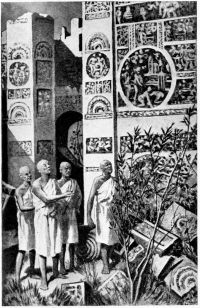 Faxian
 Theodore Duka
 James FergussonThomas CarsonWilliam GriffithCarveth Read
 Edward Burnett Tylor
HarshaJ. P. MillsVisvanatha Kanakasabhai PillaiEthel St. Clair GrimwoodDonald A. MackenzieVariousJoseph Dalton HookerEdgar Rice BurroughsEdward B. TylorAnna Harriette LeonowensR. G. LathamMoncure Daniel ConwayFaxianTheodore DukaJames FergussonThomas CarsonWilliam GriffithCarveth ReadEdward Burnett Tylor