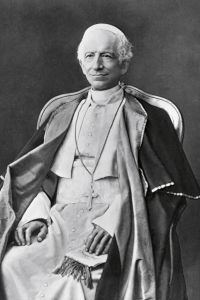
Pope Leo XIII

Definition and stakes

Arthur W. Hutton and Margaret Bryant,  1911 Encyclopædia Britannica, Volume 16… (1911)

“ The second day after his election Pope Leo XIII. crossed the Tiber incognito to his former residence in the Falconieri Palace to collect his papers, returning at once to the Vatican, where he continued to regard himself as “imprisoned” so long as the Italian government occupied the city of Rome. He was crowned in the Sistine Chapel 3rd March 1878, and at once began a reform of the papal household on austere and economic lines which found little favour with the entourage of the former pope. ”
Source: Wikisource

| contributor,  Littell's Living Age — Volume 169… (1886)

“ On the accession of the present pope he determined to open negotiations with him, and preferred this course to negotiating with the socalled Catholic party at home. “Pope Leo XIII. has more good will and interest for the consolidation of the German Empire than the majority of the German Parliament ... he is a wise, moderate, and pacific gentleman, which cannot be said of all the members of the Reichstag majority.” In short, the attitude of the late and the present pope reminds one very much of the old fable of the North Wind and the Sun. ”
Source: Wikisource

F. A. Forbes,  Pope Pius the Tenth

“ For us Leo XIII is the guardian of the Holy Scriptures, the interpreter of the doctrine of Jesus Christ, the supreme dispenser of the treasures of the Church, the head of the Catholic religion, the chief shepherd of souls, the infallible teacher, the secure guide, who directs us on our way through a world wrapped in darkness and the shadow of death. All the strength of the Church is in the pope; all the foundations of our faith are based on the successor of Peter. ”
Source: Gutenberg

Get perspective with Kwize: daily news enlightened by great literature