“ The Roman armies consisted of vast bodies of men which, when not in actual service, were established in permanent encampments in various parts of the empire, wherever it was deemed necessary that troops should be stationed. These great bodies of troops were the celebrated Roman legions, and they were renowned throughout the world for their discipline, their admirable organization, the celerity of their movements, and for the indomitable courage and energy of the men. Each legion constituted, in fact, a separate and independent community. ”
Roman legions
Definition and stakes
The theme of “Roman legions” has been addressed by authors such as Theodor Mommsen, Livy, Edward Gibbon, Eugene Lawrence and John Lord. It is often associated with terms like legion, military, Rome, Romans and Gauls.
Quotes about “Roman legions”
 J. B. Bury,
The life of St. Patrick and his place in history
(1905)
J. B. Bury,
The life of St. Patrick and his place in history
(1905)
“ There can be no greater error than to suppose that the withdrawal of the Roman legions from Britain in 407, and the rescript of the Emperor Honorius, three or four years later, permitting the citizens of Britain to arm themselves and provide for their own defence, meant the instant departure of all things Roman from British shores, the death of Roman traditions, the end of Roman civilisation. ”
Eugene Lawrence, A Smaller History of Rome
“ It must be observed that a regular consular army no longer consisted of Roman legions only, but, as Italy became gradually subjugated, the various states under the dominion of Rome were bound to furnish a contingent, and the number of allies usually exceeded that of the citizens. They were, however, kept perfectly distinct, both in the camp and in the battle-field.The men belonging to each legion were separated into four divisions. 1. 1000 of the youngest and poorest were set apart to form the Velites, the light-armed troops or skirmishers of the legion. ”
John Lord, The Old Roman World : the Grandeur and Failure of Its Civilization
“ The Romans were essentially military in all their tastes and habits. Luxurious senators and nobles showed the greatest courage and skill in the most difficult campaigns. Antony, Caesar, Pompey, and Lucullus were, at home, enervated and luxurious, but, at the head of the legions, were capable of any privation and fatigue. The Roman legion was a most perfect organization, a great mechanical force, and could sustain furious attacks after vigor, patriotism, and public spirit had fled. For three hundred years a vast empire was sustained by mechanism alone. ”
 Edward Gibbon,
The History of the Decline and Fall of the Roman Empire
Edward Gibbon,
The History of the Decline and Fall of the Roman Empire
“ The martial pride of the legions, whose victorious camps had so often been the scene of rebellion, was nourished by the memory of their past exploits, and the consciousness of their actual strength. As long as they maintained their ancient establishment of six thousand men, they subsisted, under the reign of Diocletian, each of them singly, a visible and important object in the military history of the Roman empire. ”
Livy, From the Founding of the City… (1905)
“ They sought refuge behind the front ranks of the legions, who alone amidst the general panic preserved their coolness and presence of mind. Had it been a straightforward fight, man to man, they would to all appearance have been quite a match for their foes, so much had their success, a few days previously, restored their courage. But the sudden appearance of the concealed troops and their combined attack on both flanks and on the rear of the Roman legions created such confusion and alarm that not a man had any spirit left to fight or any hope of escaping by flight. ”
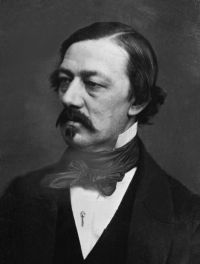 Henry William Herbert,
The Roman Traitor, Vol. 2
Henry William Herbert,
The Roman Traitor, Vol. 2
“ It burst over the heads of the astonished people like heaven's thunder, the wild prolonged war-flourish of the legions. From the Tarpeian rock, and the guarded Capitol; from the rampired Janiculum; from the fortress, beyond the Island bridge; from the towered steeps of the Quirinal, broke simultaneously the well known Roman war note! Upsprang, along the turreted wall of the Janiculum, with crested casques, and burnished brazen corslets, and the tremendous javelins of the cohorts, a long line of Metellus' legionaries. ”
Tacitus, The Histories — Book 4 (1876)
“ Never has the power of Rome been more depressed. In the winter quarters of the legions there is nothing but property to plunder and a few old men. Only dare to look up, and cease to tremble at the empty names of legions. For we have a vast force of horse and foot; we have the Germans our kinsmen; we have Gaul bent on the same objects. Even to the Roman people this war will not be displeasing; if defeated, we shall still reckon it a service to Vespasian, and for success no account need be rendered. ”
Eugene Lawrence, A Smaller History of Rome
“ The Roman Equites attached to the army were very few in number, and were chiefly employed as aids-de-camp and on confidential missions. The bulk of the cavalry consisted of foreigners, and hence we find the legions and the cavalry spoken of as completely distinct from each other. After the termination of the Social War, when most of the inhabitants of Italy became Roman citizens, the ancient distinction between the Legiones and the Socii disappeared, and all who had served as Socii became incorporated with the Legiones. ”
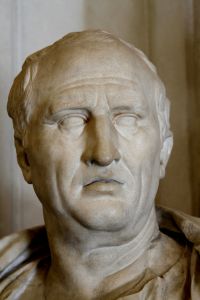 Marcus Tullius Cicero,
The Orations of Marcus Tullius Cicero…
Marcus Tullius Cicero,
The Orations of Marcus Tullius Cicero…
“ But what had Antonius to do at all with Illyricum and with the legions of Vatinius?But Brutus had nothing to do with them either. For that, perhaps, is what some worthless man may say. All the legions, all the forces which exist anywhere, belong to the Roman people. Nor shall those legions which have quitted Marcus Antonius be called the legions of Antonius rather than of the republic; for he loses all power over his army, and all the privileges of military command, who uses that military command and that army to attack the republic. ”
Various, Encyclopaedia Britannica, 11th Edition…
“ There was little scope, however, in masonry for the genius of Roman warfare, which had a better opportunity in the active work of attack and defence. For siegecraft the Roman legions were specially apt. No modern engineer, civil or military, accustomed to rely on machinery, steam and hydraulic apparatus, could hope to emulate the feats of the legionaries. In earthworks they excelled; and in such work as building and moving about colossal wooden towers under war conditions, they accomplished things at which nowadays we can only wonder. ”
 Bayard Taylor,
A History of Germany from the Earliest Times to the Present Day
Bayard Taylor,
A History of Germany from the Earliest Times to the Present Day
“ Nevertheless, he succeeded in uniting nearly all the independent tribes east of the Elbe under his command, and in organizing a standing army of 70,000 foot and 4,000 horse, which, disciplined like the Roman legions, might be considered a match for an equal number. His success created so much anxiety in Rome, that in the next year after Tiberius returned from his successes in Germany, Augustus determined to send a force of twelve legions against Marbod. ”
 Jean Paul,
Titan: A Romance. v. 2 (of 2)
Jean Paul,
Titan: A Romance. v. 2 (of 2)
“ One learns to estimate military courage very moderately, when one sees that the Roman Legions, precisely when they were mercenary, bad, slavish, and half freedmen, namely, under the Triumvirate, fought more courageously than ever. ”
 Goldwin Smith,
Lectures and Essays
Goldwin Smith,
Lectures and Essays
“ The Roman legions were formed in the first instance of citizen soldiers, who yet had been made to submit to a rigid discipline, and to feel that in that submission lay their strength. When, to keep up the siege of Veii, military pay was introduced, a step was taken in the transition from a citizen soldiery to a regular army, such as the legions ultimately became, with its standing discipline of the camp; and that the measure should have been possible is another proof that Rome was a great city, with a well-supplied treasury, not a collection of mud huts. ”
Various, Blackwood's Edinburgh Magazine…
“ The auxiliaries formed a considerable part, in point of numbers, of the Roman forces; but the strength of the legions was to be found in the Roman citizens. It was that indomitable body of men, ever flowing out, yet ever full, animated with fiery passions, but directed by consummate prudence, panting for rapine and conquest, but patient of all the toils by which they were to be attained, which constituted the strength of the armies which conquered the world. ”
“ The Roman legions, in particular, were for many centuries kept in tolerable subjection to the civil authorities of the capitol; but they were growing stronger and stronger all the time, and becoming more and more conscious of their strength. ”
The Great Events by Famous Historians…
“ He enlisted every subject of the Roman Empire whom patriotism, courage, or compulsion could collect beneath the standards; and round these troops, which assumed the once proud title of the legions of Rome he arrayed the large forces of barbaric auxiliaries, whom pay, persuasion, or the general hate and dread of the Huns brought to the camp of the last of the Roman generals. ”
 Burton Willis Potter,
The Road and the Roadside
Burton Willis Potter,
The Road and the Roadside
“ That their remains still exist in every part of the world which ever bore up the Roman legions is conclusive evidence that they were built by master workmen who realized that they were responsible to posterity and to the eternal powers. ”
Livy, From the Founding of the City… (1905)
“ When the consul and the Roman legions no longer saw anywhere the men who had just been the shield of the whole army, they endeavoured at all risks to prevent so many brave fellows from being surrounded and overwhelmed by the enemy. The Volscians formed two fronts, in one direction they met the attack of the consul and the legions, from the opposite front they pressed upon Tempanius and his troopers. ”
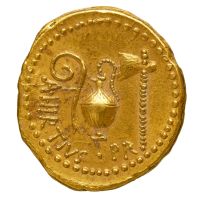 Aulus Hirtius,
Commentaries on the Gallic War…
Aulus Hirtius,
Commentaries on the Gallic War…
“ In the mean time the legions were approaching, and several messengers arrived with notice to our men and the enemy that the [Roman] general was near at hand, with his forces in battle array. Upon this intelligence, our men, confiding in the support of the cohorts, fought most resolutely, fearing, lest if they should be slow in their operations they should let the legions participate in the glory of the conquest. The enemy lose courage and attempt to escape by different ways. In vain; for they were themselves entangled in that labyrinth in which they thought to entrap the Romans. ”
Edward Gibbon,
The History of the Decline and Fall of the Roman Empire
(1897)
“ But the armies of Rome, placed at a secure distance from danger, were enervated by indulgence and luxury. Habituated to the baths and theatres of Rome, they took the field with reluctance, and were chiefly composed of veterans who had almost forgotten, or of new levies who had never acquired, the use of arms and the practice of war. The hardy legions of Gaul had long defended the frontiers of the empire against the barbarians of the North; and in the performance of that laborious service their valour was exercised and their discipline confirmed. ”
Mary Macgregor, The Story of Rome, From the Earliest Times to the Death of Augustus…
“ Fierce was the struggle between the two forces, but ere long the barbarians found that the day was going against them. The knowledge made them fight but the more desperately.Slowly but steadily the Roman legions now began to close in, shutting the Gauls together in their midst, until171 at length they were hemmed in so relentlessly that it was not possible for them to use their arms. Then the Romans slaughtered them without mercy.Forty thousand were killed, ten thousand taken prisoners, while one of the Gallic kings was captured alive. ”
“ They raised an enormous army. It consisted of eight legions. The Roman legion was an army of itself. It contained ordinarily four thousand foot soldiers, and a troop of three hundred horsemen. It was very unusual to have more than two or three legions in the field at a time. The Romans, however, on this occasion, increased the number of the legions, and also augmented their size, so that they contained, each, five thousand infantry and four hundred cavalry. They were determined to make a great and last effort to defend their city, and save the commonwealth from ruin. ”
Hutton Webster, Early European History
“ THE ROMAN ARMY THE LEGION While the Romans were conquering Italy, they were making many improvements in their army. All citizens between the ages of seventeen and forty-six were liable to active service. These men were mainly landowners—hardy, intelligent peasants—who knew how to fight and how to obey orders. An army in the field consisted of one or more legions. A legion included about three thousand heavy-armed footmen, twelve hundred light infantry, and three hundred horsemen. After the conquest of Italy the states allied with Rome had to furnish soldiers, chiefly archers and cavalry. ”
Livy, From the Founding of the City… (1905)
“ I ought to add here that a consul or Dictator or praetor, when he devotes the legions of the enemy, need not necessarily devote himself but may select any one he chooses out of a legion that has been regularly enrolled. If the man who has been so devoted is killed, all is considered to have been duly performed. If he is not killed, an image of the man, seven feet high at least, must be buried in the earth, and a victim slain as an expiatory sacrifice; on the spot, where such an image has been buried, no Roman magistrate must ever set his foot. ”
Livy, The History of Rome, Books 37 to the End
“ Some fled, and others, being delayed by the weight of their coverings and armour, were put to the sword. The whole left wing then gave way, and the auxiliaries, posted between the cavalry and the phalanx, being thrown into confusion, the terror spread even to the centre. Here the ranks were broken, and by the flying soldiers rushing in between them, the use of their long spears, called by the Macedonians sarissas, was hindered. The Roman legions advanced and discharged their javelins among them in disorder. ”
Mary Platt Parmele, A Short History of Germany
“ Upon the fall of the empire, the Roman legions were withdrawn, and the people, left defenseless, became the prey of their own northern barbarians, the Picts and Scots; the drama of Southern Europe and the Goths being re-enacted on a diminished scale. ”
Edward Gibbon,
The History of the Decline and Fall of the Roman Empire
“ We are likewise informed that the legions themselves were struck with horror and remorse, and that those pious sons of the republic refused to violate the sanctity of their venerable parent. 26 But when we recollect with how much ease, in the more ancient civil wars, the zeal of party and the habits of military obedience had converted the native citizens of Rome into her most implacable enemies, we shall be inclined to distrust this extreme delicacy of strangers and barbarians, who had never beheld Italy till they entered it in a hostile manner. ”
 Barthold Georg Niebuhr,
Niebuhr's lectures on Roman history…
(1875)
Barthold Georg Niebuhr,
Niebuhr's lectures on Roman history…
(1875)
“ It is manifest that the Romans and Latins combined sent a large force into the field; they formed ten legions, a number which could have never been raised by the Romans alone. A very clever campaign was carried on against the barbarians. The Romans fought no battles, but brought them into great straits by their entrenched lines. To this perhaps refers the notice of a grammarian, that the Gauls concluded a treaty with the Romans. ”
Frank Frost Abbott, The Common People of Ancient Rome
“ The soldier played as important a part as the merchant in extending the use of Latin. Tacitus tells us that in the reign of Augustus there were twenty-five legions stationed in the provinces. If we allow 6,000 men to a legion, we should have a total of 150,000 Roman soldiers scattered through the provinces. To these must be added the auxiliary troops which were made up of natives who, at the close of their term of service, were probably able to speak Latin, and when they settled among their own people again, would carry a knowledge of it into ever-widening circles. ”
Edward Gibbon,
The History of the Decline and Fall of the Roman Empire
(1827)
“ But in proportion as the public freedom was lost in extent of conquest, war was gradually improved into an art, and degraded into a trade [30] . The legions themselves, even at the time when they were recruited in the most distant provinces, were supposed to consist of Roman citizens. ”
Arthur E. R. Boak, A History of Rome to 565 A. D
“ The legionaries were recruited from Roman citizens or from provincials who received Roman citizenship upon their enlistment. Their units of organization, the legions, comprised nearly 6000 men, of whom 120 were cavalry and the rest infantry. The number of legions was at first eighteen, but was later [pg 212] raised to twenty-five, giving a total of about 150,000 men. The auxiliaries, who took the place of the contingents of Italian allies of earlier days, were recruited from among the most warlike subject peoples of the empire and their numbers were approximately equal to the legionaries. ”