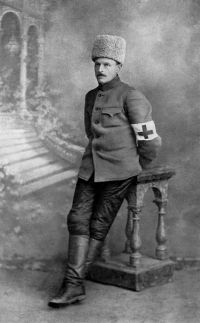
Russian cavalry

Definition and stakes

John Morse,  In the Russian Ranks: A Soldier's Account of the Fighting in Poland

“ In one thing only is Russia the stronger of the two Powers, and that is in her cavalry: and this force has not, to my knowledge, suffered a disaster, even on a small scale. Not one of her mounted regiments has been cut up, or even sustained abnormal losses; but they have certainly destroyed more than one of Germany's cavalry regiments; and that in fair open fight. The Russian cavalry has charged, successfully, all classes of troops—mounted men, infantry and artillery. So much for the paper tacticians who have asserted that the days of cavalry charges and hand-to-hand fighting are over. ”
Source: Gutenberg

John Morse,  In the Russian Ranks: A Soldier's Account of the Fighting in Poland

“ The Russians were always very strong in cavalry. I believe their mounted Cossacks alone exceeded 60,000 men; and there was, probably, 40,000 line cavalry in Poland—cuirassiers, dragoons, lancers, hussars, chasseurs, etc.—to oppose which the Germans had certainly no more than 20,000 inferior horsemen. The Russian cavalry are not comparable to those of England and France ”
Source: Gutenberg

John Morse,  In the Russian Ranks: A Soldier's Account of the Fighting in Poland

“ There was some cavalry fighting too; but, generally, the Russians were numerically superior to their foes; and the Germans, more often than otherwise, avoided proffered battle. In a few instances squadrons and regiments charged one another, the Germans always getting the worst of it, and in one case at least being much cut up. The Russian cavalry even attacked infantry, but though they got away without serious loss, it is pretty evident that only in exceptional instances can cavalry now successfully contend with modernly armed foot soldiers. ”
Source: Gutenberg

Get perspective with Kwize: daily news enlightened by great literature