
“ The red-hot light of the after-glow still burned on the waters of the bay, and shed its Egyptian-like luster on the city that lies in the circle of the Sahel, with the Mediterranean so softly lashing with its violet waves the feet of the white, sloping town. ”
Sahel
Definition and stakes
The theme of “Sahel” has been addressed by authors such as Abu Obeyd, Karl Baedeker, Ernest Alby, Henry Blackburn and Élisée Reclus. It is often associated with terms like desert, Algiers, Senegal, river and Africa.
Quotes about “Sahel”
Abu Obeyd, The Celebrated Romance of the Stealing of the Mare (1892)
“ And how should Sahel hurt thee, or how should any other, seeing that thou art the daughter of the prince of our tribe, the greatest of the princes, whose fame is in all the valleys? And yet thou speakest thus, thou daughter of the generous? Nay, it is no far journey. Listen: between thy tents and ours are but ten furlongs, for the space hath been stepped by the trackers, and if thou wilt come but one-half the road thou canst then turn back and I will go forward, and the way will have been thus divided between us and each will have accompanied the other and fear shall have been outwitted. ”
 George Edward Woodberry,
North Africa and the desert
(1914)
George Edward Woodberry,
North Africa and the desert
(1914)
“ There are no windows, no neighborhood atmosphere—only a stagnant exterior. The feeling of a retreat, of repose, of being far away is always there. These towns have a curious mixture of the eternal and the ruined in their first aspect; as of things left by the tide, derelicts of life all. A ride in the Sahel is a slow, kaleidoscopic combination of these things, a reiteration without new meaning—the town, the cemetery, the grove, the garden, the plain, the fields, camels and sheep, and herdboys—horizons, somnolence, tranquillity. ”
 William Le Queux,
Zoraida: A Romance of the Harem and the Great Sahara
William Le Queux,
Zoraida: A Romance of the Harem and the Great Sahara
“ This City of the Sun is one of violent contrasts. Seen from the sea, it fully bears out its Arab comparison of being a “diamond set in emeralds,” for in terraces of intensely white, flat-roofed houses, each with little square windows like pips upon a dice, it rises high upon the bright green Sahel hills. In the centre the Arab town with its cupolas and minarets is crowned by the great fortress, while right and left are the pleasant suburbs of St. Eugène and Mustapha, their white houses and handsome villas gleaming forth from dark luxuriant foliage. ”
Abu Obeyd, The Celebrated Romance of the Stealing of the Mare (1892)
“ Confess thy faith e'er thou diest." And she entreated him, saying "O Sahel, wilt thou not spare me, So may the Lord requite thee." But he, " There is no sparing." And to Zohwa she cried " This is he I feared, the son of perdition, And thou thyself art deceiver." But she answered her with tauntings, " Be it so, I deceived thee. Go to. We shall see this Sahel Prove himself of his skill when he loppeth thee, legs and shoulders." But Alia prayed to Sahel, " Do thou recite the Fatha, So shall the cup of death to my lips be found less bitter." ”
 Alphonse Daudet,
Letters from My Windmill
Alphonse Daudet,
Letters from My Windmill
“ As I approved the fineness and order of it all: the beautiful farm with its Moorish arcades and terraces, brilliantly white in the dawn, and its surrounding stables and barns, I recalled that it was twenty years since these brave settlers set up home in the valley of the Sahel. At first, they found only a workman's shack, and ground haphazardly planted with dwarf palms and mastic trees. Everything was yet to be done; everything to be built. At any time, there could be an attack from Arabs. ”
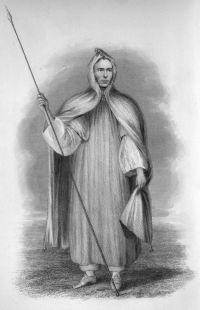 James Richardson,
Travels in the Great Desert of Sahara…
James Richardson,
Travels in the Great Desert of Sahara…
“ The golden harvest is nodding over Afric's sunny plains. Fields of ripe barley are waving in the wind, overshadowed with splendid palms of young and vigorous growth. Besides there are most beautiful olive plantations all around us. Essnousee, who now became a little more familiar, kept crying out to me with spontaneous admiration, "This is the new world (Dunyah Jedeed) !" The slave-driver had heard me praise the vast fields of fertility in America. Sahel, in fact, is a country of most vigorous and teeming fertility. But, to-day, from the camel's back, I saw the sea. ”
Henry Blackburn, Artists and Arabs; Or, Sketching in Sunshine
“ Of one of these an artistic traveller thus speaks: 'Standing on a ridge of the Sahel, far beneath lies the Bay of Algiers, from this particular point thrown into a curve so exquisite and subtle as to be well nigh inimitable by art, the value of the curve being enhanced by the long level line of the Mitidja plain immediately behind, furnishing the horizontal line of repose so indispensable to calm beauty of landscape; whilst in the background the faintly indicated serrated summits of the Atlas chain preserve the whole picture from monotony. ”
1911 Encyclopædia Britannica (1911)
“ Sahel thus understood comprises regions which form the intermediate zone between the fertile lands of the Sudan and the desert. In its plural form, Swahili, the word has become the tribal name of the natives inhabiting the coast strip opposite Zanzibar. ”
Edward Ledwich Mitford, The Arab's Pledge: A Tale of Marocco in 1830
“ Ye are true sons of Ishmael, and when the battle comes, let every Arab stand by his brother. What! shall the lord of the Sahel pay tribute to the son of the town? Shall the warrior bow to the plough-driver? Henceforth shall every man live free in his tent, without fear of having the bread taken from [124] his children, to raise taxes for a stranger. Does the Sultan want tribute, let him come and seek it; but instead of gold, he will find lead and steel, and the bones of his troops shall whiten the red sands of the Sahara. We now go north, to repay ourselves for what we have already lost. ”
Abu Obeyd, The Celebrated Romance of the Stealing of the Mare (1892)
“ Not though Abu Zeyd were here himself the Helali. For what is Abu Zeyd? Let him help thee, thou dog's daughter ! Let him deliver thee from my hand, thou daughter of Jaber! Are we not, we the Agheylat, secure in our pastures ? He, the Helali foe, where is he ? In some far dirra, Pasturing flocks of his own. He shall not help thee nor succour." But she, "Yet if God so willed he were here even now upon thee." And Sahel, " Hold thy peace, for to-night thy life hath ending. What shall Salame do to thy help in these our pastures ? The wolf is not as the lion in the manner of his seizing. ”
Karl Baedeker, The Mediterranean (1911)
“ The Littoral, 842 M. in length, with long, precipitous, and almost inaccessible stretches, has ever been dreaded on account of its storms; it is broken by the bays of Oran, Arzew, Algiers, Bougie, Philippeville, and Bona, but does not possess a single good natural harbour. Flanking the coast, in front of the Tell Atlas, are several ranges of lower hills (Sahel) , as the Sahel of Oran, between Lourmel and the mouth of the Chélif, the Sahel of Algiers, and the Sahel of Collo, while the Edough Group (3307 ft.) , composed of crystalline rock, forms an independent mountain. ”
Robert Hanbury Brown, The Fayûm and Lake Mœris (1892)
“ The high margins of the Nile are known in Egypt as the “Sahel.” As the Bahr Yûsuf has for a great many years been given an artificial connection with the Nile, and been used as a channel to carry flood water to inundate the lands along its course on both sides, it has imitated the Nile in its action on its borders, and raised a “Sahel” of its own on a smaller scale. The cross-section of the Nile Valley is thus roughly represented in the following diagram. ”
Frances E. Nesbitt, Algeria and Tunis
“ One of the roads runs along a ridge between two bays with water almost all round, and there are many ways back to Algiers, winding down amongst trees and villas. In fact driving, riding, walking, and now motoring are a constant pleasure, for though the main features of the sea and the Sahel, or great plain, with its encircling mountains, are the foundation of each view, the effects are constantly changing, and the views from the Bois de Boulogne, the Château Hydra, the village of Koubba, Notre Dame d’Afrique, and the Casbah have all a distinct individual beauty notwithstanding some sameness. ”
Robert Lambert Playfair, Travels in the footsteps of Bruce in Algeria and Tunis (1877)
“ We here entered the great valley called Oued es-Sahel, or river of the coast—known to the ancients by the name of Nasava, or Nasabath—which commences near Aumale, and terminates in the Gulf of Bougie. Like most of the rivers of Algeria, it changes its name according to the territory it traverses; thus it is successively called Oued Akbou, Oued Soumam, Oued Beni Mesaoud, Oued el-Kebir, and Oued es-Sahel. ”
Robert Lambert Playfair, Travels in the footsteps of Bruce in Algeria and Tunis (1877)
“ What the date is to the Sahara, the olive is to the Sahel; it thrives almost everywhere, and seems to content itself with the most brackish water, or even without any except that which falls from heaven during the winter months. All along the coast there are fine plantations, containing glorious old trees, but there is not the least sign of a young one being planted, or of anyone attempting to increase the size of the grove bequeathed to him by his ancestors. During all my travels in Tunis I only saw one solitary exception to this, in the plantation of General Kheir-ed-din before alluded to. ”
M. F. Mansfield, In the Land of Mosques & Minarets
“ The coast plain west of Algiers, the Sahel properly called, is in strong contrast with the cultivated plain of the Mitidja. The whole journey from Algiers out to Cherchell and back, via Miliana, Blida, and Boufarik, gives one as{232} good an idea of the ancient and modern civilization of North Africa as one could possibly have.Blida sits calmly in its fertile plain at the foot of the imposing hills which, grouped together, form the mountains of the Beni-Salah. All round about are orange groves and olive-trees of the very first splendour and production. ”
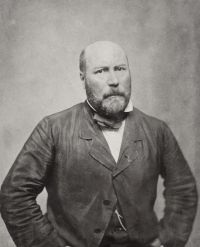 Ernest Alby,
The French in Algiers
Ernest Alby,
The French in Algiers
“ The bold arches of the Romans have long since fallen to decay, while the modest and simple earthen pipes of the Moors, which creep below the surface of the earth, still convey a fresh and plentiful supply of water. These few square miles on the Sahel form nearly the whole of the boasted French colony in Africa; cafés and canteens are their only possessions beyond the fortified camps and the range of the blockhouses, even near the largest towns, such as Medeah, Milianah, Mascara, &c., and these are only supported by the military, and may therefore be said to draw their resources from France. ”
M. F. Mansfield, In the Land of Mosques & Minarets
“ From the afternoon of Sunday, on all the roads leading into Boufarik, from Cherchell and the Sahel, from Miliana, from Blida and Algiers, throng the thousands that will make up the personnel of to-morrow’s market. They come on camel-back, on horses, mules, and donkeys, on foot, by diligence, and by rail, herded in flat unroofed cars like cattle. Some are the pure Arab type of the sandy dunes and plains of the waste Sahara, others Berber-Kabyles, and others Jews, Maltese, Spaniards, French, Italians and—tell it not in Gath—Germans. ”
Henry Blackburn, Artists and Arabs; Or, Sketching in Sunshine
“ Another event is the annual gathering of the tribes, when representatives from the various provinces camp on the hills of the Sahel, and the European can wander from one tent to another and spend his day enjoying Arab hospitality, in sipping coffee and smoking everywhere the pipe of peace. These things we only hint at as resources for visitors, if they are fortunate enough to be in Algiers at the right time; but there are one or two other things that they are not likely to miss, whether they wish to do so or not. ”
Karl Baedeker, The Mediterranean (1911)
“ Allaghan (774 ft.) the Sahel valley contracts. On the left rises the Piton d’Akbou, crowned with a late-Roman tomb of the 3rd cent, (a step-pyramid on a square base) , but not visible from the train. On the right, beyond the mouth of the copious Oued Bou Sellam (p. 269) , which rises in the mountains of Little Kabylia (p. 266) , the serrated Jebel Gueldaman (2638 ft.) juts far into the valley.122 M. Akbou (1050 ft.; Hôt. du Sahel; Hôt. Bellevue; pop. 1200; Mon. market) , a large village, is the starting-point of a path to the Col de Chellata (p. 260) . Grand eucalypti in the environs. ”
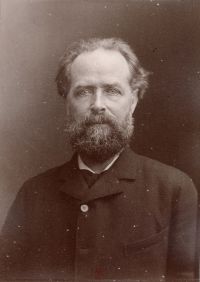 Élisée Reclus,
Africa by Élisée Reclus/Volume 2
(1892)
Élisée Reclus,
Africa by Élisée Reclus/Volume 2
(1892)
“ Both are remarkable monuments of engineering skill, presenting in their descent from the plateaux to the coast some aspects of imposing grandeur. The modern town of Bu-Arrerij, the chief place in the fertile Mejana Valley, stands at an elevation of over 3,000 feet, near the waterparting between the Wed- Sahel and Ilodna basins, and midway between Constantino and Algiers, on the railway connecting those cities. Before the conquest, Bu-Arrerij held a position of great strategic importance near the gorges of the Biban range leading from the plateaux to the Sahel Valley. ”
Karl Baedeker, The Mediterranean (1911)
“ Mustapha-Supérieur and Environs. The narrow coast-plain, here called Plaine de Mustapha, is the somewhat abrupt margin of the Sahel, to the S. of the old town, on which lie the Quartier d’Isly, Télemly, and Mustapha-Supérieur, where the white villas dating from the Turkish period, with their superb gardens and luxuriant orchards, are occupied chiefly by English and American residents. This is the favourite promenade of foreign visitors. ”
Sydney C. Grier, The Flag of the Adventurer
“ In the north the wild tribes were coming down from their hills, like vultures lured by the hope of being in at the death of the old lion. Down in the delta the wild tribes of the plains were waxing bold—interfering with the dâks, raiding the outlying houses of Bab-us-Sahel. The river itself might be considered safe wherever there was water for the steamers, but beyond the range of their guns Kamal-ud-din could do whatever he liked even on the left bank. ”
 Matilda Betham-Edwards,
Through Spain to the Sahara
Matilda Betham-Edwards,
Through Spain to the Sahara
“ The Arabs alone looked unmoved. “It is the will of God,” they say when any evil happens, and they resign themselves to it, outwardly calm as statues.In about an hour and a half we reached Algiers. The weather was glorious; and as we drove up to the well-known villa on the green height of Mustapha Supérieure, and looked down upon the bright, blue sea, and the glistening shore, and the white Moorish city crowning the sunny Sahel,{317} we said that Spain had showed us no fairer prospect. ”
James Richardson,
Travels in the Great Desert of Sahara…
“ Regini told me I should be sure to see Lebida, for it was in the road—that is to say, five or six miles off, behind sand-hills. The whole of the ground, from Sahel to these first groups of Eastern Atlas, is scattered over with Roman and Greek ruins, and, as it happens, there is a huge piece of an ancient building in the road itself, apparently a temple. I was too weak, however, to descend from the camel, to look closely at it. ”
Ernest Alby,
The French in Algiers
“ Coleah, Duera, and Delhi Ibrahim are the only colonies of any importance in the Sahel, and even there the whole colonisation consists of cafés, canteens, and a few kitchen gardens. At Coleah they have begun to form a colony of old worn out soldiers, but I have great doubts of its success. These veterans, it is true, have the double advantage of being tolerably well used to the climate and of knowing how to conduct themselves with prudence and coolness when attacked by the enemy ”
Henry Blackburn, Artists and Arabs; Or, Sketching in Sunshine
“ Many of them have come from the neighbouring villages and from their camps across the plains of the Sahel; and have set up a market of their own, where they are in full activity, trading with each other and with the Frank. ”
Ernest Alby,
The French in Algiers
“ Our battalion has been eight days at Duera, a fortified camp on the southern declivity of the Sahel, and we expect every moment to start on some great expedition. But even here we do not want occupation; for nearly every day we have to escort a transport of provisions, intended for Blidah, from Delhi Ibrahim to Buffarik. Buffarik is another fortified camp and small village, which stands on the river Arrasch in the middle of the plain of Metidja. The soil is very productive, but the air so unhealthy that the village has been depopulated more than once. ”
Élisée Reclus,
Africa by Élisée Reclus/Volume 1
(1892)
“ Like the Habab people, the elephant of this region is also nomad; during the winter rains its herds frequent the eastern slopes of the plateau bordering the Sahel, in summer returning to the Nafka heights on their way westwards to the Barka Valley and the slopes of the Abyssinian mountains. ”
Ernest Alby,
The French in Algiers
“ The Hadjutes inhabit the Sahel mountains to the westward of Coleah, and are notoriously the most thievish set of fellows in all Africa. They are the people who, on the 1st of May, cut off the heads of about forty of our regiment at Delhi Ibrahim. We set out before sunrise, and marched down towards the Metidja. I was detached on one side with a dozen others, to search the thicket with which all this country is covered. We followed a track trodden by wild beasts, for a human foot rarely wanders in this place. ”
