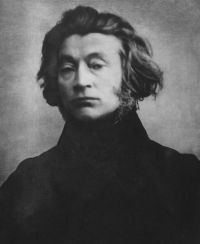
Tadeusz Kościuszko

Definition and stakes

Monica Mary Gardner Kościuszko: A Biography (1920)

Early portraits show us the winning, eager, mobile young face before life moulded it into the rugged countenance of the Polish patriot, with its stern purpose and melancholy enthusiasm, that lives as the likeness of Tadeusz Kościuszko. Even as a cadet Kościuszko was distinguished not merely for his ability, but still more for his dogged perseverance and fidelity to duty. Tradition say that, determined to put in all the study that he could, he persuaded the night watchman to wake him on his way to light the staves at three in the morning by pulling a cord that Kościuszko tied to his left hand.
Source: Wikisource

Monica M. Gardner Kościuszko

If to this patriotism oblivious of self may be added an unstained moral integrity, the magnetism of an extraordinary personal charm, the glamour of a romantic setting, we have the pure type of a national champion. Representative, therefore, in every sense is the man with whose name is immortally associated the struggle of the Polish nation for her life—Tadeusz Kościuszko.
Kościuszko was born on February 12, 1746, during Poland's long stagnation under her Saxon kings. The nation was exhausted by wars forced upon her by her alien sovereigns.
Source: Gutenberg

Monica Mary Gardner Kościuszko: A Biography (1920)

Three days after Warsaw was freed, Wilno, with a handful of soldiers rising in the night, drove out the Russian garrison, and the Russian army retreated through Lithuania, marking their way by atrocities which were but a foretaste of what awaited in no distant future that most unhappy land.
"The powerful God," says the pronunciamento of the Provisional Deputy Council of Wilno—"delivering the Polish nation from the cruel yoke of slavery has, O citizens of Lithuania, sent Tadeusz Kościuszko, our fellow-countryman, to the holy soil to fulfil His will.
Source: Wikisource

Get perspective with Kwize: daily news enlightened by great literature