“ In the year 1846 the Biglow Papers began appearing in the columns of the Boston Courier, and it was not until 1848 that what is probably the most remarkable series of satirical poems which ever appeared were furnished. For wit, insight into human nature, and finish, these poems, in the peculiar dialect of the “down-easter,” must be considered nothing short of perfect. These poems had an instantaneous effect on America, and raised the question of slavery and corruption in politics to the eyes of the people in a way they had never before been presented. ”
The Biglow Papers
Definition and stakes
Quotes about “The Biglow Papers”
Percy Holmes Boynton, A History of American Literature
“ They drew their material from the common people, as Lincoln had done with all his anecdotes, putting it in the idiom of the common people and frequently distorting it into illiterate spelling, as Lowell had done in “The Biglow Papers.” This disturbed and shocked the lovers of a refined literature—men like Stedman, for example, who wrote to Bayard Taylor, “The whole country, owing to contagion of our American newspaper ‘exchange’ system, is flooded, deluged, swamped, beneath a muddy tide of slang, vulgarity, inartistic [bathos] , impertinence, and buffoonery that is not wit.” ”
James Russell Lowell,
The Complete Poetical Works of James Russell Lowell
“ We should be wanting in our duty as the conductor of that tremendous engine, a public press, as an American, and as a man, did we allow such an opportunity as is presented to us by 'The Biglow Papers' to pass by without entering our earnest protest against such attempts (now, alas! too common) at demoralizing the public sentiment. ”
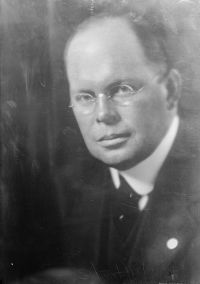
James Russell Lowell,
The Biglow Papers
“ Biglow, in the present instance, has only made use of a licence assumed by all the historians of antiquity, who put into the mouths of various characters such words as seem to them most fitting to the occasion and to the speaker. If it be objected that no such oration could ever have been delivered, I answer, that there are few assemblages for speech-making which do not better [Pg 41] deserve the title of Parliamentum Indoctorum than did the sixth Parliament of Henry the Fourth, and that men still continue to have as much faith in the Oracle of Fools as ever Pantagruel had. ”
James Russell Lowell,
The Biglow Papers
“ But for real unmistakable genius,—for that glorious fulness of power which knocks a man down at a blow for sheer admiration, and then makes him rush into the arms of the knocker-down, and swear eternal friendship with him for sheer delight; the "Biglow Papers" stand alone.If I sought to describe their characteristics, I should say, the most exuberant and extravagant humour, coupled with strong, noble, Christian purpose,—a thorough scorn for all that is false and base, all the more withering because of the thorough geniality of the writer. ”
James Russell Lowell,
The Biglow Papers
“ I am only indicating those which, as it seems to me, when taken with the "Biglow Papers," give the best idea of the man, and what his purpose in life has been, and is.I will not think so badly of my countrymen as to [Pg xxv] suppose for a moment that "The Biglow Papers" will not become the intimate friends of all good fellows in England; and when we have really made friends with a book, we like to know something about our friend's father; so I shall add the little I know of the history of James Russell Lowell. ”
James Russell Lowell,
The Biglow Papers
“ If an Englishman cannot find 'Bird-o'-freedom Sawins,' 'John P. Robinson's,' 'pious editors,' and candidates "facin' south-by-north" at home—ay, and if he is not conscious of his own individual propensity to the meannesses and duplicities of such, which come under the lash of Hosea—he knows little of the land we live in, or of his own heart, and is not worthy to read the "Biglow Papers."Instead, therefore, of any attempt of my own, I will give Mr. Lowell's own account of how and why he came to write this book. ”
James Russell Lowell,
The Biglow Papers
“ Hosea Biglow, has been so well done already in America by the hand best fitted for the task, that he must be a bold man who would meddle with the book now in the editing way. Even the humble satisfaction of adding a glossary and index has been denied to me, as there are already very good ones. ”
James Russell Lowell,
The Biglow Papers
“ THE BIGLOW PAPERS. MELIBŒUS-HIPPONAX. THE BIGLOW PAPERS,EDITED,WITH AN INTRODUCTION, NOTES, GLOSSARY, AND COPIOUS INDEX,By HOMER WILBUR, A.M.PASTOR OF THE FIRST CHURCH IN JAALAM, AND (PROSPECTIVE) MEMBER OF MANY LITERARY, LEARNED, AND SCIENTIFIC SOCIETIES, (for which see page xlvii.) The ploughman's whistle, or the trivial flute, Finds more respect than great Apollo's lute. Quarles's Emblems, B. II. E. 8. Margaritas, munde porcine, calcâsti: en, siliquas accipe. Jaa. Car. Fil. ad Pub. Leg. § 1. ”
James Russell Lowell,
The Biglow Papers
“ Thet don't agree with niggers.No doubt they go further than this. I am quite aware that Mr. Lowell will be claimed as a champion by the peace party in this country; and certainly no keener things have been said against war in general than are to be found in this book.With our own peace-at-any-price party, no one has less sympathy than I; and this leads me to urge on all English readers to bear in mind, that the "Biglow Papers" were written for a New England audience, by a New Englander, and must be judged from a New England point of view. ”
Samuel Merwin,
The Whip Hand: A Tale of the Pine Country
“ If Bigelow went heavily into the new-style freighters that were to revolutionize the lake-carrying trade, what more natural than a rush in “new freighters,” and who could know if the Bigelows should unload rapidly on an inflated market? But the great man is speaking! Before him, on the mahogany desk, were spread some papers—vastly important papers, or they could never have penetrated to the Presence to take up time of such inestimable value. “Time is money” is a phrase that had been heard to fall from the Bigelow lips. ”
James Russell Lowell,
The Biglow Papers
“ The rural population of New England is still, happily for itself, tinctured in all its language, habits, modes of feeling and thought, by a strict Scriptural training—"Out of the fulness of the heart the mouth speaketh." Look below the surface and you will see that there is no irreverence whatever beneath Hosea Biglow's daring use of Scripture ”
James Russell Lowell,
The Biglow Papers
“ The satire in them was not meant to have any personal, but only a general, application. Of the gentleman upon whose letter they were intended as a commentary Mr. Biglow had never heard, till he saw the letter itself. The position of the satirist is oftentimes one which he would not have chosen had the election been left to himself. In attacking bad principles, he is obliged to select some individual who has made himself their exponent, and in whom they are impersonate, to the end that what he says may not, through ambiguity, be dissipated tenues in auras. For what says Seneca? ”
James Russell Lowell,
The Biglow Papers
“ Biglow, exclaim with the poet, "'Sic vos non vobis' &c.;though, in saying this, I would not convey the impression that he is a proficient in the Latin tongue,—the tongue, I might add, of a Horace and a Tully."Mr. B. does not employ his pen, I can safely say, for any lucre of worldly gain, or to be exalted by the carnal plaudits of men, digito monstrari, &c. He does not wait upon Providence for mercies, and in his heart mean merces. But I should esteem myself as verily deficient in my duty (who am his friend and in some unworthy sort his spiritual fidus Achates, &c.) ”
Earl Derr Biggers,
The Agony Column — Chapter 4
(1916)
“ I told myself I should not be safe until the real murderer of the poor captain was found; and so I began to puzzle over the few clues in the case—especially over the asters, the scarab pin and the Homburg hat. It was then I remembered the four copies of the Daily Mail that Bray had casually thrown into the waste-basket as of no interest. I had glanced over his shoulder as he examined these papers, and had seen that each of them was folded so that our favorite department—the Agony Column—was uppermost. It happened I had in my desk copies of the Mail for the past week. You will understand why. ”
Hilaire Belloc,
The Free Press
“ I say that in the first place the Free Press, being a reformer, suffered from what all [Pg 61] reformers suffer from, to wit, that in their origins they must, by definition, go against the stream.The official Capitalist Press round about them had already become a habit when the Free Papers appeared. Men had for some time made it a normal thing to read their daily paper; to believe what it told them to be facts, and even in a great measure to accept its opinion. ”
Samuel Merwin,
The Whip Hand: A Tale of the Pine Country
“ Within the combination, prosperity in plenty, but always subject to the guiding judgment of G. Hyde Bigelow, hence a certain loss of identity and of control to self-respecting heads of companies; without the combination, a fight to a finish against the combined power and momentum of Bigelow & Company and the “Lumber Trust.” Just how great was this momentum no one exactly knew: but Bigelow was a magic name, no doubt of it. “You have gone over it, have you, Mr. Halloran?” said Mr. Higginson. ”
William Kirby,
The Golden Dog — Chapter XXXVI
(1877)
“ A decree authorizing the issue of an unlimited quantity of paper bills, the predecessors of the assignats of the mother country, was strongly advocated by Bigot, who supported his views with a degree of financial sophistry which showed that he had effectively mastered the science of delusion and fraud of which Law had been the great teacher in France, and the Mississippi scheme, the prototype of the Grand Company, the great exemplar. ”
Samuel Merwin,
The Whip Hand: A Tale of the Pine Country
“ Babcock; a very well dressed man with a shrewd, somewhat incredulous eye; a man who speaks cautiously, is even inclined to mumble in a low voice; and who finds his worth and caution recognized as a useful, if secondary, part of the importance of Bigelow & Company. Lacking in the audacious qualities of his senior, it would seem, but shrewd, very shrewd—not a man given to unnecessary promises or straight-out declarations. And if Mr. Babcock had a phrase, a creed, locked securely away in the depths behind that quiet face, it was “Business is Business.” Business was business to Mr. Babcock ”
Zenith Radio Corporation v. Hazeltine Research Inc…
“ The Court has repeatedly held that in the absence of more precise proof, the factfinder may 'conclude as a matter of just and reasonable inference from the proof of defendants' wrongful acts and their tendency to injure plaintiffs' business, and from the evidence of the decline in prices, profits and values, not shown to be attributable to other causes, that defendants' wrongful acts had caused damage to the plaintiffs.' Bigelow v. ”
Percy Keese Fitzhugh, Roy Blakeley's Silver Fox Patrol
“ They’re not here! The papers are stolen!”“Good night,” I said, “the plot grows thicker.”“Maybe Harry has them in his pocket,” Grove said.We looked behind, but the Ford wasn’t in sight.“The papers are stolen! The papers are stolen!” Pee-wee kept shouting, “There’s a plot! Hurry up, drive faster! I bet it was that soda clerk in Bennett’s.”“The papers aren’t so necessary,” Grove said.“Sure they’re necessary,” Pee-wee screamed; “that letter reveals the secret. Drive faster!”Brent didn’t drive any faster, he just laughed ”
James Russell Lowell,
The Biglow Papers
“ You would n't git more 'n half enough to speak of on a grave-stun; We git the licks,—we 're jest the grist thet 's put into War's hoppers; Leftenants is the lowest grade thet helps pick up the coppers. It may suit folks thet go agin a body with a soul in 't, An' aint contented with a hide without a bagnet hole in 't; But glory is a kin' o' thing I shan't pursue no furder, Coz thet 's the off'cers parquisite,—yourn 's on'y jest the murder. Wal, arter I gin glory up, thinks I at least there 's one Thing in the bills we aint hed yit, an' thet 's the glorious fun ”
Carl Schurz,
Speeches, correspondence and political papers of Carl Schurz
(1913)
“ The very appearance on the field of politics of millionaires whose money is their only, or at least their principal, title to consideration is an element of corruption, for it means that in some way somebody or something is to be bought. It means the employment of the millionaire's money to procure his election to the place he covets, either through the direct bribery of individuals, or through the bribery of a political organization with campaign funds. ”
Allan Nevins, The Evening Post: A Century of Journalism
“ These were years in which the business management of the newspaper began to feel markedly the hostility of the South. Its utterances against slavery were so biting and persistent that no one below Mason’s and Dixon’s line236 would advertise in it, and many Southern buyers boycotted New York merchants who patronized it. “Thousands of little merchants and traders in New York City,” as Bigelow later said, “jealous of the rivalry of the other more prosperous houses advertising with us, were in the habit of reporting them in the South, and in that way our advertising columns were made very barren.” ”
Washington Irving,
The Crayon Papers
“ Those whom Law had deluded used every means to delude others. The most extravagant dreams were indulged, concerning the wealth to flow in upon the company from its colonies, its trade, and its various monopolies. It is true nothing as yet had been realized, nor could in some time be realized, from these distant sources, even if productive; but the imaginations of speculators are ever in the advance, and their conjectures are immediately converted into facts. Lying reports now flew from mouth to month, of sure avenues to fortune suddenly thrown open. ”
Henry Charles Carey,
The Slave Trade, Domestic and Foreign
“ Bigelow, "are inexhaustible;" and so have they always been, but the people have been deprived of all power to profit by them, and for want of that power there was lost annually a greater amount of labour than would have paid, five times over, for the commodities for which they were compelled to look to the distant market. Of those who did not perish, because of the necessity for an universal dependence on field employments, a large portion of the labour was then, as it now must be, utterly wasted. ”
George Cary Eggleston,
Recollections of a Varied Life
“ More frequently great questions were discussed by some one or other of that outer staff of strong men who, without direct and daily contact with the newspaper, and without salary or pay of any kind, were still regarded by themselves and by the public as parts of the great intellectual and scholarly force in conduct and control of the Evening Post—such men, I mean, as Parke Godwin and John Bigelow—men once members of that newspaper's staff and still having free access to its columns when they had aught that they wished to say on matters of public concern. ”
Lincoln Steffens,
The Shame of the Cities
“ Moreover, Bigelow was applying with vigor regular machine methods. It was all very astonishing, but very significant. Magee was dead; Flinn’s end was in sight; but there was the Boss, the everlasting American Boss, as large as life. The good citizens were shocked; their dilemma was ridiculous, but it was serious too. Helpless, they watched. Bigelow nominated for recorder a man they never would have chosen. Flinn put up a better man, hoping to catch the citizens, and when these said they could see Flinn behind his candidate, he said, “No; I am out of politics. ”
H. de Vere Stacpoole and Margaret Stacpoole, The man who found himself (Smith's Magazine 1920… (1920)
“ The horrible irregularity of the whole of this business was poisoning Brownlow's mind—hunting for the head of a firm who ought to be at his office and who held possession of a client's vitally important document. ”
T. S. Arthur,
The Allen House; Or, Twenty Years Ago and Now
“ He was shown, at regular periods, a statement wherein the condition of the bank was set forth, and to which he appended his signature. But he had no certain knowledge that the figures were correct. Of the paper under discount over two-thirds was drawn or endorsed by Floyd, Lawson, Lee, & Co. At the time Judge Bigelow began investing in mill property, he was worth, in productive stocks and real estate, from thirty to forty thousand dollars. He now estimated his wealth at from sixty to eighty thousand dollars ”