“ If an animal only has to make one trip into the enclosure to get all the bait he will not be as apt to be taken as if he made several trips, which he is pretty sure to do if the bait is cut into small pieces and scattered around in the enclosure. ”
Animal enclosure
Definition and stakes
The theme of “animal enclosure” has been addressed by authors such as W. Coape Oates, A. R. Harding, W. J. Holland, Owen Jones and William T. Hornaday. It is often associated with terms like bird, nest, cage, rabbit and insect.
Quotes about “animal enclosure”
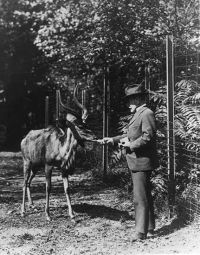 William T. Hornaday,
Popular Official Guide to the New York Zoological Park…
“ In captivity the small and delicate species of deer, antelopes and gazelles are better cared for in enclosures that are not too large. For such creatures, freedom in a large enclosure usually means early death from accident or exposure. ”
William T. Hornaday,
Popular Official Guide to the New York Zoological Park…
“ The soil of the enclosure has never been disturbed, and there is no danger that the little creatures ever will be smothered in their burrows, as frequently happens in earth that has once been dug up and filled in again. ”
 Louis Figuier,
The Insect World
“ When the successive hatchings have furnished to the mother the reinforcement she is waiting for, the workers she has raised occupy themselves in building new cells, and in raising the wall of enclosure which is to protect the nest. ”
“ It is a good plan to have the space between the inside and outside fences filled with trees and clumps of brush so as to obstruct the view. The inner enclosures are small and designed for single animals and pairs and should be about thirty or forty feet in size. There should also be several larger enclosures for the males and [Pg 74] females, for, except during the breeding season it will do no harm to allow the males to run together. Each separate enclosure should be provided with a gate so that it will be an easy matter to remove the foxes from one enclosure to another. ”
W. Coape Oates, Wild Ducks: How to Rear and Shoot Them
“ The first step will be to accustom the birds to feed inside a wire enclosure, with some dark building, such as a barn or stable, at one end of the enclosure, and connected with it by means of a door. The birds all having been coaxed inside the enclosure to feed, shut the door of the enclosure quietly, and gradually drive the birds into the dark building. Here the birds will be left all night, and owing to the darkness will not damage themselves. ”
“ After the mating season the females should be separated, placing three or four together in small enclosures and they should be well fed or otherwise they may kill and eat the young. They should be allowed to remain in these small enclosures until the young animals are large enough to take care of themselves, when they [Pg 95] should be separated and the females may again be placed in the large enclosure. ”
MacGregor Jenkins, Bucolic Beatitudes (1925)
“ To get the very best out of your ownership of a pig, thought should be given to his habitat. An enclosure is necessary. Now then; have the enclosure of such a height that your elbows rest comfortably upon the top, arrange a soft and agreeable footing on the windward side of the enclosure, and all will be well. Your relation with a pig is not an intimate one; he is not to be handled except in early infancy ”
“ Enclosure in thick woods. There are some animals such as marten, fisher, wild cat, weasel, badger and wolves that [Pg 33] do not seem promising to us to raise for various reasons. Marten do best in the high mountain sections; fisher and wild cat would be hard to keep in an inclosure; weasel and badger are not valuable and would both be difficult to keep in; wolves are not valuable for fur and would require considerable attention and food, hence, not desirable to raise. ”
Charles L. Douglas, Comparative Ecology of Pinyon Mice and Deer Mice in Mesa Verde National Park…
“ Sometimes the mice would exit and enter through the top of the nest. In some cases it appeared that the entire nest was closed; probably the occupant had closed the entrance. Such a closed nest would have the advantage of greatly moderating the microenvironment within the nest, and would allow the animal within to remain comfortable with a minimum expenditure of energy. The larger nests found in the trapping grid resembled those built by captives. Nests built of grasses were always larger than those built of juniper bark. ”
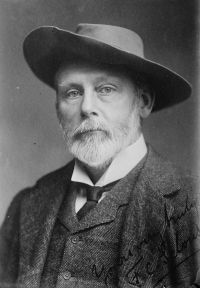 Frederick Courteney Selous,
African Nature Notes and Reminiscences
“ I have known a lion to walk round and round a stockaded cattle kraal, and at last force its way in by pressing two poles apart and squeezing through the opening thus made. Should lions, however, be disturbed and suddenly fired at whilst feeding on a bullock which they have killed inside an enclosure, they will almost always jump over the fence in their hurry to escape. ”
 Owen Jones,
A Gamekeeper's Note-book
(1910)
“ And birds of prey take their toll of the feeding multitudes. All through the year animal life finds sanctuary in the cornfield. Underground are the moles; the harvest mouse weaves its nest in the corn-stems; the rabbit makes a stop in the field near the hedge, and eats the green blades. To the ripening corn the fox brings her cubs to play. In the ditches are hedgehogs; everywhere are rats, mice, and shrew-mice. The hare follows secret paths, and there are stoats and weasels seeking prey, and finding it on every side. ”
 C. Lloyd Morgan,
Animal Behaviour
“ Some species first capture their prey, and then make the nest in which it is to be entombed. Others first prepare the nest, and then carry or drag their prey to it—often from considerable distances—quite irrespective of what seems to us the more appropriate method of the two under the particular circumstances of the case. And the way in which the victim is dragged into the nest is similarly a matter of inheritance. Each way is characteristic of the species concerned, and would be an important part of any definition of the animal based upon its modes of behaviour. ”
“ Otter and mink are two [Pg 32] animals that the sun fades the fur and as the darker the fur, the more valuable, it is important that as little sun as possible shines upon them. For this reason it is advisable to have the enclosure for these animals in the woods or thicket. In fact some trees should be in enclosures for all animals. If raising coon or opossum, they will be "at home" in the trees while other animals will enjoy the shade in the summer and will make use of the leaves in the dens for winter. ”
 John James Audubon,
Ornithological biography, Vol. 1…
“ In such cases, the common nest is always watched by one of the females, so that no Crow, Raven, or perhaps even Pole-cat, dares approach it. The mother will not leave her eggs, when near hatching, under any circumstances, while life remains. She will even allow an enclosure to be made around her, and thus suffer imprisonment, rather than abandon them. I once witnessed the hatching of a brood of Turkeys, which I watched for the purpose of securing them together with the parent. ”
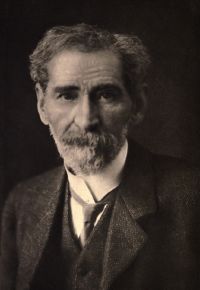 W. H. Hudson,
Argentine Ornithology, Volume 1…
“ They prefer to live near a human habitation, where there are trees: even one tree, in which they can breed and find shelter at night, will be sufficient to attach them to a dwelling, so great is their partiality for the clean-trodden ground where they can freely run about and catch insects. They haunt the cattle-pens, and become extremely familiar with the cows, horses, and sheep, following them to the pasture-grounds, where they are often seen perched on the back of a horse or other domestic animal, or stationed close to its nose on the ground, watching for insects. ”
Harry M. Lamon, Ducks and Geese
“ When goslings which are being artificially brooded are put out during the day on the grass, they should be confined at first. This can be easily accomplished by building a triangular enclosure, formed of 3 boards, 1 foot wide or wider, placed up on edge. This enclosure can be easily shifted to a new position each day thus giving the goslings fresh ground and fresh grass. ”
 Jean-Henri Fabre,
Insect life: Souvenirs of a naturalist
(1913)
“ When this number of journeys has been made,—when the Sphex has done all that is possible to store the captured prey,—her work is done, and the cell is closed, whether completely provisioned or not. Nature has endowed her with only those faculties called for under ordinary circumstances by the interests of the larva, and these blind faculties, unmodified by experience, being sufficient for the preservation of the race, the animal cannot go farther. ”
Edmund Selous, The romance of the animal world (1905)
“ If they should be detained abroad till late in the morning of a sunny day, by the quantity of their prey, they will construct arches over their path, of dirt agglutinated by a fluid excreted from their mouth. If their way should run under thick grass, sticks, etc., affording sufficient shelter, the arch is dispensed with ”
William E. Gibbs, The Fishing Industry
“ A long strip of netting was attached to upright stakes, to form an enclosure with an opening towards the sea, constructed like a fishing weir in such a way that the fish enter the enclosure at high tide and are unable to escape. ”
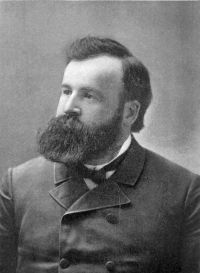 W. Hamilton Gibson,
My Studio Neighbors
“ I found the nest occupied, appropriated, monopolized, by a cow-bird fledgling—a great, fat, clamoring lubber, completely filling the cavity of the nest, the one diminutive, puny remnant of the sparrow's offspring being jammed against the side of the nest, and a skeleton of a previous victim hanging among the branches below, with doubtless others lost in the grass somewhere in the near neighborhood, where they had been removed by the bereaved mother. The ravenous young parasite, though not half grown, [Pg 38] was yet bigger by nearly double than the foster-mother. ”
 W. J. Holland,
Taxidermy and Zoological Collecting
“ The rapid and alarming destruction of all forms of wild animal life which is now going on furiously throughout the entire world, renders it imperatively necessary for those who would build up great zoological collections to be up and doing before any more of the leading species are exterminated. It is already too late to collect wild specimens of the American bison, Californian elephant seal, West Indian seal, great auk, and Labrador duck. Very soon it will also be too late to collect walrus, manatee, fur seal, prong-horn antelope, elk, moose, mountain sheep, and mountain goat. ”
“ Having decided on a favorable section of country the next step is to find a suitable location. It is not necessary or even advisable to have a large enclosure. For the beginner a half-acre to an acre will be sufficient, and a space of four or five acres is ample for extensive operations. If the enclosure is too large the animals will be wild and unmanageable, and on the other hand if too small they will become nervous and restless and will not breed well, and it is advised also that the foxes be not disturbed by visitors and be allowed to live as quietly as possible. ”
A. R. Harding, Deadfalls and Snares
“ You cannot catch them in any kind of trap if they are not there.For opossum, skunk, mink, civet cat, coon, ermine, etc., find where the animals live or where they go frequently searching for food. If building where there are dens, either locate within a few feet of the one that appears best or just off the path that the animal takes in going from one to the other. ”

“ Next to your lordly wall, in dignity of enclosure, comes your close-set wooden paling, which is more objectionable, because it commonly means enclosure on a larger scale than people want. Still it is significative of pleasant parks, and well-kept field walks, and herds of deer, and other such aristocratic pastoralisms, which have here and there their proper place in a country, and may be passed without any discredit. ”
Robert N. Bader, Amphibians and Reptiles in Captivity
“ As with all animals, there are exceptions to the rule; an iguana may refuse to eat, or a collared lizard may do well for years. Each reptile within a species may act differently from how the whole species may act in captivity. Knowing the lizards’ habitat and habits will be the deciding factor in keeping the animal alive and healthy in captivity. ”
Edward William Nelson, Wild Animals of North America
“ Those living in highly placed nests usually escape by running out on the limbs, and pass from one tree to another if necessary. Those in small trees usually drop quickly from limb to limb until they reach the ground, when they run to the nearest shelter.That these mice sometimes descend to the ground of their own volition is probable, but the fact that the stomach of every individual so far examined has contained only the fleshy parts of coniferous leaves indicate that their food habits have become so fixed as to make arboreal life a necessity. ”
 Gene Stratton-Porter,
Moths of the Limberlost: A Book About Limberlost Cabin
“ I have seen insects and nesting birds find a safety in their shelter, unknown to their kind that home elsewhere. The test is not fair enough to be worth consideration. If these same pupae had been as conspicuously placed as on the fence, on any EDIBLE GROWTH, in the same location as the fence, and then left to the mercy of playing children, grazing stock, field mice, snakes, bats, birds, insects and parasites, the story of what happened to them would have been different. ”
George John Romanes, Animal Intelligence
“ The excrement of the young of many birds who build their nests without any pretensions to concealment, such as the swallow, crow, &c., may at all times be observed about or under the nest; while that of some of those birds whose nests are more industriously concealed is conveyed away in the mouths of the parent birds, who generally drop it at a distance of twenty or thirty yards from the nest. Were it not for this precaution, the excrement itself, from its accumulation, and commonly from its very colour, would point out the place where the young were concealed. ”
W. H. Hudson,
Birds in Town & Village
“ Insect life is gathered thickly about us, for that birdless space which we have made is ever its refuge and safe camping ground. And the birds know. One came before we were up, when cat and dog were also sleeping, and a report is current among them. Like ants when a forager who has found a honey pot returns to the nest, they are all eager to go and see and taste for themselves. ”
Samuel Butler, Unconscious Memory
“ The nursing, defence, and education of offspring cannot be considered as in any way more dependent upon bodily organisation; nor yet the sites which insects choose for the laying of their eggs; nor, again, the selection of deposits of spawn, of their own species, by male fish for impregnation. The rabbit burrows, the hare does not, though both have the same burrowing apparatus. The hare, however, has less need of a subterranean place of refuge by reason of its greater swiftness. ”
 Nathaniel Southgate Shaler,
Domesticated animals
“ The success which has been attained in our ordinary large herbivora, and which has made them competent to evade the chase of the beasts of prey, has been accomplished by reducing the number of the toes, giving the strength of the aborted parts to increase the power of those remaining. The result is the formation of two great groups, the double-hoofed forms, including the pigs, deer, cattle, sheep, and their kindred, and the single-toed species, of which our horse is the foremost example. ”
 Gilbert White,
The Natural History of Selborne
“ As they take their prey with their claws, so they carry it in their claws to their nest: but, as the feet are necessary in their ascent under the tiles, they constantly perch first on the roof of the chancel, and shift the mouse from their claws to their bill, that the feet may be at liberty to take hold of the plate on the wall as they are rising under the eaves. ”
Edward Step, Animal Life of the British Isles
“ From this stronghold he issues at dusk, and trots at a light easy pace along his accustomed trails, keeping a watchful eye for rabbit, hare, pheasant, partridge, hedgehog, squirrel, vole, frog—even snails and beetles. He sometimes takes to the seashore in quest of fish, crabs, and mussels. On winter nights he will prowl around the farms, looking for a hen-house whose door has not been properly secured ”
“ The thing to guard against will be freezing. The raiser must see that they have good and deep burrows—deep enough that the ground will never freeze to their nest. They should have plenty of leaves in their nest. If the enclosure is in a thicket, and there are trees within and leaves near, the animals will no doubt carry an abundance of leaves into their dens for nests. If there are no trees in the enclosure, see that a supply is furnished each den before freezing weather in the Fall. ”



