Battery (military)

Definition and stakes

William Duane,  A military dictionary

“ The number of batteries to be opened before the place must determine the number of pieces of ordnance; and on the quantity or ordnance must depend the proportion of every species of stores for the service of the artillery.
There must be a battery to enfilade every face of the work to be besieged, that can in any way annoy the besiegers in their approaches. These batteries, at least that part of them to be allotted for guns, need not be much longer than the breadth of the rampart to be enfiladed, and will not therefore hold more than 5 or 6 heavy guns
”
Source: Gutenberg

William Duane,  A military dictionary

“ A battery in the field should never be [21] discovered by the enemy till the very moment it is to open. The guns may be masked by being a little retired; or by being covered by troops, particularly cavalry.
To enable the commanding officer of artillery to choose the proper positions for his field batteries, he should of course be made acquainted, with the effect intended to be produced; with the troops that are to be supported; and with the points that are to be attacked; that he may place his artillery so as to support, but not incommode the infantry
”
Source: Gutenberg

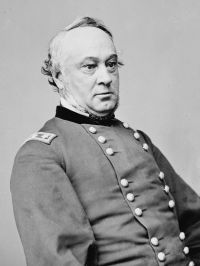
Portrait of H. W. Halleck H. W. Halleck,  Elements of Military Art and Science

“ When in order of battery, the pieces are formed in the same way as for battle, except that the guns are directed towards the enemy and prepared for firing.
The movements and manœuvres of foot artillery correspond with those of infantry, and of mounted artillery with those of cavalry, a battery being regarded as a battalion or squadron, of which the pieces form the platoons. Mounted batteries can seldom move with greater rapidity than the trot, except in cases of emergency, and even then the gallop can be kept up only for a very short time
”
Source: Gutenberg

Get perspective with Kwize: daily news enlightened by great literature