“ The deckhand on the tug{54} grabs for the line. He’s not an outfielder trying to catch the ball. The monkey fist is there only to make the line uncoil and go straight.The deckhand pulls on the heaving line, which is attached to a hawser on the ship. (Sailors don’t say the line is attached or tied. They say it’s “bent” to the hawser.) The hawser is so big that it can’t be thrown, but it can be hauled onto the tug by the heaving line. The deckhand makes the hawser fast to a bitt on the tug’s deck, and now she can pull. ”
Quotes about “deckhand”
“ You leap from your berth to the port-hole in one bound.A schooner and a coastwise steamer are in sight, gulls are swinging in long circles with the ship, and far away on the horizon lies a haze which is America.You dress with care and hurry to the deck. You bow and give a gay "good morning!" to some people you've not spoken to before. You even have a word for the man who always walks with a pedometer, and the one who is coming back from Germany after having put a noiseless soup-spoon on the market. The deck is all abloom with pretty girls in pretty hats and pretty suits. ”
 Charles Dickens,
American Notes
(1842)
Charles Dickens,
American Notes
(1842)
“ A part of the machinery is always above this deck; where the connecting-rod, in a strong and lofty frame, is seen working away like an iron top- sawyer. There is seldom any mast or tackle: nothing aloft but two tall black chimneys. The man at the helm is shut up in a little house in the fore part of the boat (the wheel being connected with the rudder by iron chains, working the whole length of the deck) ; and the passengers, unless the weather be very fine indeed, usually congregate below. Directly you have left the wharf, all the life, and stir, and bustle of a packet cease. ”
 William Henry Giles Kingston,
How Britannia Came to Rule the Waves
William Henry Giles Kingston,
How Britannia Came to Rule the Waves
“ A two-decked ship has no middle-deck, but possesses only a main and lower-deck, besides the before-mentioned quarter-deck, gangway, and forecastle. The deck on which a frigate’s single battery is carried is always called her main-deck, because the sailors are wont to denominate the upper-deck of every ship carrying guns the main-deck. In a sloop-ship or corvette the only deck, without any one above it on which guns are carried, is thus invariably called the main-deck, and, as has before been said, the one beneath it on which the officers and crew live, and which has no guns, the gun-deck. ”
 Basil Hall,
Fragments of voyages and travels…
(1831)
Basil Hall,
Fragments of voyages and travels…
(1831)
“ We midshipmen are upon watch every night for four hours together; we do nothing but walk the quarter-deck, if the ship [Pg 52] is not sailing. There is always half the crew upon deck when the ship is sailing, and we and the lieutenants order them to do so and so about the ropes and sails. All the men’s hammocks are brought upon deck, and laid in places at the side for the purpose, both to give room for the men to work under the decks, and to give them air. All the decks are washed and well scrubbed every morning, which is very right, as they are often dirtied. ”
 William Clark Russell,
The Death Ship: A Strange Story…
William Clark Russell,
The Death Ship: A Strange Story…
“ Figure the decks throbbing with men rushing with apparent aimlessness from one side to the other, from one end to the other—not a vestige of discipline among them—a drowning yell or two coming up from between the ships where some wretch that had fallen overboard was holding on—the sails shaking, the water washing beyond in a glaring white that gave a startling distinctness to the shape of the schooner as she rose softly to the level of our upper deck bulwarks upon the seething snow! ”
Charles Dickens,
American Notes
“ In the first place, they have no mast, cordage, tackle, rigging, or other such boat-like gear; nor have they anything in their shape at all calculated to remind one of a boat’s head, stem, sides, or keel. Except that they are in the water, and display a couple of paddle-boxes, they might be intended, for anything that appears to the contrary, to perform some unknown service, high and dry, upon a mountain top. There is no visible deck, even: nothing but a long, black, ugly roof covered with burnt-out feathery sparks ”
“ The deck cargo, secured by special gear, often weighs as much as forty tons, and stretches [Pg 27] almost from one end of the ship to the other. There is no way from bow to stern except over the stack by ladders; the mainsail and foresail have to be reefed up, and a jib is set on a bowsprit; and the mate at the wheel, unable to see ahead, has to steer from the orders of the skipper, who ‘courses’ the vessel from the top of the stack. To see a ‘stackie’ blindly but accurately turning up a crowded reach of London River makes one respect the race of bargees for ever. ”
 William Archer,
America To-day, Observations and Reflections
William Archer,
America To-day, Observations and Reflections
“ It shuts off the better half of the sky, the zenith. In order even to see the masts and funnels of the ship one has to go far forward or far aft and crane one's neck upward. Not a single human being have I ever descried on the "shade-deck" or on the towering bridge. The genii of the hundred-league boots remain not only inaccessible but invisible. The effect is inhuman, uncanny. All the luxury of the saloons and staterooms does not compensate for the lack of a frank, straightforward deck. ”
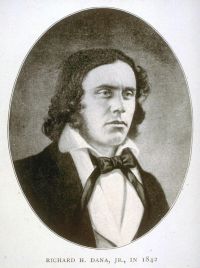 Richard Henry Dana,
Two Years Before the Mast — Chapter XXII
Richard Henry Dana,
Two Years Before the Mast — Chapter XXII
“ Between these and the forecastle was the “between-decks,” as high as the gun deck of a frigate; being six feet and half, under the beams. These between-decks were holystoned regularly, and kept in the most perfect order; the carpenter’s bench and tools being in one part, the sailmaker’s in another, and boatswain’s locker, with the spare rigging, in a third. A part of the crew slept here, in hammocks swung fore and aft from the beams, and triced up every morning. ”
Agness Greene Foster, By the Way: Travel Letters Written During Several Journeys Abroad
“ I see now, after only five days on shipboard, why all descriptions are so unsatisfactory to those who have never experienced a voyage. In the first place, the word "deck" is most inadequate. One naturally thinks that a deck is an open space on the top of a ship, similar to that of a river steamboat. The decks are in reality wide piazzas—when the sea is quiet. On them the passengers congregate—when all is well with them and with the elements. I say "up on deck," when it is only "out on the veranda." Flights of easy stairs connect the various floors. ”
 Jack London,
The Mutiny of the Elsinore
(1914)
Jack London,
The Mutiny of the Elsinore
(1914)
“ Thus, the fore-braces run to the top of the forecastle, the main-braces to the top of the 'midship-house, and the mizzen-braces to the poop. It is evident that they expect our main deck frequently to be filled with water. So evident is it that a laden ship when in big seas is like a log awash, that fore and aft, on both sides, along the deck, shoulder-high, life-lines have been rigged. Also, the two iron doors, on port and starboard, that open from the cabin directly upon the main deck, have been barricaded and caulked. ”
Richard Henry Dana,
Two Years Before the Mast — Chapter XXXII
“ Few words were spoken between the watches as they shifted, the wheel was relieved, the mate took his place on the quarter-deck, the look-outs in the bows; and each man had his narrow space to walk fore and aft in, or, rather, to swing himself forward and back in, from one belaying pin to another,—for the decks were too slippery with ice and water to allow of much walking. To make a walk, which is absolutely necessary to pass away the time, one of us hit upon the expedient of sanding the deck ”
Various, Graham's Magazine, Vol. XL, No…
“ No officer in the ship had the same dashing way of laying a boat along-side in a rough sea, or was better qualified to take charge of the deck on a sudden emergency; and although you might have heard nothing of him before this cruise, you soon felt compelled to yield the palm of seamanship to him, when you once caught his quick, unembarrassed glance, or heard his deep voice answering the quarter-deck on a dark night, in a squall, with a clear ring in its pitch, which the men used to say was worth a dozen trumpets. ”
H. A. Wise, Captain Brand of the "Centipede"
“ From the top-gallant forecastle we could see every thing that took place on the schooner’s deck: sometimes a lot of fellows forward reeving some fresh gear, peering about the low bowsprit, or putting on a seizing to a traveler on the jib-stay; with a chap or two aloft stitching a chafing-mat on the lee backstays; and then aft a man shinning up the main shrouds with a tin pot hung around his neck, greasing the jaws of the main gaff, and twitching a wrinkle out of the gaff-top-sail, so that it would lie as flat as this dining-room table set on end. ”
William Clark Russell,
The Wreck of the Grosvenor, Volume 3 of 3
“ This done, I consulted with Cornish as to what part of the deck we should choose in order to tilt the body overboard. It is generally the custom to rest the body near the gangway, but the ship was rolling too heavily to enable us to do this now, and the main-deck was afloat, so we decided on carrying the body right aft, and thither we transported it, lodging the foot of the stretcher on the rail abaft the port quarter-boat. ”
William Clark Russell,
An Ocean Tragedy
“ In a few brief moments the decks resounded with the slapping of sailors swabbing up the wet; buckets were stowed away in their places, the rope’s-ends collected, and in an incredibly short space of time all was as though no such incident as I have related had happened, the planks drying fast, some seamen aft spreading the awning, other fellows at their several jobs in the rigging or on deck, just a grin now and again passing amongst them, but no laughter and no talk, and the yacht softly pushing forwards under the increasing glory of the sun fast approaching his meridian. ”
“ In the next place, this deck must be of considerable weight—a serious disadvantage if the boat has often to be beached. And not only is the deck heavy in itself, but, situated as it is high above the water-line, it tends to make the boat top-heavy, and this must be counteracted by putting more ballast into her than would be required in an entirely open boat of the same dimensions. Now, if a small boat is intended ever to venture into rough water, the less ballast she carries and the more buoyant she is, the better. ”
James Grant, Dick Rodney; or, The Adventures of an Eton Boy
“ No man would walk on the same side of the deck with him, or exchange a word, or a light for a pipe, or use the same cup or plate; so he was generally to be seen, leaning moodily and alone, against the windlass-bitts, with his black eyes fixed on the horizon, as if he expected a sail or something else to heave in sight. ”
Earl Thomas Brassey Brassey, Yachting, Vol. 1
“ Everything depends on the state of the decks themselves and how they are laid. If they are made (p. 379) of wide planking, which is rarely, if ever, the case when the workmanship is that of a yacht-builder, they should be painted; if, however, the decks are laid with narrow planking fined off with the deck curves at the bow and stern, then, notwithstanding the beauty of white decks, it is better to varnish them. Varnishing keeps them hard, and saves many a heart pang when the little yacht is visited by a friend with nails in his boots or a lady in small heels. ”
George Cupples, The Green Hand: Adventures of a Naval Lieutenant
“ The decks were lively enough to look at; the men working quietly by twos and threes about the bulwarks all day long, and pairs of them to be made out at different points aloft, yarning away comfortably together, as the one passed the ball for the other's serving-mallet, with now a glance at the horizon, and now a grin at the passengers below, or a cautious squint at the top of the mate's cap. ”
 William Falconer,
An Universal Dictionary of the Marine
William Falconer,
An Universal Dictionary of the Marine
“ Ships of the first and second rates are furnished with three whole decks, reaching from the stem to the stern, besides a forecastle and a quarterdeck, which extends from the stern to the main-mast, between which and the fore-castle, a vacancy is left in the middle, opening to the upper-deck, and forming what is called the waist. There is yet another deck above the hinder or aftmost part of the quarter-deck, called the poop, which also serves as a roof for the captain’s cabin or couch. ”
William Falconer,
An Universal Dictionary of the Marine
“ DECKS, ponts, (decken, Dan. to cover) the planked floors of a ship, which connect the sides together, and serve as different platforms to support the artillery, and lodge the men, as also to preserve the cargo from the sea in merchant-vessels.As all ships are broader at the lower-deck than on the next above it, and as the cannon thereof are always heaviest, it is necessary that the frame of it should be much stronger than that of the others; and, for the same reason, the second or middle deck ought to be stronger than the upper deck, or forecastle. ”
C. S. Stewart, Brazil and La Plata: The personal record of a cruise
“ Some of them on the upper spars, like birds in the topmost branches of a tree, sweep to and fro over the roaring gulf below; and, occasionally a man or boy is beheld clinging to a slender spar or single sheet at the very mast-head, two hundred feet from the deck, disentangling a halliard or conductor—causing one’s nerves to shake under the apprehension of seeing him hurled, in some pitch or roll of the frigate, far overboard into the raging sea, or dashed to death at your feet on deck. ”
Frederic Stanhope Hill, Twenty years at sea: Leaves from my old log-books (1893)
“ As we had not been able to get an observation for several days, I hurried on deck with my sextant. Just as I had braced myself against the port rail, the man at the wheel carelessly let the ship yaw, and a great wave that must have weighed tons came aboard, smashing the starboard quarter boat to flinders, dashing in the cabin skylight, and sweeping the decks in a terrible manner. ”
George Cupples, The Green Hand: Adventures of a Naval Lieutenant
“ Early in the morning-watch a sudden stir of the men on deck woke me, and I bundled up in five minutes' time. But it was only the second mate setting them to wash decks, and out they came from all quarters, yawning, stretching themselves, and tucking up their trousers, as they passed the full buckets lazily along; while a couple of boys could be seen hard at work to keep the head-pump going, up against the grey sky over the bow. ”
Mrs. J. S. O. Allen, Memories of My Life
“ The most painful experience I ever had on that deck was one Saturday morning. I was sitting in my usual place, when I saw a seaman going up in the rigging. All at once I heard a fearful cry, and I saw him fall into the sea. They shut down the skylight to keep the people from causing confusion. On either side of the ship a lifeboat was lowered in a moment, and before I had time to look round I could see the mates and the men in the boats, and the lifebuoys thrown over. The captain had the ship heaved to. ”
Richard Henry Dana,
Two Years Before the Mast
“ One has to stand his wheel, and another his lookout, and the sooner he gets on deck again, the better. Accordingly, as soon as I could possibly go back to my duty, I put on my thick clothes and boots and south-wester, and made my appearance on deck. Though I had been but a few days below, yet everything looked strangely enough. The ship was cased in ice,—decks, sides, masts, yards, and rigging. Two close-reefed top-sails were all the sail she had on, and every sail and rope was frozen so stiff in its place, that it seemed as though it would be impossible to start anything. ”
“ On the next morning the deck watch was called, as the fish had commenced to bite in good shape, and five men were heaving them as fast as they could haul them in. Each line had a rig for two hooks, and each man tended two lines. In the deck space between each man was a large deck-kid or box, which was made stationary and had a partition on the inside to separate the fish that each man caught. ”
Basil Hall,
The lieutenant and commander
“ This operation throws up a good deal of dust; but it makes the deck white, which is the grand point aimed at. The wings, the store-rooms, and the cockpits, undergo a similar dose of rubbing and scrubbing; in short, every hole and corner of the decks, both above and below stairs, as folks on shore would say, is swept, and swept, and swept again, on a Sunday morning, till the panting sweepers are half dead; indeed, the rest of the ship's company are worried out of all patience, from eight o'clock to half-past ten, with the eternal cry of "Pipe the sweepers!" ”
