Isopod

Definition and stakes

William S. Furneaux,  The Sea Shore

“ The general nature of an Isopod may be readily understood by the examination of the common woodlouse that abounds in gardens and damp places almost everywhere, and the reader will probably remember having seen similar creatures crawling over the rocks on the sea shore. ”
Source: Gutenberg

W. T. Calman,  The Life of Crustacea

“ The examination of a common Woodlouse, such as Oniscus or Porcellio (Fig. 20) , will give a general idea of the form and structure of a typical Isopod, although many curious modifications are found, some of which will be mentioned in later chapters.
There is no distinct carapace, but the last vestige of one may be indicated by the fact that the first [52] thoracic somite is completely fused with the head. All the other somites of the body are distinct (in some Isopods, however, the abdominal somites are coalesced) , but the telson is not separate from the last somite.
”
Source: Gutenberg

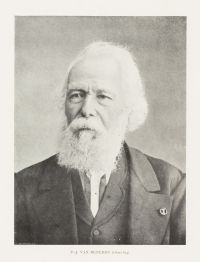
Portrait of P. J. van Beneden P. J. van Beneden,  Animal Parasites and Messmates

“ In the group of isopod crustaceans we find many necessitous beings, which, too proud to ask for food, are contented to take their place on some fish which is a good swimmer, which they abandon as soon as their interest demands it; if their host conducts them to regions that do not suit them, or if they have otherwise to complain of him, they give him up, and begin their maritime peregrinations with a fresh colleague. They always preserve all their fishing tackle and their sailing gear, and the female does not change her dress any more than the male. ”
Source: Gutenberg

Get perspective with Kwize: daily news enlightened by great literature