“ That if the repeller be removed, and the point on the vane be terminated as the lightning rods usually are, and then the metal of the lantern be strongly attached to, and connected with, the upper end of the copper rod, and the rod continued down the tower to the earth, and the sheet of copper buried in it, such a system will be an effectual and perfectly safe lightning conductor. ”
Lightning rod
Definition and stakes
A lightning rod is a conductive metal structure designed to protect buildings from lightning strikes by offering a controlled pathway for electrical current to reach the ground. Historically, Father Prokop Diviš pioneered early designs in 1754, while Benjamin Franklin popularized the concept in the 18th century, connecting it to electrical principles.
Authors like Catharine Esther Beecher focused on its protective range, while Gerald Molloy challenged existing theories, emphasizing the importance of grounding and material conductivity. Modern systems, ranging from decorative rods to Faraday cages, illustrate the evolution of this technology, balancing practicality with scientific precision to reduce risks posed by lightning’s destructive power.
Quotes about “lightning rod”
“ On a very elongated body, terminating in a point, the density becomes so exceedingly great that the outward pressure of the electricity tending to escape forces a passage through the surrounding air. Proper lightning rods must be surrounded with a number of sharp points, lest one should be injured. The proper function of a lightning rod is not to parry a dangerous flash of lightning: it ought rather, by silent but continuous draining to prevent any serious accumulation of electricity in a cloud near it. ”
Popular Science Monthly (1873)
“ MISCELLANY. The Ground Connection of Lightning-Rods.—It is asserted, by all the later authorities on the subject of lightning-rods, that a proper ground termination of the rod is of the very first importance to its efficiency as a protection against accidents by lightning. The electricity of the cloud will select the easiest path into the earth, or, as it is technically stated, follow the line of least resistance; and it is to furnish a path less resisting than the building itself that the lightning-rod is erected. But it is not enough that the rod have a sufficient conducting capacity. ”
“ In the case of two buildings alike in size and shape, situated on the same soil, one made of wood and stone as formerly, the other with much metal as now, and both without lightning rods—if the conditions are such that the lightning must discharge itself, it will always strike the latter, and never the former; in the same way as on bringing to the conductor of an electrical machine a ball of wood or stone, and one of metal, it is always the latter which will receive the spark. ”
“ A lightning rod is an electrical conductor terminating in a point and carried down to the common receiver. It may be regarded as a metallic tree, and divided into (1) the upper terminal, (2) the trunk, and (3) the roots.1. The upper terminal is a very pointed, conical or pyramidal spike of metal having a base 3 or 4 centimetres (11⁄2 inches) in radius. The point is of gold or platinum, soldered to a copper rod 1 or 2 metres long (3 feet 3 inches to 6 feet 7 inches) . This rod is joined to the rest of the upper terminal, which is of iron, either by solder, a screw, or a pin. ”
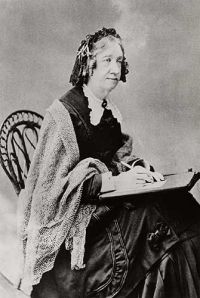
Catharine Esther Beecher,
A Treatise on Domestic Economy…
(1845)
“ A lightning rod, if it be well pointed, and run deep into the earth, is a certain protection to a circle around it, whose diameter equals the height of the rod above the highest chimney. But it protects no further than this extent. ”
“ Thunderclouds are usually about 2 miles high and from 13 to 23 miles thick. Lightning is much less frequent in mountainous than in plain countries. Copper lightning conductors are often applied to iron ships and iron buildings, but absurdly, as they are in such cases superfluous.The author advocates immense earth plates where there are no gas- and water-pipes, which he calls the best lightning rods ever erected, because they are electrically in perfect connection with the earth. ”
“ In every one of the fifty-five cases where Sir W. S. Harris’s rods were fixed they have protected the ships, except that not having points some slight damage has sometimes occurred to the tops of the masts.This shows their superiority over ropes or chains.Arago thought that lightning rods were protection against ordinary lightning, but not when it assumed the form of fire-balls. The author cites several examples to show that this opinion was not well founded.He considers a perfectly constructed lightning rod to be a perfect safeguard. ”
“ We learn that a lightning rod company in Cincinatti has patented a system of lightning protection, which consists of an iron rod running along the ridge of the building with points at each end projecting upwards. ”
Ralph Boston, Nick Carter Stories No. 152, August 7… (1914)
“ Ever since Ben Franklin designed the lightning rod as a means of protecting structures from lightning stroke, there has been periodically raised the question of the efficiency of these rods as a means of warding off the [Pg 65] bolts from the heavens. Men of eminence in the electrical world have been found arrayed on both sides of the question, and in order to arrive at some well-founded conclusion, the subject was taken up by the weather department. ”
“ Lightning rods, therefore, are so much the more indispensable as the buildings contain greater surfaces and greater masses of metal.The nature of the soil must be taken into account, as well as the buildings and other objects upon it. A dry soil, with a subsoil of dry sand, chalk, or granite, does not attract the lightning, because it is a bad conductor. ”
“ If the ramparts dominate the magazine it will be prudent to set upon them a lightning rod on a mast. Trees are only struck by lightning because their tops serve as points but their trunks are bad conductors, hence it is prudent not to have plantations, especially of lofty trees near magazines. However many points may be set up on a magazine they should all be connected together, and all joined to the principal conductor, and it would be well to have more than one principal conductor so that if one loses its continuity the lightning may have a path by the other. ”
“ Of Conductors of lightning rods struck, and their contact with the ground.The author refers to forty-one cases of lightning rods struck when not on Harris’s principle.Of these, 5 were of copper bands soldered together; 5 were of copper wire either as rope or chain; 1 was made of bands of sheet iron; 11 were of bars of iron joined by screws or by solder; 3 had pieces of lead between the parts where they were screwed together; 3 were of simple iron wire, or of rope or chain of iron wire; 3 were of iron joined together by hooks; 12 are described as chains (metal not specified) ”
“ When injury to buildings has occurred where lightning rods are fixed, they have been “ignorantly and wrongly applied,” or joints have rusted, the rods been broken, or earth contact has become imperfect.He refers to Harris and Faraday as to sectional area of conductor. (111) Considers a rope to be better than a rod, as it is less liable to be fractured and to have badly formed joints.The upper extremity should project into the air as high as the diameter of the chimney top. ”
“ The dimensions of the above are seldom given.The largest bands reported are 16 centimetres (c. 61⁄4 inches) in width.The largest bars reported are 55 centimetres (c. 21⁄4 inches) in width and 15 centimetres (c. 1⁄2 inch) in thickness.The description of the earth connection is also imperfect.Of eighty-nine lightning rods described as struck, only twelve are noted as having their ends in running water or wells, and one in damp soil. ”
Gerald Molloy, Lightning, Thunder and Lightning Conductors (1890)
“ These experiments are very simple, but they really put before us, in the clearest possible way, the whole theory of lightning conductors. In particular, they give us ocular demonstration that an efficient lightning rod not only makes the lightning harmless when it comes, but tends very much to prevent its coming. ”
Gerald Molloy, Lightning, Thunder and Lightning Conductors (1890)
“ Security Afforded by Lightning Rods.—You might, perhaps, be inclined to infer hastily, from the examples I have set before you, in the course of this lecture, of buildings which were struck and severely injured by lightning though provided with lightning conductors, that a lightning rod affords a very imperfect protection to life and property. ”
F.C.S. Richard Anderson, Lightning Conductors: Their History…
“ If the house or barn be long, there may be a rod and point at each end, and a middling wire along the ridge from one to the other. A house thus furnished will not be damaged by lightning, it being attracted by the points and passing through the metal into the ground without hurting anything. Vessels also, having a sharp-pointed rod fixed on the top of their masts, with a wire from the foot of the rod reaching down round one of the shrouds to the water, will not be hurt by lightning.’ Franklin had occasion subsequently greatly to modify the advice here given. ”
F.C.S. Richard Anderson, Lightning Conductors: Their History…
“ The tramping ‘lightning-rod men’ of the United States are notorious for extortion and ignorance: they use all kinds of fantastic and peculiar shaped terminal rods and conductors,134 the main object being to make as great a show with as little metal as possible. Their work is almost entirely confined to the upper portion of the conductor, to the neglect of the most important part—the earth terminal. In consequence, the majority of the lightning conductors in America are untrustworthy ”
Elisha Gray,
Electricity and Magnetism
“ From this experiment Franklin conceived the [Pg 12] idea of erecting lightning-rods to protect buildings, which are used to this day.The news spread all over Europe, not through the medium of electricity, however, but as soon as sailing vessels and stage-coaches could carry it. Many philosophers repeated the experiments and at least one man sacrificed his life through his interest in the new discovery. In 1753 Professor Richman of St. Petersburg erected on his house a metal rod which terminated in a Leyden jar in one of the rooms. ”
Gerald Molloy, Lightning, Thunder and Lightning Conductors (1890)
“ Cases are not uncommon in which builders provide underground a carefully constructed reservoir of water, into which the lower end of the lightning rod is introduced. The idea seems to prevail that a reservoir of water constitutes a good earth contact; and this is quite true of a natural reservoir, such as a lake, where the water is in contact with moist earth over a considerable area. But an artificial reservoir may have quite an opposite character, and practically insulate the lightning conductor from the earth. ”
Gerald Molloy, Lightning, Thunder and Lightning Conductors (1890)
“ Introduction of Lightning Rods into England.—The progress of lightning conductors was more slow in England and on the Continent of Europe, owing to a fear, not unnatural, that they might, in some cases, draw down the lightning where it would not otherwise have fallen. People preferred to take their chance of escaping as they had escaped before, rather than invite, as it were, the lightning to descend on their houses, in the hope that an iron rod would convey it harmless to the earth. ”
Popular Science Monthly (1881)
“ Connection with a body of water inclosed in a masonry basin, such as a reservoir, is not a proper way of grounding the rod. A lightning-rod acts as a constant drain upon the charge in the clouds in its neighborhood, and when the rods are numerous over any area, as in a well-protected town, storm clouds will pass over without any lightning flashes taking place, though such form of discharge will occur before reaching the protected district and after passing it. ”
“ Reference is then made to “Regnier’s System of Lightning Rods,” Appendix F., p. 53, which is thought to be much too expensive.REPORT on the foregoing Instructions made by La Place, Rochon, Charles, Montgolfier, and Gay Lussac to the National Institute.2nd November, 1807. The reporters say that experience has taught that the point of a lightning rod 4 or 5 metres (13 to 161⁄3 feet) does not effectually protect a space round it greater than one having a radius of 10 to 12 metres (323⁄4 to 391⁄4 feet) . ”
F.C.S. Richard Anderson, Lightning Conductors: Their History…
“ He has for many years advocated the method of employing a great number of small lightning-rods, in preference to one rod of large size, for the protection of buildings from the effects of lightning; the main characteristic of his system being that of covering the building with a network of metal furnished with very many points, combined with numerous and ample earth-contacts. This idea has been thoroughly worked out at the Hôtel de Ville, Brussels; and probably no other building is so completely guarded from the dangers of thunderstorms. ”
“ No one seems to have thought that the new masses of metal which had been brought into the church could have any effect on the course of the lightning, otherwise the lightning-rods would have been connected with the gas-pipes, or the earth connection been prolonged to proximity with the pipe. ”
Gerald Molloy, Lightning, Thunder and Lightning Conductors (1890)
“ If no such system of water-pipes or gas-pipes is at hand, then the lightning rod should be connected with moist earth by means of a bed of charcoal or a metal plate not less than three feet square. This metal plate should be always of the same material as the conductor, otherwise a galvanic action would be set up between the two metals, which in course of time might seriously damage the contact. Dry earth, sand, rock, and shingle are bad conductors ”
“ Several points are preferable to a single point, because the “gathering power” is increased thereby, and the chance of lightning striking other things in the immediate vicinity of the conductor is proportionately diminished; the top of the rod is less likely to be fused when struck, the stroke being divided between the various points; and also because the brush discharge is thereby facilitated. He dwells with much emphasis on the importance of the earth connection, which he regards as a joint, and advocates greater surface than is usual at present. ”
“ He lastly considers the question, formerly much debated as to whether a lightning rod attached to a house will attract to the house a discharge that otherwise would not have struck it, and he concludes that there is no foundation for the erroneous impression that the existence of a lightning conductor can ever cause damage. ”
“ If of iron he prefers a flat bar 1 inch by 1⁄4 inch, weighing 13 ounces per foot, or No. 00 copper, weighing 61⁄2 ounces per foot. He also advocates copper rope.He thoroughly believes in the conduction through the mass of the metal, and quotes (p. 12) several experiments in support of that view.He believes in a good earth and in connecting all waterspouts, eaves, gutters, and metal work generally with the earth and with the conductor; he thinks one good rod enough, and sees no reason why lightning rods should not be painted, indeed, thinks it better to do so, for they become less unsightly ”
Worthington Hooker, The Child's Book of Nature
“ If the lightning comes down directly toward a [3154] house in a considerable quantity, instead of striking the house, it will go down the rod into the ground. Another way in which the rod affords protection is this: Sometimes the lightning or electricity goes down the rod from the clouds above in a continual stream of very small quantity, just as it went down the string of Franklin’s kite. A cloud with a great deal of electricity in it often has it discharged in this quiet way. ”
“ A single rod may be placed on small houses, and its elevation should be at least half of the distance to which its protection is expected to extend.10. Metallic roofs should be united with the lightning rods.11. As a general rule, large masses of metal within the building, particularly those which have perpendicular elevation, ought to be connected with the rod.ON LIGHTNING AND LIGHTNING CONDUCTORS. By W. H. Preece, Mem. Inst. C.E. (Journal of the Society of Telegraph Engineers, 27 November, 1872.) ”
Various, Scientific American, Vol. XXXVII.…
“ This sponge will absorb readily the gross impurities of the water, and can easily be taken out and cleaned once or twice a week. (42) A. C. S. asks: 1. Is there any reason why lightning rod points should always be bright, if the points are kept sufficiently sharp? A. It makes no difference if the points are not bright. 2. If lightning rods put up in the ordinary way above the roof terminate in the eaves' spouting of the house, and said spouting had good ground connections, would this not be equal to the best lightning rod, and thereby save many feet of rod and many dollars of expense? ”