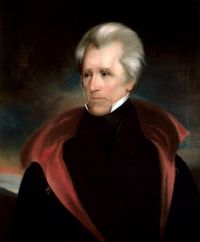
“ I do not insist upon having the gold standard, but if we are to have but one, I think that the best. The expense of maintaining a metallic currency is of course greater than that of paper; but it must be borne in mind that a paper currency is only tolerable when convertible at the will of the holder into coin—and no one asks for more than that. A metallic currency is also subject to considerable loss by abrasion or the annual wear; and it is quite important to know which metal—gold or silver—can be most cheaply supported. ”
Metallic currency
Definition and stakes
Quotes about “metallic currency”
Karl Marx,
A Contribution to the Critique of Political Economy
(1904)
“ Metallic currency has its remedy in the import and export of precious metals which immediately enter circulation and thus, by their influx or efflux, cause the prices of commodities to fall or rise. The same effect on prices must now be exerted by banks by the artificial imitation of the laws of metallic currency. If gold is coming in from abroad it proves that the currency is inadequate, that the value of money is too high and the prices of commodities too low, and, consequently, that bank notes must be put in circulation in proportion to the newly imported gold. ”
Various, Blackwood's Edinburgh Magazine…
“ If the nation possessed a circulation of bank-notes capable of being extended in proportion as the metallic circulation was withdrawn by the exchanges of the commerce in grain, as was the law during the war, the industry of the country might be vivified and sustained during the absence of the precious metals, and their want be very little, if at all, experienced. But it is well known that not only is there no provision made by law, or the policy of government, for an extension of the paper circulation when the metallic currency is withdrawn, but the very reverse is done. ”
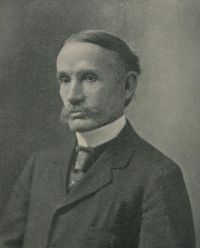
Various, The Atlantic Monthly, Volume 01…
“ But there are these two signal points of distinction between a paper and a metallic currency: first, that paper money may be increased or diminished much more easily than metallic money; and, second, that any excess or deficiency of the former is not so easily corrected by the natural operations of trade. The sudden or large increase of the metals is prevented by their scarcity and the laborious processes necessary to produce them, and a sudden or large decrease of them could be brought about only by some great public calamity which should destroy them or cause them to be hoarded. ”
The Unity of Western Civilization
“ The actual provision of metallic currency has from the earliest times been almost entirely under the control of the government which took into its own hands, as an essential part of the police protection which it gives to the people, the coining of currency, stamping the coin in such a way that anybody who took one might know that he was getting a certain weight of a precious metal. ”
Various, Blackwood's Edinburgh Magazine…
“ But the extension of the metallic currency of the globe, though it cannot altogether remove, materially lessens this dreadful danger. It inspires confidence among moneyed men. It diminishes the terror of the withdrawal of the precious metals, which, when it once seizes them, is productive of such unbounded calamities ”
Charles Francis Bastable, 1911 Encyclopædia Britannica (1911)
“ The desire for adornment is not a keen one with most civilized persons; and, so far as it exists, is gratified in other ways than by using silver or gold. For purposes of manufacture their use is large and increasing. The second head is that with which we are principally concerned. It is evidently connected with the need for metallic currency; and this again depends on the level of prices and the monetary organization, including in the latter the banking system. Currency requirements still form the largest part of the demand for the precious metals. ”
Charles Francis Bastable, Encyclopædia Britannica, Ninth Edition (1883)
“ The expense of a metallic currency is, however, combined with its weight, a strong reason for the great developments of representative money and credit in modern times, with the result that gold and silver are hardly ever used in large domestic transactions, all such payments being made by cheques, which are cleared off against one another. ”
John Bates Clark,
Essentials of Economic Theory
“ Since a coin consists chiefly of raw metal, we may therefore count on having before us a régime of falling prices, whatever metallic currency we adopt. The rate of the fall and the degree of steadiness in it will be greater with some metals than with others. The variations in the value of gold are, on the whole, comparatively steady. This metal fluctuates in amount and in cost, but the changes are less sudden than in the case of most others. ”
John Haslam,
The Paper Currency of England Dispassionately Considered
“ One of the chief defects of a purely metallic currency consists in the very circumstance that it does not contract and expand with the decrease and increase of marketable commodities requiring to be exchanged for each other, but that, on the contrary, through the operation of an influx or efflux of gold, it not unfrequently contracts or expands in a far greater proportion than the state of the markets would justify, thereby producing an excessive depreciation or appreciation in general prices ”
A Biography of Henry Clay, the Senator from Kentucky
“ But its supporters argue that such a system of convertible paper as this country has so long had is radically wrong; that all our evils are to be traced to the banks; and that the sooner they are put down, and a currency exclusively metallic is established, the better. They further argue, that such a metallic currency will reduce inflated prices, lower the wages of labor, enable us to manufacture cheaper, and thereby admit our manufacturers to maintain a successful competition with foreigners. ”
Karl Marx,
A Contribution to the Critique of Political Economy
(1904)
“ That subsidiary currency consists of metal tokens, such as silver, copper, etc., is mainly due to the fact that in most countries the less valuable metals such as silver in England, copper in ancient Rome, Sweden, Scotland, etc., had circulated as money before they were degraded by the process of circulation to the rank of small change and replaced by a more precious metal. Besides, it is natural that the money symbol which grows directly out of metallic circulation, should itself be a metal. ”
Various, The Arena, Volume 18, No. 93, August…
“ In other words, the fluctuations in the value of silver are confined to it in its bullion shape, and cannot enter into its form as money. The idea that paper currency must be redeemed in gold, as money, or silver, as money, is erroneous. It is redeemed in those metals because they have value as merchandise. In domestic transactions this fact is often lost sight of, but it becomes manifest in international exchanges when the metallic money passes strictly on its merits as bullion, and without regard to the stamp it bears. ”
J. N. Larned, History for ready reference, Volume 6 (1895)
“ He said: "'Our population, notably the agricultural population, finds that it has not at its disposition sufficient resources in currency, in metallic money. On the other hand, if the Government in the actual state of affairs reopens the mints to the free coinage of silver, we would be flooded by the abundance of this metal coming from all other countries of the world, and we could not resist the even greater evil of the inevitable depreciation of one of our precious metals, that is to say, of the effective destruction of the legal ratio upon which our monetary system is based. ”
William Ridgeway, The Origin of Metallic Currency and Weight Standards
“ The man who possesses sheep exchanges them for oxen with the man who possesses oxen, the owner of corn exchanges his commodity for some implement or ornament of metal with the owner of the latter. The metals are only regarded as merchandise, not yet being in any degree set apart to serve as a medium of exchange in the terms of which all other commodities are valued. This is the practice which prevails in so civilized a country as China down to our own days. The only coinage which the Chinese possess is copper cash. ”
J. N. Larned, History for ready reference, Volume 6 (1895)
“ To afford a hope that a monetary union will succeed in establishing stability in the relative value of gold and silver, it is essential that the nations adhering to it should be of such number and importance that the metallic currency of the whole body shall be of sufficient extent to allow of the exercise of adequate influence on the value of the two metals. ”
William Ridgeway, The Origin of Metallic Currency and Weight Standards
“ And they offer their gold for sale to their neighbours likewise at a cheap rate, giving thrice as much gold as they get copper in exchange and twice as much gold as they get silver in exchange, for they have not the skill to work the gold, and the metals which they receive in exchange are rare in their country and more necessary for life [112] . ”
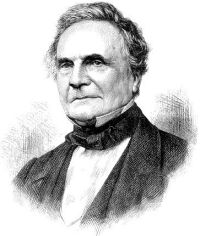
Charles Babbage,
On the Economy of Machinery and Manufactures
“ One of the most obvious differences between a metallic and a paper circulation is, that the coin can never, by any panic or national danger, be reduced below the value of bullion in other civilized countries; whilst a paper currency may, from the action of such causes, totally lose its value. Both metallic and paper money, it is true, may be depreciated, but with very different effects.1. Depreciation of coin. The state may issue coin of the same nominal value, but containing only half the original quantity of gold, mixed with some cheap alloy ”
John Bates Clark,
Essentials of Economic Theory
“ If the volume of business were to increase at the rate of two per cent a year, while other influences affecting prices were to remain unchanged, the currency would not expand as rapidly as the demand for it, and prices would not only fall, but would fall at the same rate as if only one metal had been used. Use ten metals instead of two,—make coins of tin, platinum, copper, nickel, etc.,—and if the grand composite still insures the one per cent rate of general increase of metallic money, prices will vary as they would have varied with a currency of gold alone. ”
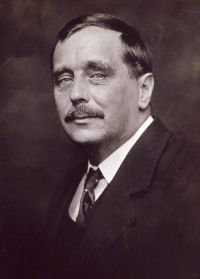
H. G. Wells,
The World Set Free
“ Gold was now a waste product in the release of atomic energy, and it was plain that no metal could be the basis of the monetary system again. Henceforth all coins must be token coins. Yet the whole world was accustomed to metallic money, and a vast proportion of existing human relationships had grown up upon a cash basis, and were almost inconceivable without that convenient liquidating factor. It seemed absolutely necessary to the life of the social organisation to have some sort of currency, and the council had therefore to discover some real value upon which to rest it. ”
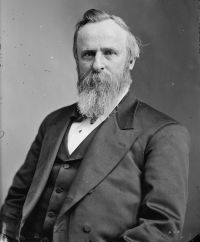
Rutherford Birchard Hayes,
State of the Union Addresses
“ In adapting the new silver coinage to the ordinary uses of currency in the everyday transactions of life and prescribing the quality of legal tender to be assigned to it, a consideration of the first importance should be so to adjust the ratio between the silver and the gold coinage, which now constitutes our specie currency, as to accomplish the desired end of maintaining the circulation of the two metallic currencies and keeping up the volume of the two precious metals as our intrinsic money. ”
Grover Cleveland,
A Compilation of the Messages and Papers of the Presidents…
“ Were there infinitely stronger reasons than can be adduced for hoping that such action would secure for us a bimetallic currency moving on lines of parity, an experiment so novel and hazardous as that proposed might well stagger those who believe that stability is an imperative condition of sound money. No government, no human contrivance or act of legislation, has ever been able to hold the two metals together in free coinage at a ratio appreciably different from that which is established in the markets of the world. ”
Alexander K. McClure, Our Presidents and how we make them (1900)
“ Thus the largest possible enjoyment of both metals is gained with a value universally accepted throughout the world, which constitutes the only practical bimetallic currency, assuring the most stable standard, and especially the best and safest money for all who earn their livelihood by labor or the produce of husbandry. ”
William Arthur Shaw, The History of Currency, 1252 to 1896
“ Such is the nature of the bimetallic law that any overshooting of the ratio, on no matter which side,—in favour of silver or in favour of gold,—establishes a differentiation, and the differentiation at once gives to the one metal a fulcrum or lever point—a purchasing power—against the other, and the undervalued metal, whichever it is, at once tends to disappear. Four years after this autocratic measure of France, it was found that her currency was in so depreciated a state, through exchange, that the only pieces current were lacking one-third of their full weight. ”
Irving Fisher,
The Purchasing Power of Money…
“ If all countries had their irredeemable paper money, and had no money acceptable elsewhere, there could be no international adjustment of monetary matters. Price levels in different countries would have no intimate connection. Indeed, to some extent the connection is actually broken between existing countries which have different metallic standards,—for example, between a gold-basis and a silver-basis country,—although through their nonmonetary uses the two metals are still somewhat bound together. ”
Irving Fisher,
The Purchasing Power of Money…
“ When bimetallism has broken down at one ratio, it can always be set in operation again at another, but the transition requires a depreciation of the currency. The only way of reintroducing the metal which has passed out of the currency reservoir is by lowering the amount of it in the monetary unit,—unless the still more drastic measure is adopted of raising the coinage weight of money already in circulation. ”
John Ruskin,
Munera Pulveris
(1894)
“ Such indestructibility, and facility of being tested, are united in gold; its intrinsic value is great, and its imaginary value greater; so that, partly through indolence, partly through necessity and want of organization, most nations have agreed to take gold for the only basis of their currencies;—with this grave disadvantage, that its portability enabling the metal to become an active part of the medium of exchange, the stream of the currency itself becomes opaque with gold—half currency and half commodity, in unison of functions which partly neutralize, partly enhance, each other's force. ”
The Problem of the Rupee, Its Origin and Its Solution
“ It is obvious from this that the par of exchange between any two countries will be stable if they employ the same metal functioning as their standard money freely convertible into and exportable as bullion, for in that case they would have as a measure of value a common medium, the value of which could not differ, given freedom of commerce, in the two countries by more than the cost of its transhipment, i.e. within specie points. On the other hand, there can be no fixed par of exchange between two countries having different metals as their currency standards of value. ”
John Stuart Mill,
Principles of Political Economy
(1871)
“ There is not indeed the self-acting check which convertibility brings with it. But there is a clear and unequivocal indication by which to judge whether the currency is depreciated, and to what extent. That indication is, the price of the precious metals. When holders of paper cannot demand coin to be converted into bullion, and when there is none left in circulation, bullion rises and falls in price like other things; and if it is above the Mint price, if an ounce of gold, which would be coined into the equivalent of 3l. ”
Various, Chambers's Journal of Popular Literature… (1853)
“ Thus, the United States required one hundred millions; Germany, eighty-four millions; and Italy, sixteen millions. This meant an average extra demand on the ten years of twenty millions annually.We must bear these figures in mind in endeavouring to see how gold has become scarce, and, as it is termed, ‘appreciated in value.’ Besides the coinage for these and the other states which have to put a certain quantity of gold through the mints every year in order to keep up their normal currency, there is the large demand for the metal for employment in the arts and manufactures. ”
The Problem of the Rupee, Its Origin and Its Solution
“ The insufficiency of silver and the want of credit currency caused such an embarrassment to trade that there grew up a change in the attitude towards the Currency Act of 1835, and people, for once, began to ask whether, although it was well to have changed from bimetallism to monometallism, it would not have been better to have preferred gold monometallism to silver monometallism. ”