“ Deer give beautiful animation to the forests, harmonizing finely in their color and movements with the gray and brown shafts of the trees and the swaying of the branches as they stand in groups at rest, or move gracefully and noiselessly over the mossy ground about the edges of beaver meadows and flowery glades, daintily culling the leaves and tips of the mints and aromatic bushes on which they feed. There are three species, the black-tailed, white-tailed, and mule deer; the last being restricted in its range to the open woods and plains to the eastward of the Cascades. ”
Mule deer
Definition and stakes
The theme of “mule deer” has been addressed by authors such as William T. Hornaday, Harvey Riley, Randolph B. Marcy, Russell K. Grater and William Clark. It is often associated with terms like hunter, antler, antelope, white and hunting.
Quotes about “mule deer”
 Harold Edward Bindloss,
The Gold Trail — Chapter X
(1910)
“ Both the black-tail deer and the mule-deer are to be met with in that country, but, somewhat strange to say, they are, as a rule, more plentiful round the smaller settlements than in the wilderness, and they are always singularly difficult to see. The inexperienced sportsman cannot invariably discern one when it is pointed out to him, and the bush deer very seldom stand silhouetted against the sky. Their pale tinting blends with that of the fir trunks and the tall fern, and they seem to recognize the desirability of always having something near them that breaks their continuity of outline. ”
Russell K. Grater, Mammals of Mount Rainier National Park
“ Seasonal migrations, food preferences, natural enemies, and other characteristics are much alike in both species, although the mule deer habitually favors a more sparsely timbered, less rugged terrain. ”
 Orange Jacobs,
Memoirs of Orange Jacobs
“ He is so called for two reasons: first, many males have dark stripes across their shoulders and the same kind of stripes across the loin; the mule-deer has the same; secondly, the mule-deer has enormous ears, equalling, if not exceeding, in size those of the mule. His head is more like a calf's head than that of a deer. He frequently reaches in weight two-hundred-and-fifty and even three hundred pounds. He is king of the deer family. He is not often shot, as he is known, only, to the hunter and the adventurous pioneer. ”
Walter Woelber Dalquest, Mammals of Washington, Volume 2
“ The mule deer seem more social than the blacktail. In the late summer they gather in bands of 10 to 20 or more. In winter, under pressure of hunger, they gather in herds and raid haystacks and pastures. ”
William Clark, History of the Expedition Under the Command of Captains Lewis and Clark…
“ The black-tailed deer never runs at full speed, but bounds with every foot from the ground, at the same time, like the mule deer. He sometimes inhabits the woodlands, but more [167] often the prairies and open grounds. It may be generally said, that he is of a size larger than the common deer, and less than the mule deer. The flesh is seldom fat, and in flavour is far inferior to any other of the species.3. The mule deer inhabit both the seacoast and the plains of the Missouri, and likewise the borders of the Kooskooskee river, in the neighbourhood of the Rocky mountains. ”
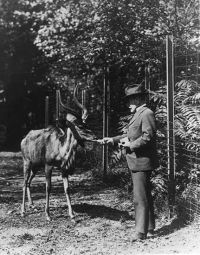 William T. Hornaday,
The Minds and Manners of Wild Animals…
“ The startled mule deer leaps out, jumps a hundred feet or more at a great pace, then foolishly stops and looks back, to gratify his curiosity. That is the hunter's chance; and that fatal desire for accurate information has been an important contributory cause to the extermination of the mule deer, or Rocky Mountain "black-tail," throughout large areas. In the Yellowstone Park the once-wild herds of mule deer have grown so tame under thirty years of protection that they completely overrun the parade ground, the officers' quarters, and even enter porches and kitchens for food. ”
Edward William Nelson, Wild Animals of North America
“ They have little of the protective caution so characteristic of the white-tails, and when a shot is fired at a band they often begin a series of extraordinary “buck jumps,” bounding high in the air, facing this way and that, sometimes not taking fight until after several additional shots have been fired. These high, bounding leaps are characteristic of mule deer and are commonly made when the animals are suddenly alarmed and often when they are in full flight through brushy thickets. ”
The Living Animals of the World…
“ The Mule-deer, found in most parts of North America west of the Missouri, as far south {297}as Southern California, stands about 3 feet 3 inches at the shoulder, and weighs over 17 stone clean. It carries good antlers, measuring as much as 30 inches, and in colour is tawny red in summer, brownish grey in winter. It is a far better sporting animal than the sneaking white-tailed deer, and affords excellent stalking. These deer are still abundant in many localities. ”
Edwin C. Alberts, Rocky Mountain National Park, Colorado
“ Although elk, especially the bulls, occasionally stay high in the deep-snow belt, most of them feed in lower meadows during winter.It should be easier to find MULE DEER, a familiar sight in many areas in early morning or evening, even in midsummer. Hikers encounter them on the trails throughout the park. When startled, the mule deer takes flight, characteristically bounding from all four feet at once, making soaring leaps, and landing with such force that its feet make a drumming sound. ”
William T. Hornaday,
The Minds and Manners of Wild Animals…
“ The white-tailed deer saves its life by skulking low in timber and thick brush. This is why it so successfully resists the extermination that has almost swept the mule deer, antelope, white goat, moose and elk from all the hunting-grounds of the United States. Thanks to its alertness in seeing its enemies first, its skill and quickness in hiding, and its mental keenness in recognizing and using deer sanctuaries, the white- tailed or "Virginia" deer will outlive all the other hoofed animals of North America. ”
 Mayne Reid,
The Hunters' Feast: Conversations Around the Camp Fire
“ Their form, however, as well as their size, colour, and markings, leave no doubt of their being specifically distinct not only from the latter, but from each other. Indeed, there are two varieties of the black-tails, differing in some respects, although both have the dark hair upon the tail, and the long ears, which so much distinguish them from other deer. The great length of their ears gives to their heads something of a “mulish” look—hence they are often known among the trappers by the name of “mule deer.” ”
 George Bird Grinnell,
Musk-Ox, Bison, Sheep and Goat
“ White-tail deer are greatly attached to particular localities, and when undisturbed, confine their wanderings within very narrow limits. Even if thoroughly frightened, and driven to a considerable distance, they soon return. If an old white-tail buck is run [Pg 142] with dogs, he may make a long chase, and cover a wide stretch of country, but to-morrow he will probably be found in his old home. In the same way, mule deer, mountain sheep, white goats, and antelope show their attachment for localities, and unless persistently disturbed, wander but little. ”
Edwin C. Alberts, Rocky Mountain National Park, Colorado
“ Few shed antlers, therefore, are seen by visitors to the park.26 Mule deer are common. The fawns, born in early June, are spotted when young. Male bighorn display the horns that have made them famous.27In summer, mule deer are seen singly or in small groups, browsing in the higher country; like the elk, they descend into the lower meadows in autumn. They, too, find the winter difficult, because of limited range. Deer are browsing animals, eating such things as willow, aspen, antelope bitterbrush, and even pine needles. ”
Various, St. Nicholas Vol. XIII, September…
“ The white-tailed deer is small and much like the antelope in color, but has a far more sleek and handsome coat. The black-tailed or mule deer is twice as large as its white-tailed cousin, and wears a quaker-colored coat, which in summer is tinged with brown. Sometimes, on horseback, I have met the deer in the mountains without giving them any alarm, and we have stood and gazed at one another at our leisure, just to satisfy curiosity. But they know that a man on foot or carrying a rifle is a dangerous creature, and they never stop long to look at him. ”
William T. Hornaday,
Popular Official Guide to the New York Zoological Park…
“ The Mule Deer makes its home in rugged ravines and bad lands so common along the creeks and rivers of the Rocky Mountain region, extending well eastward into the plains. Of late years it has been driven out of the most accessible of its former haunts, and forced to take shelter in the rugged fastnesses of the foothills and mountains. ”
Writers' Program of the Work Progress Administration, Washington, A Guide to the Evergreen State (1941)
“ The size of individual catches determines the prize winner. The hunter seeking big game will find bear, cougar, and deer in the mountainous country. In deer season, which seldom lasts more than 15 days, the bag is limited to one buck; the law also forbids slaying a doe and the use of dogs. The mule deer, averaging 140 pounds dressed, is found on nearly all the islands of Puget Sound; the larger whitetail, dressing from 250 to 300 pounds, roams the Cascades. ”
Hunting in Many Lands: The Book of the Boone and Crockett Club
“ The tail is that of the ordinary mule-deer, or blacktail, of Colorado and Montana, but there is no white patch on the rump.The most of the deer in Lower, as well as in Southern, California have little white on their rumps, as in these specimens, but the upper surface of the tail is generally dark. The majority of the animals also are smaller than the typical mule-deer of our Northern States, but whether the differences between the two are great enough and constant enough to form a defined variety, some more competent naturalist must decide. ”
 John Muir,
The Mountains of California
“ Even the wild sheep, the best mountaineers of all, choose regular passes in making journeys across the summits. Deer seldom cross the range in either direction. I have never yet observed a single specimen of the mule-deer of the Great Basin west of the summit, and rarely one of the black-tailed species on the eastern slope, notwithstanding many of the latter ascend the range nearly to the summit every summer, to feed in the wild gardens and bring forth their young. ”
William T. Hornaday,
Our Vanishing Wild Life: Its Extermination and Preservation
“ Since last winter's great slaughter in northwestern Montana, of 11,000 hungry deer, the species has been so reduced that it is no longer right to kill mule deer anywhere in our country, and a universal close season for five years is the duty of every state which contains that species. ”
The Living Animals of the World…
“ But it is not a little surprising that the species from warm climates should flourish in damp and cold ones. The axis deer would be a real addition to the fauna of the great European forests, if it is found that it survives the winter snows without some form of artificial shelter. No one seems to have considered the advisability of introducing the mule-deer into the Central European woods. It is a much finer animal than the fallow buck, and the venison is excellent. ”
Anonymous, Cactus Forest Drive, Saguaro National Monument
“ Mexican Mule Deer—Most people are accustomed to thinking of deer as animals of the forest, but surprisingly enough the rough foothill country in the desert supports a large population of deer. The Mule Deer is a true vegetarian and during the fall and winter browses extensively on trees and shrubs and during spring and summer consumes a variety of grasses and herbs. The young are born in late spring or summer and the fawns are sometimes seen at that time of year. ”
The Living Animals of the World…
“ In those woods where fallow deer are preserved in a wild state, as on many of the German Emperor's sporting-estates, the mule-deer would be a far more ornamental animal. Few people know what immense herds of red and fallow deer, as well as of wild boars, still exist, under careful preservation, in the forests of the great German, Austrian, and Russian princes, and in the royal forests of their respective countries. ”
 Lafayette Houghton Bunnell,
Discovery of the Yosemite, and the Indian War of 1851…
“ A mule is the best of sentinels to alarm a camp on the approach of danger. Deer and elk whistle and strike the earth perpendicularly with their feet when jumping up to discover the cause of alarm. Deer and antelope are both so inquisitive, that if the hunter has not been seen, or has been but imperfectly seen, by dropping into the grass or brush, and raising some object to view and suddenly withdrawing it, the deer or antelope will frequently come up within a few feet of the object. ”
James P. Gilligan, Wild Animals of the Rockies
“ These fights consist of the males horning and pushing one another around for short periods, when the stronger buck will finally throw the other off his feet and gore him with sharp, pointed antlers until he leaves. Mule deer herd together in the winter, feeding on aspen leaves and branches, and pawing away the snow from low bushes and shrubs to obtain their preferred diet. When the snow has melted on the steep south slopes 22 in early June, they break up into little bands and scatter to the four winds. ”
Abijah Long, The Big Cave (1956)
“ Among these are the gray mule deer, still found in the narrow gulches and on top of rocky ridges, jack rabbits which continue to multiply and dart rapidly hither and thither, being most noticeable at dusk, rock squirrels which dwell primarily in the rocky cliffs, and numerous kinds of rats which seem to have little trouble eking out an existence. ”
Various, The Nursery, April 1878, Vol. XXIII. No…
“ With this purpose, the deer will often make enormous leaps, or run around in a circle so as to confuse and puzzle his pursuers. He will mount a stone wall, and run along it for some distance, well aware that the dog cannot scent him so well on the rock as on the grass. If he can find a pond or stream of water, the deer will plunge in and swim a long distance, so that the dogs may lose his trail.It is a joyful sound to the poor hunted deer when the dogs send up that sad, dismal howl, which they give utterance to when they have lost all scent of the deer, and despair of finding it. ”
American Big Game in Its Haunts…
“ In many places the hills are covered with an almost impenetrable chaparral of scrub oak, buckthorn, greasewood, manzanita, and deer-brush, in which the wary deer have taken refuge. In and through these, guided sometimes by the tracks of the deer, or encouraged by the presence of such tracks even if he cannot follow them, up steep mountains, exposed to the heat of the sun, in dust, over rocks, and without water, toils the hunter, who accounts himself lucky if, by tramping scores of miles through this sort of impediment, he succeeds, after days of toil, in killing his deer. ”
 Eugène Sue,
The Mysteries of Paris, illustrated with etchings…
“ Occasionally a more animated scene presents itself; distant echo gives out the faint sound of the hunting-horn, and the cry of hounds; suddenly a frightened deer bursts from the neighbouring forest, stands for a few seconds in terrified alarm upon the frozen plain, then darts onward, and is quickly lost amid the thickets on the opposite side. The trampling of horses, the barking of dogs, are rapidly brought nearer by the breeze; and now, in their turn, a pack of dogs with brown and tawny-spotted skins issue from the brushwood from which the frightened deer but just now came ”
baron de Jean-Baptiste-Barthélemy Lesseps, Travels in Kamtschatka, during the years 1787 and 1788…
“ In these sportive amusements the tame deer gradually draws his prey within musquet shot of the hunter. With a well managed deer, one is able to seize his companion alive; a cord is hung upon the horns of the former, which, in their play, he entangles in the horns of his adversary. From that time the greater the efforts made by the wild deer to escape, the closer the running knot is drawn, and the more strongly the tame deer pulls at the cord, in order to give his master time to come up. It frequently happens however that the wild deer suspects the trick, and escapes the danger by flight. ”
 John James Audubon,
Audubon and His Journals, Volume 2
“ The Deer is heard coming. It has inadvertently cracked a dead stick with its hoof, and the dogs are now so near 472 that it will pass in a moment. There it comes! How beautifully it bounds over the ground! What a splendid head of horns! How easy its attitudes, depending, as it seems to do, on its own swiftness for safety! All is in vain, however; a gun is fired, the animal plunges and doubles with incomparable speed. There he goes! He passes another stand, from which a second shot, better directed than the first, brings him to the ground. ”
Related terms
Authors who wrote about “mule deer”
William T. HornadayHarvey Riley Randolph B. MarcyRussell K. GraterWilliam ClarkSaxton T. Popebaron de Jean-Baptiste-Barthélemy Lesseps
 William J. LongMayne ReidEdward Kay RobinsonWilliam NowlinJames P. GilliganWalter Woelber DalquestOrange JacobsLeo E. MillerMartin HunterEdgar Fritz RandolphJohn H. Dixon
 Henry William HerbertGeorge Bird Grinnell
