Petroglyph

Definition and stakes

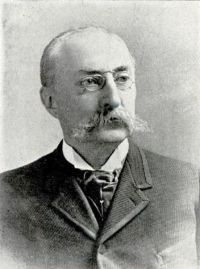
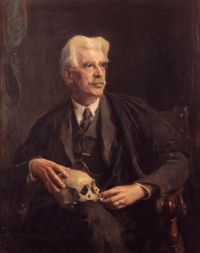
Portrait of Garrick Mallery Garrick Mallery,  Picture-Writing of the American Indians

“ Upon the western wall of this passageway is a collection of the colored sketches of which Fig. 983 is a reduced copy. The entire face of the rock upon which the pictograph occurs measures about 12 or 15 feet in width and 8 in height. The largest human figure measures 6 feet in height, from the end of the toes to the top of the head, the others being in proportion as represented.
Fig. 12.—Petroglyph at Tule river, California.
“Upon the ceiling are a number of well executed drawings of the beaver, bear, centipede (Fig. 12) , and bald eagle (Fig. 13) .
”
Source: Gutenberg

Portrait of Garrick Mallery Garrick Mallery,  Picture-Writing of the American Indians

“ Interest has been felt in petroglyphs, because it has been supposed that if interpreted they would furnish records of vanished peoples or races, and connected with that supposition was one naturally affiliated that the old rock sculptures were made by peoples so far advanced in culture as to use alphabets or at least syllabaries, thus supporting [773] the theory about the mythical mound builders or some other supposititious race. ”
Source: Gutenberg

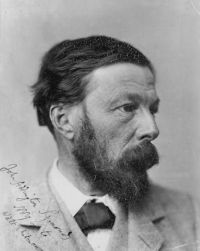
Portrait of Alfred C. Haddon Alfred C. Haddon,  Evolution in Art: As Illustrated by the Life-histories of Designs

“ As petroglyphs are much more permanent than pictographs on more perishable materials, they are more likely to be preserved from ancient times, but it is probable that the latter were actually of more frequent occurrence.
There is no single system of pictography. Everywhere a figure of a man means a man, and that of a tree stands for a tree, and to this extent pictographs can be deciphered by any one.
”
Source: Gutenberg

Get perspective with Kwize: daily news enlightened by great literature