Summary

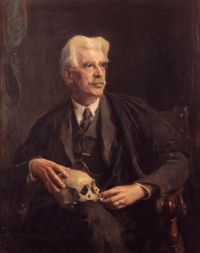
Portrait of Alfred C. Haddon Alfred C. Haddon Evolution in Art: As Illustrated by the Life-histories of Designs

In future those who write on decorative art will have to prove that any pattern or design is a purely arbitrary form; that assumption is no longer permissible.
We have left the lotus far behind, and though it is hard to believe that the multitudinous designs of so many ages and of such diverse countries are all derived from the sacred flower of Ancient Egypt, yet it may well be that the oldest stock was a lotus derivative, and that the symbolism of that flower gave to it sufficient vitality to spread and multiply and replenish the earth.
Source: Gutenberg

Portrait of Alfred C. Haddon Alfred C. Haddon Evolution in Art: As Illustrated by the Life-histories of Designs

If the originating artist lost something out of his own handiwork, it is no wonder that a copyist should lose more, especially when the latter may not have access to the original, but base his reproductions on copies several times removed from it. A late stage of degeneration of pictorial art, through more or less incompetent copying, is seen in the cheap lithographs which occupy, without adorning, the walls of houses of the country folk, many of which, like the analogous frescoes of Pompeii, are the pictorial echoes of the works of masters of the craft.
Source: Gutenberg

Portrait of Alfred C. Haddon Alfred C. Haddon Evolution in Art: As Illustrated by the Life-histories of Designs

I have already suggested that the isolation of a people and uniformity in their existence will tend to stagnation in art, and that intercourse with other peoples, whether by trade, war or migration, serves as a stimulus to artistic expression.
To return to our more immediate subject, consciousness of purpose has extremely little to do with human evolution, nor has it much more to say to the evolution of patterns among primitive peoples.
Source: Gutenberg

Get perspective with Kwize: daily news enlightened by great literature