 Arthur Schopenhauer,
The Essays of Arthur Schopenhauer…
Arthur Schopenhauer,
The Essays of Arthur Schopenhauer…
“ The power of religious dogma, when inculcated early, is such as to stifle conscience, compassion, and finally every feeling of humanity. ”
Arthur Schopenhauer,
The Essays of Arthur Schopenhauer…
“ The power of religious dogma, when inculcated early, is such as to stifle conscience, compassion, and finally every feeling of humanity. ”
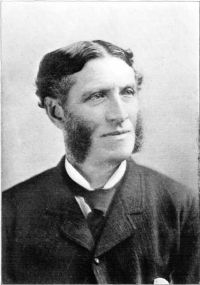 Matthew Arnold,
Literature and Dogma
(1883)
Matthew Arnold,
Literature and Dogma
(1883)
“ Nothing is more common, indeed, than for religious writers, who have a strong sense of the genuine and moral side of Christianity, and who much enlarge on the preeminence of this, to put themselves right, as it were, with dogmatic theology, by a passing sentence expressing profound belief in its dogmas, though in discussing them, it is implied, there is little profit. ”
 François Guizot,
Meditations on the Essence of Christianity…
François Guizot,
Meditations on the Essence of Christianity…
“ The dogmas of Creation and Providence bring us into the presence of God; it is the action of God upon the world and man that they proclaim and affirm. The dogma of Original Sin brings us back to man; it is the act of man towards God, which stands at the very beginning of the history of mankind. ”
Baron John Francis Arundell Arundell of Wardour, Tradition, Principally with Reference to Mythology and the Law of Nations
“ Philosophy alone is not religion, nor is sentiment alone religion; but religion is that which, based on an intelligent principle, teaches that principle as dogma, exhibits it in worship, and applies it in discipline. Dogma worship and discipline are the constituents, so to speak, the mind spirit, and body of religion.”—“Origin and Development of Religious Belief.” By S. Baring Gould, M.A. Rivingtons, 1869. Part i., p. 119.Here it is said that “religion is the representative of a philosophic idea. It always reposes on some hypothesis.” ”
François Guizot,
Meditations on the Essence of Christianity…
“ One leading and common characteristic in these dogmas strikes me at the outset: they deal frankly with the religious problems natural to and inherent in man, and offer at once the solution. {17} The dogma of Creation attests the existence of God, as Creator and Legislator, and it attests also the link which unites man with God. The dogma of Providence explains and justifies prayer, that instinctive recourse of man to the living God, to that supreme Power which is ever present with him in life, and which influences his destiny. ”
“ Hence, Venerable Brethren, springs that ridiculous proposition of the Modernists, that every religion, according to the different aspect under which it is viewed, must be considered as both natural and supernatural. Hence it is that they make consciousness and revelation synonymous. Hence the law, according to which religious consciousness is given as the universal rule, to be put on an equal footing with revelation, and to which all must submit, even the supreme authority of the Church, whether in its teaching capacity, or in that of legislator in the province of sacred liturgy or discipline. ”
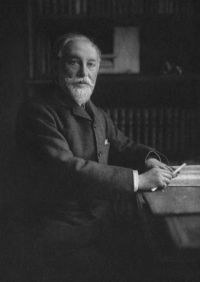 Frederic Harrison,
Popular Science Monthly
(1884)
Frederic Harrison,
Popular Science Monthly
(1884)
“ Let us take each one of these three elements of religion—belief, worship, conduct—and try them all in turn as applicable to the Unknowable. How mere a phrase must any religion be of which neither belief, nor worship, nor conduct can be spoken! Imagine a religion which can have no believers, because, ex hypothesi, its adepts are forbidden to believe anything about it. Imagine a religion which excludes the idea of worship, because its sole dogma is the infinity of Nothingness. ”
 Kersey Graves,
The World's Sixteen Crucified Saviors…
Kersey Graves,
The World's Sixteen Crucified Saviors…
“ The most important lesson deducible from all the religious systems, commemorated in history, and noticed in this work, is, that all religious conceptions, whether in the shape of doctrine, precept, prophecy, prayer, religious devotion, or a belief in miracles, are a spontaneous outgrowth of the moral and religious elements of the human mind. And to assign them a higher origin is to ignore the developments of modern science, and insult the highest intelligence of the age. ”
Great leaders: Historic portraits from the great historians
“ The author defines his purpose as an attempt to trace that spirit which ‘leads men on all occasions to subordinate dogmatic theology to the dictates of reason and of conscience, and, as a necessary consequence, to restrict its influence upon life’—which predisposes men, in history, to attribute all kinds of phenomena to natural rather than miraculous causes; in theology, to esteem succeeding systems the expressions of the wants and aspirations of that religious sentiment which is planted in all men ”
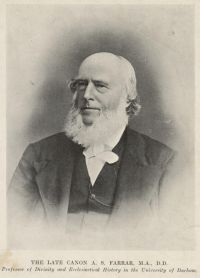 Adam Storey Farrar,
History of Free Thought in Reference to The Christian Religion
Adam Storey Farrar,
History of Free Thought in Reference to The Christian Religion
“ The ethical element of Christianity becomes elevated above the dogmatic. The sermon on the mount is regarded as the very soul of Christ's teaching. And in looking forward to the future of Christianity, the Christian religion is considered likely to become the religion of the world, merely because it will have ceased to be the religion of form and dogma, and become the highest type of ethics. ”
Sarah E. Wall, Orange Grove (1866)
“ When a doctrine has been enforced upon it as an essential article of religious faith which it could never reconcile with itself, it begins to question whether there is any such principle as religious faith, and what its value to the soul when it involves such absurdities. ”
Various, The Catholic World, Vol. 07, April 1868 to September…
“ At most, we have only taken account of that part of the book where the limits of science, the belief in the supernatural, and especially the marvellous harmony between Christian dogmas and religious problems, that are innate to man, are treated with so much wisdom and authority. ”
Matthew Arnold,
Literature and Dogma
(1883)
“ And shake the belief in the One God in Trinity and Trinity in Unity, the belief in righteousness is shaken, it is thought, also. Whereas righteousness and the God of righteousness, the God of the Bible, are in truth quite independent of the God of ecclesiastical dogma, the work of critics of the Bible,—critics understanding neither what they say nor whereof they affirm. ”
 John H. Stapleton,
Explanation of Catholic Morals
John H. Stapleton,
Explanation of Catholic Morals
“ BELIEVING AND DOING.MORALS pertain to right living, to the things we do, in relation to God and His law, as opposed to right thinking, to what we believe, to dogma. Dogma directs our faith or belief, morals shape our lives. By faith we know God, by moral living we serve Him; and this double homage, of our mind and our works, is the worship we owe our Creator and Master and the necessary condition of our salvation.Faith alone will save no man. ”
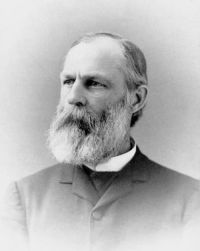 Crawford Howell Toy,
Introduction to the History of Religions
Crawford Howell Toy,
Introduction to the History of Religions
“ The old myths are retained, but they are purified, humanized, and allegorized, and in some cases applied, to new persons and events, according to changes in religious construction.1158. The next phase is the recognition by science of the absolute domination of natural law in the world of phenomena. Religion, when it accepts this view, holds fast to the belief in the ultimate personal moral Force, and conceives of this Force as working and expressing and manifesting itself only in phenomena in accordance with natural law—that is, this law is regarded as the expression of the divine will. ”
 Theodore Parker,
The Collected Works of Theodore Parker
(1876)
Theodore Parker,
The Collected Works of Theodore Parker
(1876)
“ To answer the question, we must go back to the primitive facts of religious consciousness within us. Then we find religion is voluntary obedience to the law of God, inward and outward obedience to that law he has written on our nature, revealed in various ways through Instinct, Reason, Conscience, and the Religious emotions. Through it we regard Him as the absolute object of Reverence, Faith, and Love. ”
Various, British Quarterly Review, American Edition…
“ But he maintains the great position that all other religions are limited in their range of thought, and in their adaptability to man; while Christianity includes within itself the sum of all religious truth, the nexus of all justifiable religious tendencies, the correction of all extravagances, the answer and solvent to all human inquiry. ”
William James, The Varieties of Religious Experience…
“ Worship and sacrifice, procedures for working on the dispositions of the deity, theology and ceremony and ecclesiastical organization, are the essentials of religion in the institutional branch. Were we to limit our view to it, we should have to define religion as an external art, the art of winning the favor of the gods. In the more personal branch of religion it is on the contrary the inner dispositions of man himself which form the centre of interest, his conscience, his deserts, his helplessness, his incompleteness. ”
Freiherr von Friedrich Hügel, The Mystical Element of Religion…
“ Such special, characteristic Revelations, Doctrines and Institutions, as we find them in all the great Historical Religions, and in their full normative substance and form in Christianity and Catholicism, can indeed alone completely develop, preserve and spread Religion in its depth and truth; yet they ever presuppose a general, usually dim but most real, religious sense and experience, indeed a real presence and operation of the Infinite and of God in all men. ”
William James, The Varieties of Religious Experience (1902)
“ Wherever this interior prayer is lacking, there is no religion; wherever, on the other hand, this prayer rises and stirs the soul, even in the absence of forms or of doctrines, we have living religion. One sees from this why 'natural religion,' so-called, is not properly a religion. It cuts man off from prayer. ”
François Guizot,
Meditations on the Essence of Christianity…
“ For myself, arrived at the term of a long life, one of labour, of reflection, and of trials,—of trials in thought as well as in action,—I am convinced that, the Christian dogmas are the legitimate and satisfactory solutions of those religious problems which, as I have said, nature suggests and man carries in his own breast, and from which he cannot escape. ”
 Harold Frederic,
The Damnation of Theron Ware
Harold Frederic,
The Damnation of Theron Ware
“ With you, of course, it is different. You have a thousand things to interest and pleasantly occupy you in your work and its ceremonies, so that mere belief or non-belief in the dogma hardly matters. But in our church dogma is everything. ”
Kersey Graves,
The Bible of Bibles; Or, Twenty-Seven "Divine" Revelations
“ It should be borne in mind, that all the dogmas and doctrines of our current religious faith originated at a period before the sun of science had risen above the moral horizon, and anterior to the birth of moral science, and hence, like other productions of that age, are heavily laden with error. ”
International Congress of Arts and Science…
“ The fourth problem arises, when we examine the rational law of the religious nature or of the having of religion which lies in the being and organization of the reason. The having of religion may be demonstrated as a law of the normal consciousness from the immanent feeling of necessity and obligation which properly belongs to religion, and from its organic place in the economy of consciousness, which receives its concentration and its relation to an objective world-reason only from religion. ”
Crawford Howell Toy,
Introduction to the History of Religions
“ The ethical side of religion corresponds to the general ethical standard of the people—in savages it is low, but it exists. (5) The conception of salvation as the goal of religious faith and service; the salvation looked for is at first physical, is gradually moralized, and ultimately takes the form of spiritual union with the deity. These are the essential elements of religion; they all exist in crude form in the lowest strata of society, and are purified in the course of social growth. ”
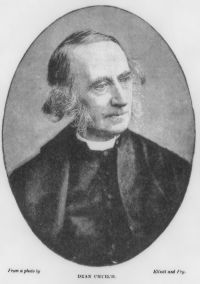 R. W. Church,
Occasional Papers
R. W. Church,
Occasional Papers
“ From the age of fifteen dogma has been the fundamental principle of my religion; I know no other religion. I cannot enter into the idea of any other sort of religion; religion, as a mere sentiment, is to me a dream and a mockery. As well can there be filial love without the fact of a father, as devotion without the fact of a Supreme Being. ”
William James, The Varieties of Religious Experience (1902)
“ In our last lecture we had a glimpse of the way in which a platonizing writer like Emerson may treat the abstract divineness of things, the moral structure of the universe, as a fact worthy of worship. In those various churches without a God which to-day are spreading through the world under the name of ethical societies, we have a similar worship of the abstract divine, the moral law believed in as an ultimate object. 'Science' in many minds is genuinely taking the place of a religion. ”
William Evans, The Great Doctrines of the Bible
“ Yet, the doctrine of the fall has a relation to Christianity that it does not have to other religions, or religious systems. The moral character of God as seen in the Christian religion far surpasses the delineation of the Supreme Being set forth in any other religion, and thus heightens and intensifies its idea of sin. ”
 Josiah Royce,
The Religious Aspect of Philosophy
(1885)
Josiah Royce,
The Religious Aspect of Philosophy
(1885)
“ A religion must teach some moral code, must in some way inspire a strong feeling of devotion to that code, and in so doing must show something in the nature of things that answers to the code or that serves to reinforce the feeling. A religion is therefore practical, emotional, and theoretical; it teaches us to do, to feel, and to believe, and it teaches the belief as a means to its teaching of the action and of the feeling. ”
 Andrew Dickson White,
History of the Warfare of Science with Theology in Christendom
Andrew Dickson White,
History of the Warfare of Science with Theology in Christendom
“ A true and noble theology can hardly fail to recognise, in the love of Nature and care for our fellow-men thus promoted, something far better, both from a religious and a moral point of view, than any efforts to win the Divine favour by flattery, or to avert Satanic malice by fetichism. ”
Various, The Catholic World, Vol. 26, October…
“ The certainties of reason, of history and experience, of the judgments of the human conscience, of divine revelation, of Catholic authority, of the common sense of mankind, are amply sufficient for refuting every kind of infidel or heretical error which cloaks itself under a scientific pretext, and for proving and defending all that belongs to sacred dogma in faith or morals, or is in proximate connection with it. Unity and harmony in these things need not be disturbed by differences and discussions respecting all manner of scientific questions. ”
William James, The Varieties of Religious Experience (1902)
“ Religion, therefore, as I now ask you arbitrarily to take it, shall mean for us the feelings, acts, and experiences of individual men in their solitude, so far as they apprehend themselves to stand in relation to whatever they may consider the divine. Since the relation may be either moral, physical, or ritual, it is evident that out of religion in the sense in which we take it, theologies, philosophies, and ecclesiastical organizations may secondarily grow. ”
 Karl Rosenkranz,
Pedagogics as a System
Karl Rosenkranz,
Pedagogics as a System
“ The religious spirit, the consciousness of the Absolute, and the reverence for it, should permeate all. Not unfrequently, however, we find that what is meant by religion is theology, or the church ceremonial, and these are only one-sided phases of the total religious process. ”
George Bethune English, The Grounds of Christianity Examined by Comparing The New Testament with the Old
“ The grand principle of men considered as having relation to the Deity, and under an obligation to be religious, is, that they ought to consult their reason, and seek every where for the best instruction; and of Christians and Protestants the duty, and professed principle is, to consult reason and the Scripture, as the rule of their faith and practice. ”
Adam Storey Farrar,
History of Free Thought in Reference to The Christian Religion
“ Christianity offers occasion for opposition by its inherent claims, independently of accidental causes. For it asserts authority over religious belief in virtue of being a supernatural communication from God, and claims the right to control human thought in virtue of possessing sacred books which are at once the record and the instrument of this communication, written by men endowed with supernatural inspiration. ”
Matthew Arnold,
Literature and Dogma
(1883)
“ But instantly there will be raised the objection that this is morality, not religion; morality, ethics, conduct, being by many people, and above all by theologians, carefully contradistinguished from religion, which is supposed in some special way to be connected with propositions about the Godhead of the Eternal Son, or propositions about the personality of God, or about election or justification. Religion, however, means simply either a binding to righteousness, or else a serious attending to righteousness and dwelling upon it. ”
William James, The Varieties of Religious Experience (1902)
“ And although the favor of the God, as forfeited or gained, is still an essential feature of the story, and theology plays a vital part therein, yet the acts to which this sort of religion prompts are personal not ritual acts, the individual transacts the business by himself alone, and the ecclesiastical organization, with its priests and sacraments and other go-betweens, sinks to an altogether secondary place. ”
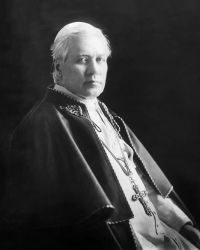 Pope Pius XJosef DonatWilliam JamesVariousFrançois GuizotKersey GravesMatthew ArnoldAdam Storey FarrarCrawford Howell ToyAndrew Dickson WhiteFrederic HarrisonBaron John Francis Arundell Arundell of WardourTheodore ParkerArthur SchopenhauerFreiherr von Friedrich HügelHarold FredericR. W. ChurchWilliam EvansKarl RosenkranzGeorge Bethune English