“ Let us for a moment put the question: if experiences have so much value in their eyes, why do they not attach equal weight to the experience that thousands upon thousands of Catholics have that the Modernists are on the wrong road? It is, perchance, that all experiences except those felt by the Modernists are false and deceptive? The vast majority of mankind holds and always will hold firmly that sentiment and experience alone, when not enlightened and guided by reason, do not lead to the knowledge of God. What remains, then, but the annihilation of all religion, - atheism? ”
Summary
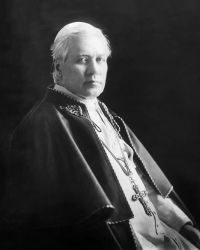
"Pascendi," an encyclical issued by Pope Pius X in 1907, addresses the challenges posed by Modernism to Catholic doctrine, condemning its perceived blending of faith with secular thought and its weakening of ecclesiastical authority. Written in response to intellectual trends undermining traditional dogma, the text critiques Modernists for equating religious experience with personal emotion, arguing that such views threaten the objective truth of the Church’s teachings.
Central themes include the conflict between reason and immanence, the role of Sacred Scripture, and the necessity of the Church’s magisterium in safeguarding doctrinal purity. Through strong rebukes of "false philosophy" and appeals to adhere to scholastic tradition, the encyclical asserts that Modernism’s rejection of absolute truth ultimately leads to atheism, framing the Church’s authority as an extension of shared religious conscience.
Quotes from Pascendi (Pope Pius X)
“ If we pass from the moral to the intellectual causes of Modernism, the first which presents itself, and the chief one, is ignorance. Yes, these very Modernists who pose as Doctors of the Church, who puff out their cheeks when they speak of modern philosophy, and show such contempt for scholasticism, have embraced the one with all its false glamour because their ignorance of the other has left them without the means of being able to recognise confusion of thought, and to refute sophistry. Their whole system, with all its errors, has been born of the alliance between faith and false philosophy. ”
“ They have no bitterness in their hearts against the authority which uses them roughly, for after all it is only doing its duty as authority. Their sole grief is that it remains deaf to their warnings, because delay multiplies the obstacles which impede the progress of souls, but the hour will most surely come when there will be no further chance for tergiversation, for if the laws of evolution may be checked for a while, they cannot be ultimately destroyed. And so they go their way, reprimands and condemnations notwithstanding, masking an incredible audacity under a mock semblance of humility. ”
“ For in the same way as the Church is a vital emanation of the collectivity of consciences, so too authority emanates vitally from the Church itself. Authority therefore, like the Church, has its origin in the religious conscience, and, that being so, is subject to it. Should it disown this dependence it becomes a tyranny. For we are living in an age when the sense of liberty has reached its fullest development, and when the public conscience has in the civil order introduced popular government. Now there are not two consciences in man, any more than there are two lives. ”
“ We speak, of course, of truth in itself - as for that other purely subjective truth, the fruit of sentiment and action, if it serves its purpose for the jugglery of words, it is of no use to the man who wants to know above all things whether outside himself there is a God into whose hands he is one day to fall. True, the Modernists do call in experience to eke out their system, but what does this experience add to sentiment? Absolutely nothing beyond a certain intensity and a proportionate deepening of the conviction of the reality of the object. ”
“ Were one to attempt the task of collecting together all the errors that have been broached against the faith and to concentrate the sap and substance of them all into one, he could not better succeed than the Modernists have done. Nay, they have done more than this, for, as we have already intimated, their system means the destruction not of the Catholic religion alone but of all religion. With good reason do the rationalists applaud them, for the most sincere and the frankest among the rationalists warmly welcome the modernists as their most valuable allies. ”
“ Hence, Venerable Brethren, springs that ridiculous proposition of the Modernists, that every religion, according to the different aspect under which it is viewed, must be considered as both natural and supernatural. Hence it is that they make consciousness and revelation synonymous. Hence the law, according to which religious consciousness is given as the universal rule, to be put on an equal footing with revelation, and to which all must submit, even the supreme authority of the Church, whether in its teaching capacity, or in that of legislator in the province of sacred liturgy or discipline. ”
“ In matters of religious sentiment and religious experience, you know, Venerable Brethren, how necessary is prudence and how necessary, too, the science which directs prudence. You know it from your own dealings with sounds, and especially with souls in whom sentiment predominates; you know it also from your reading of ascetical books - books for which the Modernists have but little esteem, but which testify to a science and a solidity very different from theirs, and to a refinement and subtlety of observation of which the Modernists give no evidence. ”
“ In matters of religion it is the duty of philosophy not to command but to serve, but not to prescribe what is to be believed but to embrace what is to be believed with reasonable obedience, not to scrutinise the depths of the mysteries of God but to venerate them devoutly and humbly. ”
“ First of all they lay down the general principle that in a living religion everything is subject to change, and must change, and in this way they pass to what may be said to be, among the chief of their doctrines, that of Evolution. To the laws of evolution everything is subject - dogma, Church, worship, the Books we revere as sacred, even faith itself, and the penalty of disobedience is death. The enunciation of this principle will not astonish anybody who bears in mind what the Modernists have had to say about each of these subjects. ”
“ Blind that they are, and leaders of the blind, inflated with a boastful science, they have reached that pitch of folly where they pervert the eternal concept of truth and the true nature of the religious sentiment ”
“ Moreover they lay the axe not to the branches and shoots, but to the very root, that is, to the faith and its deepest fires. And having struck at this root of immortality, they proceed to disseminate poison through the whole tree, so that there is no part of Catholic truth from which they hold their hand, none that they do not strive to corrupt. Further, none is more skilful, none more astute than they, in the employment of a thousand noxious arts; for they double the parts of rationalist and Catholic, and this so craftily that they easily lead the unwary into error ”
“ About philosophy, they tell you, they know nothing whatever - and in this they display remarkable astuteness, for they are particularly anxious not to be suspected of being prejudiced in favour of philosophical theories which would lay them open to the charge of not being objective, to use the word in vogue. And yet the truth is that their history and their criticism are saturated with their philosophy, and that their historico-critical conclusions are the natural fruit of their philosophical principles. ”
“ After this what is to become of the dogmas of the Church? The dogmas brim over with flagrant contradictions, but what matter that since, apart from the fact that vital logic accepts them, they are not repugnant to symbolical truth. Are we not dealing with the infinite, and has not the infinite an infinite variety of aspects? In short, to maintain and defend these theories they do not hesitate to declare that the noblest homage that can be paid to the Infinite is to make it the object of contradictory propositions! ”
“ Religion, whether natural or supernatural, must, like every other fact, admit of some explanation. But when Natural theology has been destroyed, the road to revelation closed through the rejection of the arguments of credibility, and all external revelation absolutely denied, it is clear that this explanation will be sought in vain outside man himself. It must, therefore, be looked for in man; and since religion is a form of life, the explanation must certainly be found in the life of man. Hence the principle of religious immanence is formulated. ”
“ Having reached this point, Venerable Brethren, we have sufficient material in hand to enable us to see the relations which Modernists establish between faith and science, including history also under the name of science. And in the first place it is to be held that the object of the one is quite extraneous to and separate from the object of the other. For faith occupies itself solely with something which science declares to be unknowable for it. Hence each has a separate field assigned to it: science is entirely concerned with the reality of phenomena, into which faith does not enter at all ”
“ Should anyone ask how it is that this need of the divine which man experiences within himself grows up into a religion, the Modernists reply thus: Science and history, they say, are confined within two limits, the one external, namely, the visible world, the other internal, which is consciousness. When one or other of these boundaries has been reached, there can be no further progress, for beyond is the unknowable. ”
“ In order to oppose a new answer to such accusations, which the history of the Christian religion refutes by never failing arguments, it is Our intention to establish and develop by every means in our power a special Institute in which, through the co-operation of those Catholics who are most eminent for their learning, the progress of science and other realms of knowledge may be promoted under the guidance and teaching of Catholic truth. God grant that we may happily realise our design with the ready assistance of all those who bear a sincere love for the Church of Christ. ”
“ Therefore, since God is the object of religion, we must conclude that faith, which is the basis and the foundation of all religion, consists in a sentiment which originates from a need of the divine. This need of the divine, which is experienced only in special and favourable circumstances, cannot, of itself, appertain to the domain of consciousness; it is at first latent within the consciousness, or, to borrow a term from modern philosophy, in the subconsciousness, where also its roots lies hidden and undetected. ”
“ Agnosticism tells us that history, like ever other science, deals entirely with phenomena, and the consequence is that God, and every intervention of God in human affairs, is to be relegated to the domain of faith as belonging to it alone. In things where a double element, the divine and the human, mingles, in Christ, for example, or the Church, or the sacraments, or the many other objects of the same kind, a division must be made and the human element assigned to history while the divine will go to faith. ”
“ They recognise that the three chief difficulties for them are scholastic philosophy, the authority of the fathers and tradition, and the magisterium of the Church, and on these they wage unrelenting war. For scholastic philosophy and theology they have only ridicule and contempt. Whether it is ignorance or fear, or both, that inspires this conduct in them, certain it is that the passion for novelty is always united in them with hatred of scholasticism, and there is no surer sign that a man is on the way to Modernism than when he begins to show his dislike for this system. ”
“ But it is not solely by objective arguments that the non-believer may be disposed to faith. There are also subjective ones at the disposal of the Modernists, and for those they return to their doctrine of immanence. They endeavour, in fact, to persuade their non-believer that down in the very deeps of his nature and his life lie the need and the desire for religion, and this not a religion of any kind, but the specific religion known as Catholicism, which, they say, is absolutely postulated by the perfect development of life. ”
“ It is therefore the right of philosophy and of science to form conclusions concerning the idea of God, to direct it in its evolution and to purify it of any extraneous elements which may become confused with it. Finally, man does not suffer a dualism to exist in him, and the believer therefore feels within him an impelling need so to harmonise faith with science, that it may never oppose the general conception which science sets forth concerning the universe. ”
“ Therefore the religious sentiment, which through the agency of vital immanence emerges from the lurking places of the subconsciousness, is the germ of all religion, and the explanation of everything that has been or ever will be in any religion. ”
“ The doctrine of the faith which God has revealed has not been proposed to human intelligences to be perfected by them as if it were a philosophical system, but as a divine deposit entrusted to the Spouse of Christ to be faithfully guarded and infallibly interpreted. Hence the sense, too, of the sacred dogmas is that which our Holy Mother the Church has once declared, nor is this sense ever to be abandoned on plea or pretext of a more profound comprehension of the truth. ”
“ It is pride which fills Modernists with that confidence in themselves and leads them to hold themselves up as the rule for all, pride which puffs them up with that vainglory which allows them to regard themselves as the sole possessors of knowledge, and makes them say, inflated with presumption, We are not as the rest of men, and which, to make them really not as other men, leads them to embrace all kinds of the most absurd novelties; it is pride which rouses in them the spirit of disobedience and causes them to demand a compromise between authority and liberty ”
“ Meanwhile, Venerable Brethren, fully confident in your zeal and work, we beseech for you with our whole heart and soul the abundance of heavenly light, so that in the midst of this great perturbation of men's minds from the insidious invasions of error from every side, you may see clearly what you ought to do and may perform the task with all your strength and courage. ”
“ It is impossible to approve in Catholic publications of a style inspired by unsound novelty which seems to deride the piety of the faithful and dwells on the introduction of a new order of Christian life, on new directions of the Church, on new aspirations of the modern soul, on a new vocation of the clergy, on a new Christian civilisation. ”
“ To ascertain the nature of dogma, we must first find the relation which exists between the religious formulas and the religious sentiment. This will be readily perceived by him who realises that these formulas have no other purpose than to furnish the believer with a means of giving an account of his faith to himself. These formulas therefore stand midway between the believer and his faith; in their relation to the faith, they are the inadequate expression of its object, and are usually called symbols; in their relation to the believer, they are mere instruments. ”
“ When an adversary rises up against them with an erudition and force that render him redoubtable, they try to make a conspiracy of silence around him to nullify the effects of his attack, while in flagrant contrast with this policy towards Catholics, they load with constant praise the writers who range themselves on their side, hailing their works, excluding novelty in every page, with choruses of applause; for them the scholarship of a writer is in direct proportion to the recklessness of his attacks on antiquity, and of his efforts to undermine tradition and the ecclesiastical magisterium ”
“ When a Catholic laymen or a priest forgets that precept of the Christian life which obliges us to renounce ourselves if we would follow Jesus Christ and neglects to tear pride from his heart, ah! but he is a fully ripe subject for the errors of Modernism. Hence, Venerable Brethren, it will be your first duty to thwart such proud men, to employ them only in the lowest and obscurest offices; the higher they try to rise, the lower let them be placed, so that their lowly position may deprive them of the power of causing damage. ”
“ But it is pride which exercises an incomparably greater sway over the soul to blind it and plunge it into error, and pride sits in Modernism as in its own house, finding sustenance everywhere in its doctrines and an occasion to flaunt itself in all its aspects. ”
“ Take away the intelligence, and man, already inclined to follow the senses, becomes their slave. Vain, too, from another point of view, for all these fantasias on the religious sentiment will never be able to destroy common sense, and common sense tells us that emotion and everything that leads the heart captive proves a hindrance instead of a help to the discovery of truth. ”
“ To this must be added the fact, which indeed is well calculated to deceive souls, that they lead a life of the greatest activity, of assiduous and ardent application to every branch of learning, and that they possess, as a rule, a reputation for the strictest morality. Finally, and this almost destroys all hope of cure, their very doctrines have given such a bent to their minds, that they disdain all authority and brook no restraint; and relying upon a false conscience, they attempt to ascribe to a love of truth that which is in reality the result of pride and obstinacy. ”
“ Thus the way is open to the intrinsic evolution of dogma. An immense collection of sophisms this, that ruins and destroys all religion. Dogma is not only able, but ought to evolve and to be changed. This is strongly affirmed by the Modernists, and as clearly flows from their principles. For amongst the chief points of their teaching is this which they deduce from the principle of vital immanence; that religious formulas, to be really religious and not merely theological speculations, ought to be living and to live the life of the religious sentiment. ”
“ We allude, Venerable Brethren, to many who belong to the Catholic laity, nay, and this is far more lamentable, to the ranks of the priesthood itself, who, feigning a love for the Church, lacking the firm protection of philosophy and theology, nay more, thoroughly imbued with the poisonous doctrines taught by the enemies of the Church, and lost to all sense of modesty, vaunt themselves as reformers of the Church ”
“ You must start with the supposition that the Church has its birth in a double need, the need of the individual believer, especially if he has had some original and special experience, to communicate his faith to others, and the need of the mass, when the faith has become common to many, to form itself into a society and to guard, increase, and propagate the common good. ”
“ Hence, studying more closely the ideas of the Modernists, evolution is described as resulting from the conflict of two forces, one of them tending towards progress, the other towards conservation. The conserving force in the Church is tradition, and tradition is represented by religious authority, and this both by right and in fact; for by right it is in the very nature of authority to protect tradition, and, in fact, for authority, raised as it is above the contingencies of life, feels hardly, or not at all, the spurs of progress. ”
“ In the same way, then, as faith and science are strangers to each other by reason of the diversity of their objects, Church and State are strangers by reason of the diversity of their ends, that of the Church being spiritual while that of the State is temporal. ”
“ But let us see how the Modernist conducts his apologetics. The aim he sets before himself is to make the non-believer attain that experience of the Catholic religion which, according to the system, is the basis of faith. There are two ways open to him, the objective and the subjective. The first of them proceeds from agnosticism. It tends to show that religion, and especially the Catholic religion, is endowed with such vitality as to compel every psychologist and historian of good faith to recognise that its history hides some unknown element. ”
“ If the Modernists have not yet reached this point, they do ask the Church in the meanwhile to be good enough to follow spontaneously where they lead her and adapt herself to the civil forms in vogue. Such are their ideas about disciplinary authority. But far more advanced and far more pernicious are their teachings on doctrinal and dogmatic authority. This is their conception of the magisterium of the Church: No religious society, they say, can be a real unit unless the religious conscience of its members be one, and one also the formula which they adopt. ”
“ But how the Modernists make the transition from Agnosticism, which is a state of pure nescience, to scientific and historic Atheism, which is a doctrine of positive denial; and consequently, by what legitimate process of reasoning, starting from ignorance as to whether God has in fact intervened in the history of the human race or not, they proceed, in their explanation of this history, to ignore God altogether, as if He really had not intervened, let him answer who can. ”
Common terms
Similar works
History of the Conflict Between Religion and Science…A Theological-Political Treatise…The Church The Schools and Evolution…The Catholic Dogma: Extra Ecclesiam Nullus Omnino Salvatur…What We Want (a group of priests…The Church, the Schools and Evolution…Petri Privilegium (Henry Edward Manning…Encyclopædia Britannica, Ninth Edition…Pastoral Letter Promulgating the Jubilee…The Catholic Dogma: Extra Ecclesiam Nullus Omnino Salvatur…
