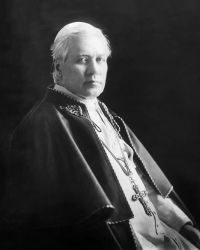
“ They would also have the believer avail himself of the formulas only in as far as they are useful to him, for they are given to be a help and not a hindrance; with proper regard, however, for the social respect due to formulas which the public magisterium has deemed suitable for expressing the common consciousness until such time as the same magisterium provide otherwise. ”
Magisterium
Definition and stakes
The theme of “magisterium” has been addressed by authors such as Pope Pius X, Auguste Boudinhon and Henry Edward Manning. It is often associated with terms like teacher, professor, theology, philosophy and university.
Quotes about “magisterium”
“ So, too, acting on the principle that science in no way depends upon faith, when they treat of philosophy, history, criticism, feeling no horror at treading in the footsteps of Luther, they are wont to display a certain contempt for Catholic doctrines, or the Holy Fathers, for the Ecumenical Councils, for the ecclesiastical magisterium ”
“ If the Modernists have not yet reached this point, they do ask the Church in the meanwhile to be good enough to follow spontaneously where they lead her and adapt herself to the civil forms in vogue. Such are their ideas about disciplinary authority. But far more advanced and far more pernicious are their teachings on doctrinal and dogmatic authority. This is their conception of the magisterium of the Church: No religious society, they say, can be a real unit unless the religious conscience of its members be one, and one also the formula which they adopt. ”
Auguste Boudinhon, 1911 Encyclopædia Britannica (1911)
“ Others, while recognizing the supreme authority of the papal magisterium in matters of doctrine, confine the infallibility to those cases alone in which the pope chooses to make use of it, and declares positively that he is imposing on all the faithful the obligation of belief in a certain definite proposition, under pain of heresy and exclusion from the Church; they do not insist on any special form, but only require that the pope should clearly manifest his will to the Church. ”
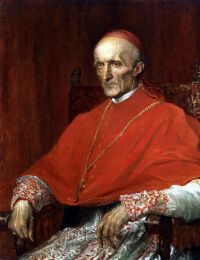 Henry Edward Manning,
Petri Privilegium
(1871)
Henry Edward Manning,
Petri Privilegium
(1871)
“ It is separate in no sense, nor can be, nor can so be called, without manifold heresy, unless the word be taken to mean distinct. In this sense, the Roman Pontiff is distinct from the Episcopate, and is a distinct subject of infallibility; and in the exercise of his supreme doctrinal authority, or magisterium, he does not depend for the infallibility of his definitions upon the consent or consultation of the Episcopate, but only on the Divine assistance of the Holy Ghost. ”
A Select Collection of Old English Plays…
“ Commaunded two knaves be besyde himselfe."Both editions have it so, and the alteration was made by Dodsley, and followed by Reed, although it is by no means necessary to the due understanding of the passage.—Collier.445. Thynge decayed, 1st edit.446. Holly, 1st edit., holy, edit. 1569.447. i.e., One magisterium; a chymical term expressive of the highest powers of transmutation, and sometimes used for any masterly performance.—S.Mastery seems here used in the sense of mystery or trade, which is derived from the French mestier, and that perhaps from magisterium. See Warton's "Hist. Engl. ”
T. W. Allies, The Formation of Christendom, Volume II
“ He Himself is the one Teacher whose voice they express: He who came on earth for three and thirty years speaks for evermore in those whom He sends as one Body, which calls no man teacher, because it is the Body of Christ, the Teacher: so that this function of magisterial teaching is the great distinctive office of His Church, coming from above, and invested with the authority of the God-man, by which it draws to it disciples, whose consent is not the ground but the result of its authority. ”
 Mortimer Adler,
Two Essays on Docility
(1940)
Mortimer Adler,
Two Essays on Docility
(1940)
“ The definition of docility as the right amount of respect for the authority of teachers (or books) is by itself insufficient to determine action. It is a truth too remote from the exigencies of practice to direct us in the particular decisions we have to make. In this particular case—with this teacher or book, in view of my temperamental weaknesses, my tendencies to be indolent or impatient, and in connection with this point of doctrine abut which I have strong feelings—what is the right amount of respect due those who are trying to instruct me? ”
 Frederic Harrison,
Matthew Arnold
(1896)
Frederic Harrison,
Matthew Arnold
(1896)
“ What we find so perplexing is, that the Master, who, in judging poetry and literature, had most definite principles, clear-cut canons of judgment, and very strict tests of good and bad, doctrines which he was always ready to expound, and always able to teach others, no sooner passes into philosophy, into politics, into theology, than he disclaims any system, principles, or doctrines of any kind. 'Oh!' we hear him cry, 'I am no philosopher, no politician, no theologian. ”
Saint of Alexandria Clement, The writings of Clement of Alexandria… (1867)
“ What has to be observed at home, and how our life is to be regulated, the Instructor has abundantly declared. And the things which He is wont to say to children by the way, while He conducts them to the Master, these He suggests, and adduces the Scriptures themselves in a compendious form, setting forth bare injunctions, accommodating them to the period of guidance, and assigning the interpretation of them to the Master. For the intention of His law is to dissipate fear, emancipating free-will in order to faith. ”
 Henry Osborn Taylor,
The Mediaeval Mind
(1911)
Henry Osborn Taylor,
The Mediaeval Mind
(1911)
“ Lend a hand, good Master,"—and the pupil becomes self-deprecatory. "Flint has fire within, which comes out only when struck; so the light of knowledge exists by nature in human minds, but a teacher is needed to knock it out." "It is easy," responds the Master, "to show you wisdom's path, if only you will pursue it for the sake of God, for the sake of the soul's purity and to learn the truth, and also for its own sake, and not for human praise and honor." ”
Henry Osborn Taylor,
The Mediaeval Mind (Volume 1 of 2…
“ There is some coy demurring over the steepness of the way; but the pupil is ardent, and the Master confident that with the aid of Divine Grace they will ascend the seven grades of philosophy, by which philosophers have gained honour brighter than that of kings, and the holy doctors and defenders of our Catholic Faith have triumphed over all heresiarchs. ”
Mortimer Adler,
Two Essays on Docility
(1940)
“ There is also an element of gratitude in docility, responsive to the charity of teaching; and an element of humility, because through docility we are rightly ordered to our superiors. We cannot be instructed by our peers, or at least not in the respects in which there is peerage or equality in knowledge. Unlesss the teacher has an authority which comes from greater knowledge or skill, he cannot justly be our master, nor need we be docile as his students. ”
 John Ruskin,
Ariadne Florentina: Six Lectures on Wood and Metal Engraving
John Ruskin,
Ariadne Florentina: Six Lectures on Wood and Metal Engraving
“ Gentlemen, believe me, there never was any great advancing art yet, nor can be, without didactic purpose. The leaders of the strong schools are, and must be always, either teachers of theology, or preachers of the moral law. I need not tell you that it was as teachers of theology on the walls of the Vatican that the masters with whose names you are most familiar obtained their perpetual fame. ”
“ The doctorate.A master of arts or of laws becomes a bachelor of divinity after subscribing certain declarations required by statute and preaching a sermon in the University church. Four years later he must “keep an act” or print a dissertation, in Latin or English, upon some matter of biblical exegesis or history, of dogmatic theology, ecclesiastical history or antiquities, or on the evidences of Christianity. The “act” is kept in the same way as that for the medical degree, and includes a viva voce examination. ”
 John William Burgon,
Inspiration and Interpretation
John William Burgon,
Inspiration and Interpretation
“ I will not argue with them, while they presume to write B.D. and D.D. after their names,—hold Chaplaincies,—preside over Schools and Colleges,—profess to lecture in Divinity,—officiate at the altars of the Church of England,—by virtue of their sacred office, and by virtue of that only, are instructors of youth. They cannot, (if they are in the full enjoyment of their faculties,) they cannot imagine, for a moment, that, as honest men, they can remain where they are! They must either recal their words or resign their stations! ”
 Alexander Maclaren,
Expositions of Holy Scripture
Alexander Maclaren,
Expositions of Holy Scripture
“ Take your orders from Him; let men rave as they like. Be content to be approved by Him; let men think of you as they please. The Master's smile is life, the Master's frown is death to the slave; what matters it what other people may say? 'He that judgeth me is the Lord.' So keep yourselves above the cackle of 'public opinion'; do not let your creed be crammed down your throats even by a consensus of however venerable and grave human teachers. ”
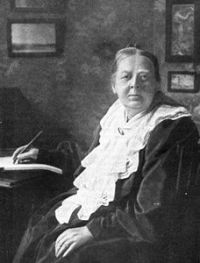 Mary Everest Boole,
Logic Taught by Love
(1905)
Mary Everest Boole,
Logic Taught by Love
(1905)
“ The moment that any idolatrous tension on his personality or his characteristics is set up, the true teacher gives new impulsion to his pupils, sending them forth on their appointed path: "Why call ye me good? There is none good but One, that is God. Call no man your Master on earth; for One is your Master, even The Unseen Unity. ”
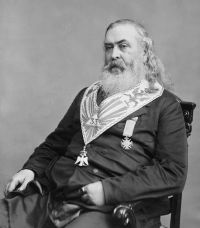 Albert Pike,
Morals and Dogma of the Ancient and Accepted Scottish Rite of Freemasonry
Albert Pike,
Morals and Dogma of the Ancient and Accepted Scottish Rite of Freemasonry
“ If you have been disappointed in the first three Degrees, as you have received them, and if it has seemed to you that the performance has not come up to the promise, that the lessons of morality are not new, and the scientific instruction is but rudimentary, and the symbols are imperfectly explained, remember that the ceremonies and lessons of those Degrees have been for ages more and more accommodating themselves, by curtailment and sinking into commonplace, to the often limited memory and capacity of the Master and Instructor, and to the intellect and needs of the Pupil and Initiate ”
 Johann Gottlieb Fichte,
On the Nature of the Scholar — Lecture IX.…
Johann Gottlieb Fichte,
On the Nature of the Scholar — Lecture IX.…
“ Besides those possessors of the Idea, whose business it is, by guiding and ordering the affairs of men, to introduce the Idea immediately into life, there is yet another class—those, namely, who are peculiarly and by preëminence called Scholars, who manifest the Idea directly in spiritual conceptions, and whose calling it is to maintain among men the conviction that there is, in truth, a Divine Idea accessible to human thought, to raise this Idea unceasingly to greater clearness and precision, and thus to transmit it from generation to generation fresh and radiant in ever-renewed youth. ”
Mortimer Adler,
Two Essays on Docility
(1940)
“ The living teachers—the local embodiments of learning—are seldom the great teachers. The great teachers are usually dead, though, in another sense, they are eminently alive for us as teachers through their books. Books are instruments of instruction, and obviously call for docility in those who would learn from them, as much as living teachers do. The virtue is essentially the same, whether exercised toward the book of an absent teacher or toward the ministrations of one who is present. ”
Bernard Capes, Historical vignettes, 2nd series (1912)
“ The young man to whom he spoke, and into whose eyes he had turned to look, lowered his lids as if abashed or aggrieved, and just perceptibly shrugged his shoulders. “Master,” he said, presuming on the Master’s tolerance, “is it not the mystery of original sin in them which baffles you? And where on this earth are eyes to lack that riddle? You are too old, Master, by near fifteen hundred years to find the model you seek. There was never but one in all the world.” ”
“ It must be realised that the degree in arts always differed from degrees in theology law and medicine inasmuch as these latter implied competence to exercise the corresponding professions. There was no such corresponding profession in the case of arts, except that of the schoolmaster. The clergyman, lawyer, or doctor at least exercised himself in these subjects, but the “artist” unless he was a regent-master, or a magister scholarum elsewhere, left his studies when he left his university. ”
Johann Gottlieb Fichte,
On the Nature of the Scholar — Lecture IX.…
“ In every word uttered by the Academic Teacher in the exercise of his calling, let it be Knowledge that speaks,—let it be his longings to extend her dominion,—let it be his deep love for his hearers, not as his hearers, but as the future ministers of Knowledge:—Knowledge, and these living desires to extend her dominion, let these speak, not the Teacher. ”
Johann Gottlieb Fichte,
The Vocation of the Scholar — Lecture IV. The Vocation of the Scholar
(1794)
“ And if I discover for the Scholar a vocation most honourable, most lofty, and distinguished above that of all other classes of men, how is it possible for me to lay it before you without exceeding the limits of modest expression, without seeming to undervalue other vocations, without being apparently blinded by self-conceit? ”
Various, The Catholic World, Vol. 20, October 1874‐March 1875
“ But it is idle to recommend this study to the generality of students in philosophy and theology, as a substitute for the study of the minor approved authors. Dogmatic and moral theology and philosophy are real sciences, as they are taught in the Catholic schools, and they can be and must be learned from text-books and the oral instruction of professors. The presumption is in favor of the books and teachers approved by ecclesiastical authority, that they teach sound doctrine. ”
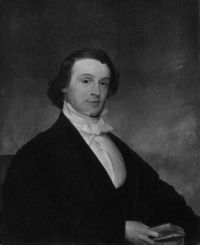 George E. Ellis,
The Red Man and the White Man in North America
(1882)
George E. Ellis,
The Red Man and the White Man in North America
(1882)
“ Trained in the rigid discipline of the seminary, under the keen, soul-penetrating search of his spiritual director, to an entire self-disclosure and an absolute self-surrender in abnegation and obedience, the pupil yielded his whole being, thought, purpose, will, and inclination to the control of his superior. ”
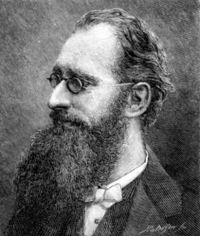 Mandell Creighton,
Historical Lectures and Addresses
(1903)
Mandell Creighton,
Historical Lectures and Addresses
(1903)
“ The fact that I am unfettered by any positive knowledge of possibilities allows me greater freedom in drawing an ideal picture of the functions which a professor of ecclesiastical history might conceivably discharge. ”
 Leslie Stephen,
Dictionary of National Biography…
(1900)
Leslie Stephen,
Dictionary of National Biography…
(1900)
“ His influence was especially paramount among the younger masters of arts, for whom he was identified with the cause of realism in its struggles with the Parisian nominalism, with the cause of the philosophical faculty in its jealousy of the superior faculties of theology and canon law, with the cause of the seculars in their conflicts with the mendicants, and of the university in itself in its jealous struggle against external ecclesiastical authority. ”
Various, The Catholic World, Vol. 13, April to September…
“ Supposing the professor understands at all the meaning of the scholastic terms he uses, it is clear that he understands by Christianity the history of which moves under the influence of two generic ideas—nothing divine, nothing fixed, permanent, and immutable, the law alike for intellect and will, but the views and theories or judgments which men form of the works of God, his word, his law, or his kingdom. ”
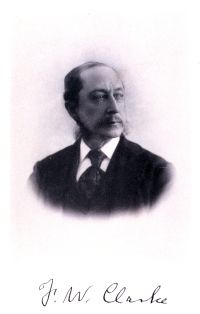 Frank Wigglesworth Clarke,
Popular Science Monthly
(1876)
Frank Wigglesworth Clarke,
Popular Science Monthly
(1876)
“ Men must be chosen professors because of their fitness to teach specified subjects, and not on account of their notions, real or professed, concerning abstract theological dogmas. Moral character ought, of course, to be considered ”
Robert Willis, Servetus and Calvin
“ In this bold step we have another glimpse of the self-reliant, and it may be, somewhat presumptuous, character of the man; for even as the emancipated novice of the monk’s school and Saragossan professors, when little more than of age, showed himself as Theologian in the ‘De Erroribus Trinitatis,’ so did the newly becapped Magister Artium now come forward as Lecturer on Geography and Astrology, and the scarce fledged doctor in physic, as a teacher of his fellows and the world at large, in the art and mystery of treating Disease. ”
Various, Encyclopaedia Britannica, 11th Edition…
“ The word also is used in a sense transferred from this to express the relation between the founder of a school of religion, philosophy, science, art, &c., and his disciples. It is partly in this sense and partly in that of one whose work serves as a model or type of superlative excellence that such terms as “old masters” are used. In medieval universities magister was particularly applied to one who had been granted a degree carrying with it the licentia docendi, the licence to teach. ”
 Annie Besant,
London Lectures of 1907
Annie Besant,
London Lectures of 1907
“ What is the work of these Masters in the religions of the world, and why is it that this thought of the Masters has been so revived in the modern world, and made so much more living, in a sense, than it has been for many a long year? ”
