Tailorbird

Definition and stakes

Kenneth H. Jones,  Twentieth Century Impressions of Hongkong… (1908)

“ The Tailor Bird, as is well known, makes its nest by stitching together, with thread manufactured by itself, the free margins of a large leaf, or by approximating two big leaves in such a way as to make a kind of bag, and in this its little nest of fine grass, with a vegetable down lining, is placed. The Rain Bird, from its size, could not possibly lay its eggs in the nest of the Tailor Bird, so that probably they are laid on the ground and then carried in the bird's bill to their resting-place. ”
Source: Wikisource

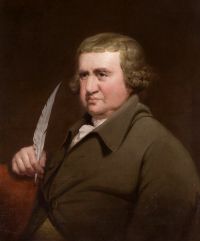
Portrait of Erasmus Darwin Erasmus Darwin,  Zoonomia, or, the Laws of Organic Life… (1796)

“ But the taylor-bird will not ever trust its nest to the extremity of a tender twig, but makes one more advance to safety by fixing it to the leaf itself. It picks up a dead leaf, and sews it to the side of a living one, its slender bill being its needle, and its thread some fine fibres; the lining consists of feathers, gossamer, and down; its eggs are white, the colour of the bird light yellow, its length three inches, its weight three sixteenths of an ounce; so that the materials of the nest, and the weight of the bird, are not likely to draw down an habitation so slightly suspended. ”
Source: Wikisource

Douglas Dewar,  A Bird Calendar for Northern India

“ In it are laid two or three eggs of salmon hue with reddish-brown and purple-grey blotches.
Throughout April the sprightly tailor-birds are busy with their nests. The tailor-bird (Orthotomus sutorius) is a wren with a long tail. In the breeding season the two median caudal feathers of the cock project as bristles beyond the others. The nest is a wonderful structure. Having selected a suitable place, which may be a bush in a garden or a pot plant in a verandah, the hen tailor-bird proceeds to make, with her sharp bill, a series of punctures along the margins of one or more leaves.
”
Source: Gutenberg

Get perspective with Kwize: daily news enlightened by great literature