“ The town--a town of brick and tin--stands at the apparent edge of a vast plain of withered grass, from whose inhospitable aspect it turns and nestles, as if for protection, round the scrub-covered hills to northward. From among the crowd of one-storied dwelling-houses, more imposing structures, the seats of Government and commerce, rise prominently to catch the eye and impress the mind with the pleasing prospect of wealthier civilisation. ”
Quotes about “townland”
 Peter Kropotkin,
The State: Its Historic Role
(1908)
Peter Kropotkin,
The State: Its Historic Role
(1908)
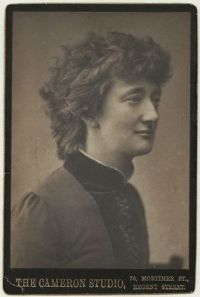
“ Generally, the town, whose enclosure grows in length and breadth with the population and surrounds itself with higher and higher towers, erected, each, by such and such a parish or such guild, and having its own individual character,—generally, I say, the town is divided into four, five or six districts or sections which radiate from the citadel to the ramparts. In preference these districts are inhabitated, each, by one "art" or craft, whereas new trades—the "young arts"—occupy the suburbs, which will soon be enclosed in a new fortified circle. ”
 Alice Stopford Green,
Town Life in the Fifteenth Century…
Alice Stopford Green,
Town Life in the Fifteenth Century…
“ The traveller who has asked at the bookshop of a provincial town for a local history or even for a local guide is as well able to realize the distance which parts us from France, Italy, or Germany, as is the student who inquires for a detailed account of how civic life or any one of its characteristic institutions grew up among us. A certain number of town histories do indeed exist, but they by no means always deal necessarily or even mainly with the life of the borough itself. ”
 Violet Jacob,
The Sheep-Stealers
Violet Jacob,
The Sheep-Stealers
“ HEREFORD town is one of those slumbrous cities, guiltless of any bait with which to lure the sight-seer, but possessing both a cathedral and an individuality of its own. It is a town which seems to have acquired no suburbs, to have grown up in its proper area out of the flat fields which lie around. But on the night of which I am speaking an unwonted stir was going on, a rumbling of vehicles through streets usually silent, and a great noise of voices and hoofs in the different inn yards. ”
 Mark Twain,
Following the Equator
(1897)
Mark Twain,
Following the Equator
(1897)
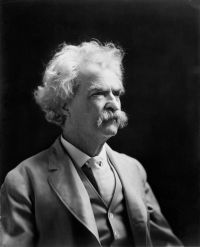
“ And everywhere through the soft morning vistas we glimpse the villages, the countless villages, the myriad villages, thatched, built of clean new matting, snuggling among grouped palms and sheaves of bamboo; villages, villages, no end of villages, not three hundred yards apart, and dozens and dozens of them in sight all the time; a mighty City, hundreds of miles long, hundreds of miles broad, made all of villages, the biggest city in the earth, and as populous as a European kingdom. ”
Various, Punch, or the London Charivari…
“ In short, with Local Government invested, the whole VillageShall grow vigorous, and virtuous, and prosperous, and proud,And free from Landlord pressure, and the Parson's petty pillage,The peasants shall no longer to the slums of London crowd.Chorus.—From the Village, new Village, a happy little spot,A home of peace and plenty, where oppression may not plot;Where there's room enough for all.And the "hind" is not a "thrall,"In the Village shaped on Democratic lines! A SAFE NOVEL. (With Interpolated Notes by Our Own Legal Adviser.) ”
 Eugène Sue,
The Branding Needle; or, The Monastery of Charolles
Eugène Sue,
The Branding Needle; or, The Monastery of Charolles
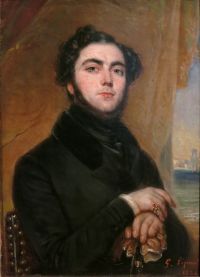
“ Never did the eye of man dwell upon a more smiling village. A village? No; it rather resembles a large borough. From at least six to seven hundred houses are scattered on the slope of that hill, without counting the vast thatched structures that are situated below on the meadow, which is watered by a river that rises to the north of the valley, crosses it and forms its boundary far away where the horizon dips. ”
 Philip Gibbs,
People of Destiny: Americans as I saw them at Home and Abroad
Philip Gibbs,
People of Destiny: Americans as I saw them at Home and Abroad
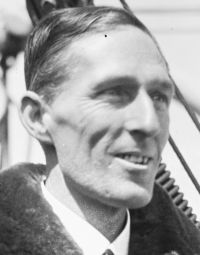
“ To English eyes accustomed to dingy brick houses in the suburbs of big cities, to the dreary squalor of some new [Pg 71] little town which straggles around a filthy railway station, with refuse-heaps in undeveloped fields, and a half-finished "High Street," where a sweetstuff-shop, a stationer, and an estate agent establish themselves in the gloomy hope of business, these American villages look wonderfully clean, bright, and pleasant! ”
Edward Hungerford, The Personality of American Cities
“ You have climbed up from the heart of the busy town, past the business section, spreading itself out as business sections of all successful towns must continue to do, past the trim snug little white Colonial houses—that must have been stolen from old Salem or Newburyport—all set among the dark greens of the cedars and the firs, and belying the Northland tales of the tree foliage by the great rose-bushes that bloom all the year round, up on to the place where tradition says the silent chiefs of red men used to gather.... ”
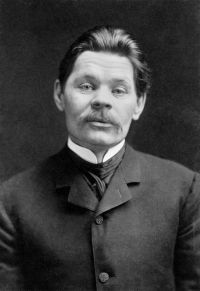 Maksim Gorky,
Tales of Two Countries
Maksim Gorky,
Tales of Two Countries
“ The whole population of the town is there: workers, soldiers, tradespeople, priests, officials, fishermen; all are intoxicated with the spirit of spring-time, talking, laughing, singing in joyous confusion, as if they were a single body overflowing with the zest of life. ”
J. N. Larned, History for ready reference, Volume 3… (1895)
“ They should be taught to see in the town common or village green a survival of that primitive institution of land-community upon which town and state are based. They should be taught the meaning of town and family names; how the word 'town' means, primarily, a place hedged in for the purposes of defence; how the picket-fences around home and house-lot are but a survival of the primitive town idea; how home, hamlet, and town live on together in a name like Hampton, or Home-town. They should investigate the most ordinary thing for these are often the most archaic. ”
Various, The Atlantic Monthly, Volume 09…
“ A township where one primitive forest waves above, while another primitive forest rots below,—such a town is fitted to raise not only corn and potatoes, but poets and philosophers for the coming ages. ”
Thos. D. Murphy, In Unfamiliar England
“ The main part of the town lies in a depression in the undulating downs, its villas, houses and streets all set down on a liberal scale with plenty of room for trees, in whose luxuriant foliage the place is half hidden. All around stretches the wavelike succession of the hills, diversified with forest and bright with heather and gorse. ”
S. Baring-Gould, Old Country Life
“ The charms of an old English county town do not force themselves on our notice, are missed altogether by the hasty visitor; they have to be found out, they come by surprises, they depend on certain lights and plays of shadow, on the bursting into leaf of certain trees, on the setting up of certain hucksters' stalls. That a great deal of their picturesqueness is passing away is, alas! ”
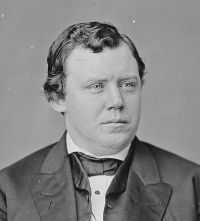 Ignatius Donnelly,
Cæsar's Column: A Story of the Twentieth Century
Ignatius Donnelly,
Cæsar's Column: A Story of the Twentieth Century
“ We shut out all speculators.No towns started in any other way shall have railroad or mail facilities.When once a municipality is created in the way I have described, it shall provide, in the plat of the town, parks for recreation; no lot shall contain less than half an acre; the streets shall be very wide and planted with fruit trees in double and treble rows. In the center of the town shall be erected a town hall, with an assembly chamber, arranged like a theater, and large enough to seat all the inhabitants. ”
H. R. Wilton Hall, Social Life in England Through the Centuries
“ The little Canadian boy's question can be asked about every town and village in the land. There are no two places exactly alike; each one has its own history, which, however simple it may be, is quite worth knowing. The busy manufacturing town, with its tens and hundreds of thousands of people, where all is movement and bustle, has its history; and the lonely country village, where everybody knows everybody else, has often a history even more interesting than that of the big town—if we only knew what to look for, and where to look for it. ”
James Grant, Oliver Ellis (1865)
“ Though a new town on the north, and another on the south, were rising into existence, the mass of the citizens dwelt yet within the steep, narrow closes and wynds of the ancient city, from which many made vows they would never remove. ”
Mark Twain,
Life on the Mississippi — Chapter 58
(1883)
“ Here is a town of twelve or thirteen thousand population, with electric lighted streets, and with blocks of buildings which are stately enough, and also architecturally fine enough, to command respect in any city. ”
Francis Davy Longe, Lowestoft in olden times
“ In order to form a tolerably correct idea of what our old town was at the beginning of the 15th century, we must dismiss altogether from our mind’s eye the large populous town with which we are acquainted, and picture to ourselves a village of small cottages with thatched roofs being gradually improved by the erection of houses of a better class. ”
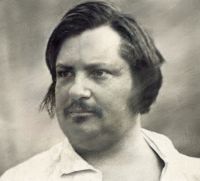 Honoré de Balzac,
Sons of the Soil
Honoré de Balzac,
Sons of the Soil
“ One comfortable house and the parsonage are distinguishable; but the township is a large one,—about two hundred scattered houses in all, those of the village forming as it were the capital. The roads are lined with fruit-trees, and numerous little gardens are strewn here and there,—true country gardens with everything in them; flowers, onions, cabbages and grapevines, currants, and a great deal of manure. The village has a primitive air; it is rustic, and has that decorative simplicity which we artists are forever seeking. ”
 H. G. Wells,
Tales of Space and Time
H. G. Wells,
Tales of Space and Time
“ Here and there, in those sluggish times, a town grew a little larger than its neighbours, as a port or as a centre of government; but all the towns in the world with more than a hundred [199] thousand inhabitants could be counted on a man's fingers. ”
 William Makepeace Thackeray,
The Paris Sketch Book of Mr. M. A. Titmarsh…
William Makepeace Thackeray,
The Paris Sketch Book of Mr. M. A. Titmarsh…
“ The town is, certainly, the most moral of towns. You pass, from the railroad station, through a long, lonely suburb, with dusty rows of stunted trees on either side, and some few miserable beggars, idle boys, and ragged old women, under them. ”
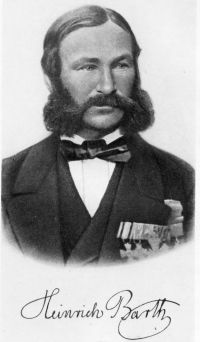 Heinrich Barth,
Travels and discoveries in North and Central Africa
(1890)
Heinrich Barth,
Travels and discoveries in North and Central Africa
(1890)
“ Having now a horse whereon to mount, I rode every day, either into the eastern town to pay a visit to the sheikh, or to the vizier, or roving around the whole circuit of the capital, and peeping into the varied scenes which the life of the people exhibited. The precincts of the town with its suburbs are just as interesting as its neighbourhood (especially during the months that precede the rainy season) is monotonous and tiresome in the extreme. ”
 Edward Augustus Freeman,
City and Borough
(1889)
Edward Augustus Freeman,
City and Borough
(1889)
“ City and borough then are both rather formal words; town is the word which comes most naturally to the lips when there is no special reason for using one of the others. Of the two formal words, borough is English, city is Latin; it comes to us from Gaul and Italy by some road or other. It is in Domesday that we find, by no means its first use in England, but its first clearly formal use, its first use of it to distinguish a certain class of towns, to mark those towns which are civitates as well as burgi from those which are burgi only. ”
J. N. Larned, History for ready reference, Volume 4… (1895)
“ There is a good deal to make one believe that 'town ' [see, above, TOWN] continued to be the common popular term for what we may describe in general language as a rural centre of population even into the 18th century. ... The far more general use of the word 'town' than of 'township' in early New England is most naturally explained by supposing that it was the word ordinarily employed in England at the time of the migration,—at any rate, in East Anglia. ”
 Charles Ball,
Fifty Years in Chains; or, the Life of an American Slave
(1860)
Charles Ball,
Fifty Years in Chains; or, the Life of an American Slave
(1860)
“ I had no doubt that I was in the neighborhood of some town, but of its name, and the part of the country in which it was located, I was ignorant. I at length found that I was receding from the woods altogether, and entering a champaign country, in the midst of which I now perceived a town of considerable magnitude, the inhabitants of which were entirely silent, and the town itself presented the appearance of total solitude. ”
Mrs. Charles Gerrard King, Letters from Muskoka
“ These last can only be obtained by the growth and encouragement of the ornamental as well as useful arts; then comes the dawning of political power, till at length we see with amusement that the scattered hamlet has become a thriving village, the village a populous town, and the town expanded into a stately city, carrying wealth, commerce, and civilisation to the remotest parts of what a few years back was simply unbroken forest. ”
Alice Stopford Green,
Town Life in the Fifteenth Century…
“ There is no better starting point for the study of town life in England than the fifteenth century itself, when, with ages of restless growth lying behind them, and with their societies as yet untouched by the influences of the Renascence or the Reformation or the new commercial system, the boroughs had reached their prosperous maturity. ”
 Henry David Thoreau,
Winter: From the Journal of Henry D. Thoreau…
(1888)
Henry David Thoreau,
Winter: From the Journal of Henry D. Thoreau…
(1888)
“ I find that into my idea of the village has entered more of the elm than of the human being. They are worth many a political borough. They constitute a borough. The poor human representative of his party sent out from beneath their shade will not suggest a tithe of the dignity, the true nobleness and comprehensiveness of view, the sturdiness and independence, and serene beneficence that they do. They look from township to township. . . . They battle with the tempests of a century. ”
 Richard Jefferies,
Wild Life in a Southern County
Richard Jefferies,
Wild Life in a Southern County
“ For instance, you may find a town which, by the incidence of the railroad and the springing up of great industries, has shot far ahead of the other sleepy little places; its population may treble itself, its trade be ten times as large, its attractions one would imagine incalculably greater. Nothing of the kind: its annual fair is not nearly so important an event to the village mind as that of an old-world slumberous place removed from the current of civilisation. ”
Edward Lewes Cutts, Parish Priests and Their People in the Middle Ages in England
“ The old inhabitants, reinforced by the new military and ecclesiastical populations, found the northern half of the city too strait for them, and a new walled town sprang up at the foot of the hill, and soon stretched out a long, narrow suburb southward, along the high-road, defended by parallel dykes. ”
“ Each village has a character and a reputation of its own, and cherishes views regarding its neighbours which it is not slow to impart either to them or to foreigners. The colour of these townships divides them into the three classes of our title. ”
H. G. Wells,
The dream: A novel
(1923)
“ It had grown from a minute hamlet into what we used to call an 'urban district.' In that old world in which there was neither freedom nor direction, the land was divided up into patches of all sorts and sizes and owned by people who did what they liked with it, subject to a few vexatious and unhelpful restrictions. ”
Grace Dunlop Peter, A Portrait of Old George Town
“ No better example could be found than this old town with its families who had come from well-to-do circumstances, not, as was the case with so many settlers of the new country, in order to escape trouble. ”
H. R. Wilton Hall, Social Life in England Through the Centuries
“ As the population increased in the town, streets of houses sprang up, some large, some small, built in rows and crescents and terraces, in which all the houses were alike; and very dull and drab and mean-looking many of them have become. ”
Robert Melvin Blackwood, The Battles of the British Army
“ The town itself is handsome and extensive; and the streets, intersecting each other at right angles, are broad and airy, generally built with stone, and with terraces in front. The Company’s gardens, walks, parade, and castle, all add to the beauty of the place, and render it superior to any colonial city in the possession of Great Britain. ”
Alice Stopford Green,
Town Life in the Fifteenth Century…
“ It is evident, indeed, from the nature of the subject, that any writer who desires to give a survey of provincial town life as we can now picture it—from printed materials scattered in county histories, archæological journals, reports of commissions, imperfect abstracts of town documents, parliamentary records, charters, and stray pamphlets—must inevitably remain exposed to much correction in matters of detail from experts with local knowledge. ”
 James Harvey Robinson,
An Introduction to the History of Western Europe
James Harvey Robinson,
An Introduction to the History of Western Europe
“ The townspeople were scarcely more than serfs, in spite of the fact that they lived within a wall and engaged in industry instead of farming. They had to pay irritating dues to their lord, just as if they had still formed a farming community. The emancipation of the townsmen from their lords and the establishment of a suitable form of government for their town were necessary preliminaries to the free development of town life.Increase of trade promotes the growth of the towns. ”
