AI-generated from sources
Attacked on Both Flanks, Leo XIII's Just Wage Between Individualists and Socialists
In Brief
- Leo XIII defended private property against socialism in the name of the wage-earner, whose savings it protects, yet held that a wage accepted under the pressure of need is an injustice whatever the contract says.
- The charge of socialism came first from the individualist side: in 1891 the American review The Arena accused the Pope of leaning toward State interference while also faulting him for shielding landed monopoly.
- Socialist critics aimed less at any clause than at the Church's role and at reform itself: for them arbitration and philanthropy were gifts of capital, and the goal was the end of wages, not fairer ones.
- The claim that a wage owes something to need, not only to the market, outlived the quarrel, resurfacing in English Liberal wage boards and in arguments that consumers share the duty of a living wage.
Main authors
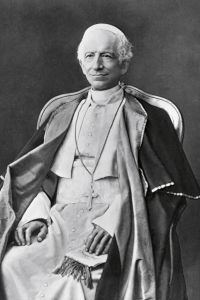
In its September 1891 number, the American review The Arena gave the Pope's letter on labor a long and exasperated reading. Leo XIII, one contributor wrote, went “floundering round in a sea of contradictions,” at one moment voicing principles close to the anarchists', at another favoring extreme socialism, all the while imagining himself an individualist [1]. The same number found the opposite fault. In his desire to uphold the rights of property, the Pope had ended up maintaining the privileges of monopoly, and many Catholics would now feel bound in conscience to resist any taxation of land [2]. One review, two charges. The letter was too socialist and too protective of the propertied at once.
Elsewhere, too, the letter was read two ways. Maisie Ward recalls that the Pope's hope of giving workpeople a share in the land, so as to bridge the gulf between vast wealth and deep poverty, was treated by conservatives almost as an acceptance of existing property, while radicals simply tried to evade it [3]. The pattern deserves more than a shrug about misreading. A Church that refused both socialism and an unchecked wage bargain, and justified both refusals by the same principle—that a worker's pay answers to a justice older than the market—offered each camp the profile of its enemy's ally. The double accusation is not a misunderstanding of the position. It is its outline.
Leo XIII, or property defended in the worker's name
The letter's case against socialism is not made on behalf of the owners. It is made on behalf of the wage-earner. To transfer the possessions of individuals to the community, Leo XIII argues, would deprive the worker of the liberty to dispose of his wages, and with it of any hope of increasing his stock and bettering his condition [4]. Property here is the wage saved, labor turned into a holding. Only after this practical argument does the Pope reach what he calls the point of far greater moment: the socialist remedy is against justice, since every man has by nature the right to possess property as his own [4].
The same natural law that founds property then sets a limit on the contract. Workman and employer, the letter concedes, should as a rule agree freely, wages included [5]. But beneath every such agreement lies a dictate of natural justice “more imperious and ancient than any bargain between man and man”: pay must suffice to support a frugal and well-behaved wage-earner [5]. A worker who accepts harsher terms out of necessity, because no employer will offer better, is not a free party to a deal. He has suffered force and injustice [5]. The market's consent no longer suffices to make a wage just.
What readers retained was often the indictment more than the cure. In Zola's novel Rome, the Pope's text is summed up as a chronicle of the undeserved misery of the toilers, the excessive hours and the insufficient pay, with the principle that contracts extorted by threats of starvation are unjust [6]. The same passage notes that, compelled to stay vague on questions of organization, the Pope contented himself with encouraging the corporative movement under State patronage [6]. A novelist's paraphrase is a reading, not the text. But it shows where the weight fell: on a workman who must not be left defenseless before a system that turns the misery of the majority into the wealth of a few.
Against that concentration, the letter's remedy was not abolition but multiplication. If workpeople could look forward to a share in the land, the gulf between vast wealth and deep poverty would be bridged and the two orders brought closer together [3]. The formula rejects common ownership, and it rejects indifference to who ends up owning what. That is also why it could be read either way. The more conservative treated it almost as an acceptance of existing property, while Zola's paraphrase has it placing the corporative movement under State patronage [6, 3].
The Arena's verdict, socialism in an individualist's clothes
The individualist charge begins, oddly, with applause. The Arena seized on one sentence of the letter—that the results of labor should belong to him who has labored—as the keynote of a right of property upheld by the best churchmen and economists in all ages [7]. That natural law of labor, the review insisted, stands opposed to State socialism. Had the Pope adhered to it, he would have been saved from an illogical position [7]. The quarrel was not over property itself. It was over what follows from it.
What followed, for the reviewer, was a slide toward the State. Competition needed restraining, he granted, but not by the state interference and legislative tinkering to which the Pope leaned “in spite of his protests against socialism” [8]. Yet this individualist was no defender of laissez-faire. His own remedy was to abolish monopolies or absorb them into the functions of the State [8], and his creed held that true individualism requires an equality of opportunity which monopoly destroys [1]. He wanted private ownership of land reconciled with mankind's common right to the earth through taxation [2]. The charge of socialism came from a reformer who simply drew the line elsewhere: at land and monopoly, not at the wage.
A stricter liberalism measured the danger differently. Summarizing Herbert Spencer in 1885, the Eclectic Magazine reported his view that a citizen's freedom is measured not by the nature of his government but by the small number of laws to which he is subject [9]. On that scale, being forced to work for another's benefit is a degree of slavery, and it matters little, Spencer argued, whether the master is an individual or society [10]. Applied to pay, the same logic made any legal floor suspect. Lucilius Emery, in Concerning Justice, counted proposals for a minimum wage among the measures hampering the citizen's freedom in his occupation, pressed even if the wage should prove worth more than the labor [11].
The irony is that Leo XIII's first argument belonged to this liberal arsenal. An 1872 essay in Popular Science Monthly already defended individual property and the liberty of disposal against the socialists [12]—the very liberty the Pope said socialism would take from the wage-earner [4]. A liberal could applaud the first half of the letter and recoil at the second. Two decades earlier, a Catholic review had made a related observation. In its volume for 1869–70, The Catholic World observed that the proposition shared by every party of the labor movement—that society or the state is obliged to relieve the miseries of the poor—was what made even “infidel socialism” acceptable to multitudes [13].
Cardinal Manning's case shows how quickly the label stuck. His strenuous advocacy of the working classes and his declaration that every man has a right to work or to bread led to his being denounced as a Socialist, as the 1911 Encyclopædia Britannica records [14]. He denied it more than once. The entry's verdict is precise: never a Socialist in principle, he favored some of socialism's methods because they alone seemed to meet the pressing poverty before him [14]. In words The Arena quoted in 1897, he held that a starving man's natural right to life prevails over all positive laws of property, which the review called the philosophy of justice [15]. Manning ranked need above the laws of property and was called a socialist, whatever he called himself.
Patience preached to the poor, and the socialist charge
On the other flank, the charge took another shape: less an objection to a doctrine than to a role. Robert Ingersoll wanted the discussion moved from the poor to the rich. If the Catholic Church had so much power, let it soften the hearts of capitalists rather than waste its time preaching patience to those who bore the burdens of the world [16]. William Montgomery Brown went further, holding every modern church to be founded on capitalism and every religious institution to be “of the capitalist, by the capitalist, for the capitalist” [17]. Neither passage names the encyclical. Their charge targets the speaker rather than any clause, and no wage provision could answer it.
The deeper objection was one of method. Socialists, Paul Lafargue wrote, do not pursue their ideal by appealing to the intelligence of the capitalist class and to its sentiments of justice and humanity, but by fighting it and stripping it of the political power that protects its economic despotism [18]. A letter addressed to employers' consciences was, on these terms, a wrong turn by design. A text collected by Jack London in The Cry for Justice draws the consequence: the socialist movement exists not for better wages but for the abolition of wages and profits, and boards of arbitration or philanthropies are mere gifts of the capitalist [19]. The just wage, so central to Leo XIII, was here the thing to be overcome. It reformed a system its critics wanted gone.
Yet the two adversaries fought on shared ground: small property. Leo XIII accused socialism of robbing the wage-earner of his chance to own [4]. Friedrich Adolf Sorge, in 1890, turned the charge around. It is not the socialist who drives the man of small means from his house and his soil, he wrote, but the large capitalist and the large landowner, who draw small sums to themselves “as the magnet attracts iron filings” [20]. Wilhelm Liebknecht, in 1899, promised that socialism would make property the possession of everyone, a truth rather than a lie for the majority [21]. Each side claimed to be the true friend of the small owner. They disagreed on whether he could be saved inside the wage system or only beyond it.
The tension also ran through Catholic ranks. Zola's Rome describes what the novel calls Catholic socialism, triumphant in the United States, where bishops such as Mgr. Ireland were forced to set themselves at the head of working-class agitation, and Cardinal Manning standing by the workers during a famous strike [22]. Antonio Fogazzaro's novel The Saint shows the reverse pressure. Its Christian Democrats find broth at the convent gate insufficient, want better laws, and run into the stubborn prohibition of the Vatican [23]. Both are fictions, pulling in opposite directions. Together they suggest a Catholic social movement that one novel calls socialist and that, in the other, Rome held back.
The living wage, what outlived the quarrel
Beneath the polemics, one claim survived both flanks: a wage is not merely a price. Stephen Leacock denied that wages and prices tend toward social justice under free competition. Enormous salaries do not reflect enormous services, he argued, nor humble wages a humble contribution, and incomes left to themselves do not follow “the simple law of natural justice” [24]. His denial leaves The Arena's natural law of labor standing and denies only that the market delivers it: being entitled to what one produces is not the same as receiving it [7, 24]. It echoes the Pope's distinction between the bargain and a justice beneath it, though Leacock measures that justice by what a man contributes, not by what he needs [5].
Legislation arrived at a kindred principle without the theology. Walter Lyon Blease, writing a history of English Liberalism in 1913, describes how the Wage Boards Act and the Miners' Minimum Wage Act set up machinery to fix wages that would ensure a reasonable standard of health and comfort [25]. Their common premise, he writes, was that absolute liberty of the individual had meant the degradation, if not the destruction, of many who were poor [25]. The admission is striking from a liberal pen. A liberal history thus conceded what Spencer's measure of freedom, by the fewness of laws, had denied [25, 9].
The argument for a living wage, meanwhile, widened the circle of those responsible. J. Elliot Ross grounded it in social necessity, the same norm that in his view settles the righteousness of private property, and concluded that consumers, who benefit from the workman's labor, are especially bound to see that he obtains it [26]. He also tied the standard to its conditions: it depends on how much there is to go round, and on governmental supplements such as free education and insurance [27]. The just wage ceased to be a matter between one employer and one worker. It became a social debt that the buyer shared.
Two other voices mark the boundaries of the position. Johann Jacoby, in 1887, called for State-help as well as self-help, but judged wage labor itself as little compatible with justice and humanity as the slavery and servitude of former times [28]. Leo XIII kept the wage and judged it; Jacoby judged it and wanted it gone. Washington Gladden, by contrast, held that the church could be neither umpire nor partisan between socialists and the defenders of the wage system, economic method lying beyond its province [29]. Leo XIII did not abstain. He judged both camps [4, 5].
A pope who defended private property in the name of the worker's savings, and who held that a wage accepted under the pressure of need is an injustice whatever the contract says, could satisfy neither of the great camps of his time. To individualists, the wage floor and the turn to State patronage looked like socialism; one American review in 1891 even found in the same letter both a lean toward State interference and a shield for landed monopoly. To socialists, who wanted the wage system abolished rather than made fairer, appeals to the employer's conscience missed the point, and their sharpest words fell on the Church's role rather than on any clause. Within Catholic ranks, at least as two novels told it, the same tension ran between what one called Catholic socialism and a Rome that held reformers back.
What outlived the quarrel was not a program but a distinction, between the price a wage fetches and the justice it owes. Two decades on, English Liberal legislation fixed minimum wages on the ground that absolute liberty had degraded the poor, and advocates of a living wage extended the obligation to consumers. Being attacked from both sides was the price of standing on that distinction. Say that a bargain both parties have signed can still be unjust, and one side will call you a socialist, the other a servant of capital.