“ Here we have one line of advance from candles and oil lamps to gas, and from gas to electricity; and we can recognize many other threads of advance all converging upon electricity. We produce heat and light by electricity. We transmit intelligence by the telegraph and telephone, and we use electricity as a motive power. In fact, we have fairly entered upon an electrical age, and it is obvious that the electrical engineer will be much in demand in the future. Those of you who devote yourselves to electrical subjects will certainly find a place and room to work. ”
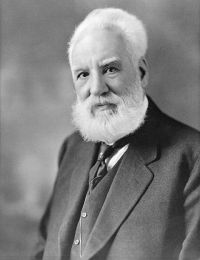
Alexander Graham Bell
Biographical details

Alexander Graham Bell (1847–1922), a Scottish-born Canadian-American scientist and inventor, is celebrated for patenting the first practical telephone in 1876. His work, shaped by his family’s expertise in elocution and his deaf mother and wife, extended to hearing devices, optical telecommunications, hydrofoils, and aeronautics.
Bell’s research also delved into heredity, reflecting his interdisciplinary rigor. His writings, including lectures on electric telephony and articles in Popular Science Monthly, reveal a vision of science as a force to bridge human communication and technological advancement.
Quotes by Alexander Graham Bell
 Alexander Graham Bell,
The Telephone: A lecture entitled Researches in Electric Telephony
Alexander Graham Bell,
The Telephone: A lecture entitled Researches in Electric Telephony
“ The idea of increasing the carrying power of a telegraph wire in this way took complete possession of my mind, and it was this practical end that I had in view when I commenced my researches in Electric Telephony.In the progress of science it is universally found that complexity leads to simplicity, and in narrating the history of scientific research it is often advisable to begin at the end. ”
Alexander Graham Bell,
Popular Science Monthly
(1880)
“ The fundamental idea, on which rests the possibility of producing speech by the action of light, is the conception of what may be termed an undulatory beam of light in contradistinction to a merely intermittent one. By an undulatory beam of light, I mean a beam that shines continuously upon the selenium receiver, but the intensity of which upon that receiver is subject to rapid changes, corresponding to the changes in the vibratory movement of a particle of air during the transmission of a sound of definite quality through the atmosphere. ”
