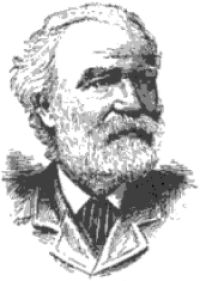
Benjamin Vaughan Abbott

Biographical details

Portrait of Benjamin Vaughan Abbott Benjamin Vaughan Abbott,  Popular Science Monthly (1881)

“ Upon the American view, a patent is a compact made with the inventor to induce him to disclose his invention for the public benefit; as a reward for which he receives an exclusive privilege which is in the nature of property. As respects many important inventions, the privilege would have little value if not good against Government, for the reason that the thing is only useful in Government business. What would be the worth of a patent for articles useful only in the army and navy, for a revenue or postage stamp, or the like, if Government might use the invention free? ”
Source: Wikisource

Portrait of Benjamin Vaughan Abbott Benjamin Vaughan Abbott,  Popular Science Monthly (1882)

“ Does the copyright law sustain property in the mere title of a book? The tendency of thought is that the law of trade-marks affords such protection as there is for a title, as distinguished from the body or contents; that the purpose of the copyright law is to secure the exclusive right of publishing the substantial work, and that it protects the title only as being a part of the work. ”
Source: Wikisource

Portrait of Benjamin Vaughan Abbott Benjamin Vaughan Abbott,  Popular Science Monthly (1881)

“ Our patent law is not confined to new machines and new compositions of matter, but extends to any new and useful art of manufacture; and a manufacturing process is clearly an art. The principle is that, whoever discovers that a certain useful result will be produced in any art by the use of certain means, is entitled to a patent, provided he fully and accurately specifies the means. This means need not be a machine or an apparatus; it may be a process. A machine is a thing. A process is a mode of action. ”
Source: Wikisource

Get perspective with Kwize: daily news enlightened by great literature