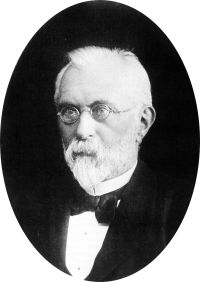
Douglas Houghton Campbell

Biographical details

Portrait of Douglas Houghton Campbell Douglas Houghton Campbell Elements of Structural and Systematic Botany

When one takes up a plant his attention is naturally first drawn to its general appearance and structure, whether it is a complicated one like one of the flowering plants, or some humbler member of the vegetable kingdom,—a moss, seaweed, toadstool,—or even some still simpler plant like a mould, or the apparently structureless green scum that floats on a stagnant pond.
Source: Gutenberg

Portrait of Douglas Houghton Campbell Douglas Houghton Campbell Elements of Structural and Systematic Botany

THE CELL.
If we make a thin slice across the stem of a rapidly growing plant,—e.g. geranium, begonia, celery,—mount it in water, and examine it microscopically, it will be found to be made up of numerous cavities or chambers separated by delicate partitions. Often these cavities are of sufficient size to be visible to the naked eye, and examined with a hand lens the section appears like a piece of fine lace, each mesh being one of the chambers visible when more strongly magnified. These chambers are known as “cells,” and of them the whole plant is built up.
Source: Gutenberg

Get perspective with Kwize: daily news enlightened by great literature