Oogonium

Definition and stakes

Project Gutenberg,  The Project Gutenberg Encyclopedia…

“ The reproduction of Characeae is characterized by a pronounced oogamy, the reproductive organs being the most highly differentiated among Chlorophyceae. The antheridia and oogonia are formed at the nodes of the appendages. The oogonium, seated on a stalk cell, is surrounded by an investment consisting of five spirally-wound cells, from the projecting ends of which segments are cut off, constituting the so-called stigma. ”
Source: Gutenberg

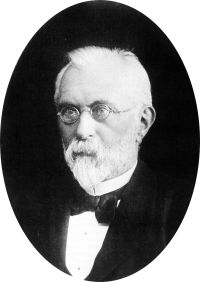
Portrait of Eugenius Warming Eugenius Warming,  A handbook of systematic botany (1895)

“ The oogonia are developed at the extremities of certain branches: they are bottle-shaped cells with very long and thin necks (trichogyne) , open at the end (a in A) ; at the base of each oogonium is a spherical oosphere. The spermatozoids reach the oosphere through the trichogyne, or through an aperture in the wall when the trichogyne is absent, and fertilisation having taken place, the oogonium becomes surrounded by a cell-layer (envelope) , which grows out from the cells near its base (b in A) , and in this way a kind of fruit is formed (B) (spermocarp, cystocarp) . ”
Source: Gutenberg

M. C. Cooke,  Fungi: Their Nature and Uses

“ During the formation of the oogonia there arise from its pedicel or from neighbouring filaments slight cylindrical curved branches, sometimes turned round the support of the oogonia, and which all tend towards this organ. Their superior extremity is intimately applied to its wall, then ceases to be elongated, becomes slightly inflated, and is limited below by a partition; it is then an oblong cell, slightly curved, filled with protoplasm, and intimately applied to the oogonia—in fact, an antheridium or organ of the male sex. Each oogonium possesses one or several antheridia. ”
Source: Gutenberg

Get perspective with Kwize: daily news enlightened by great literature