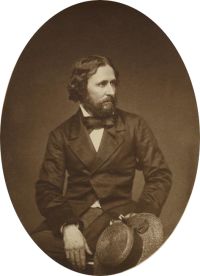
John Charles Frémont

Biographical details

Portrait of John Charles Frémont John Charles Frémont The Exploring Expedition to the Rocky Mountains…

Crossing a low spur, which bordered the creek, we descended to a kind of plain among the lower spurs, the desert being in full view on our left, apparently illimitable. A hot mist lay over it to-day, through which it had a white and glistening appearance; here and there a few dry- looking buttes and isolated black ridges rose suddenly upon it. "There," said our guide, stretching out his hand towards it, "there are the great llanos, (plains,) no hay agua; no hay zacate-- nada: there is neither water nor grass--nothing; every animal that goes upon them, dies."
Source: Gutenberg

Portrait of John Charles Frémont John Charles Frémont The Exploring Expedition to the Rocky Mountains…

Horse, gun, clothes--all became the prey of these Arabs of the New World.
Tabeau had been one of our best men, and his unhappy death spread a gloom over our party. Men, who have gone through such dangers and sufferings as we had seen, become like brothers, and feel each other's loss. To defend and avenge each other, is the deep feeling of all. We wished to avenge his death; but the condition of our horses, languishing for grass and repose, forbade an expedition into unknown mountains. We knew the tribe who had done the mischief--the same which had been insulting our camp.
Source: Gutenberg

Portrait of John Charles Frémont John Charles Frémont The Exploring Expedition to the Rocky Mountains…

A stillness the most profound and a terrible solitude forced themselves constantly on the mind as the great features of the place. Here, on the summit, where the stillness was absolute, unbroken by any sound, and solitude complete, we thought ourselves beyond the region of animated life; but while we were sitting on the rock, a solitary bee (bromus, the humble-bee) came winging his flight from the eastern valley, and lit on the knee of one of the men.
It was a strange place, the icy rock and the highest peak of the Rocky mountains, for a lover of warm sunshine and flowers
Source: Gutenberg

Get perspective with Kwize: daily news enlightened by great literature