Mary Anne Venning

Biographical details

Mary Anne Venning,  Rudiments of Conchology

“ NAUTILUS.
"So many families of the fourth order, Cephalopoda, are found only in a fossil state, and which you will not easily meet with, that I shall not consider it needful to give you the whole catalogue," observed Mr. Elliot to his young pupils at the beginning of the next lesson.
"But we are exceedingly interested about fossils," replied Charles; "pray do not pass any species that we may be likely to find."
"And I," said Lucy, "have much wished to ask whether the snake-stone ever was a shell? it is something like a Planorbis, but heavy and imperfect."
”
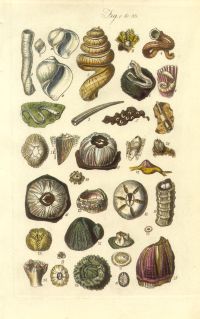
Source: Gutenberg

Mary Anne Venning,  Rudiments of Conchology

“ We have now lost sight of the pillar-lip, and in the genus Haliòtis we find a flat, ear-shaped shell, the spire nearly hidden, the disk perforated lengthways with pores. Species twenty-one. The animals that inhabit the ear-shells fasten themselves so firmly to the surfaces of rocks, that much force is needful to disengage them: during the fine nights of summer, the animal feeds on the herbage that grows on the sea-shore. The sea-ear from New Zealand, and that from California, are superb shells of considerable size. The British species, Haliòtis tuberculàta, is not uncommon. ”
Source: Gutenberg

Mary Anne Venning,  Rudiments of Conchology

“ In a discoid shell the spire is depressed; when held up, the whorls turn from right to left, and the aperture is left-handed. The largest species is P. cornu-arietis, [B] which is a native of Brazil. P. corneus is common in ponds and ditches. Empty shells are to be found at the edge of the water. (Plate 9.) If you take the animal to examine, and study its habits, remember that you have no right to injure it, and that you have already promised me that no kind of cruelty shall take place. ”
Source: Gutenberg

Get perspective with Kwize: daily news enlightened by great literature