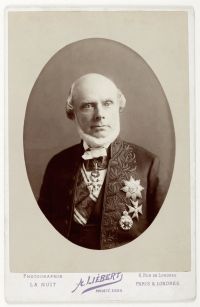
A. de Quatrefages

A. de Quatrefages

Summary

Portrait of A. de Quatrefages A. de Quatrefages The human species (1879)

It is the White who, impelled by his restless ardour, has invaded the world, and is every day multiplying his conquests and colonies. It is he who has searched out the home of the coloured races, and who everywhere mingles his blood with their own. Almost all the half-breed populations recognize him as their father, and this gives rise to a double result. These races are at once raised above the maternal race, and the two brought closer together, as if they possessed a common element.
Source: Gutenberg

Portrait of A. de Quatrefages A. de Quatrefages The human species (1879)

I recollect that no animal has ever learnt the language of another. I know too well the distance there is between animal interjections and articulate speech, and I am as well aware as anyone that to use such an instrument, so as to produce from it true languages, can only be accomplished by the superior intelligence of man.
Agassiz, when he had arrived at this point, must have felt that he had lost himself, and that, in trying to harmonise the idea of a single human species with that of several races of distinct origin, he was entering an endless labyrinth.
Source: Gutenberg

Portrait of A. de Quatrefages A. de Quatrefages The human species (1879)

Here, again, we must return to the comparison of man with animals. Does it follow that, because all the races of dogs belong to one and the same species, they all have the same aptitudes? Will a hunter choose indifferently a setter, or a blood-hound to use as a pointer or in the chase? Will he consider the street-cur as of equal value with either of these pure-breeds? Clearly not. Now we must never forget that, while superior to animals and different to them in many respects, man is equally subject to all the general laws of animal nature.
Source: Gutenberg

Get perspective with Kwize: daily news enlightened by great literature