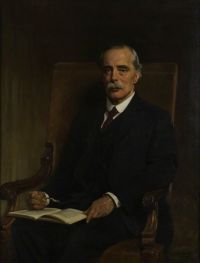
Alfred William Pollard

Alfred William Pollard

Summary

Portrait of Alfred William Pollard Alfred William Pollard 1911 Encyclopædia Britannica, Volume 6… (1911)

To be in touch throughout his life with the best French poets of the day was much for Chaucer. Even with their stimulus alone he might have developed no small part of his genius. But it was his great good fortune to add to this continuing French influence, lessons in plot and construction derived from Boccaccio’s Filostrato and Teseide, as well as some glimpses of the higher art of the Divina Commedia. He shows acquaintance also with one of Petrarch’s sonnets, and though, when all is said, the Italian books with which he can be proved to have been intimate are but few, they sufficed.
Source: Wikisource

Portrait of Alfred William Pollard Alfred William Pollard 1911 Encyclopædia Britannica, Volume 6… (1911)

Chaucer’s art here again is at its highest. He takes the plot of Boccaccio’s Teseide, but only as much of it as he wants, and what he takes he heightens and humanizes with the same skill which he had shown in transforming the Filostrato. Of the individual characters Theseus himself, the arbiter of the plot, is most notably developed; Emilie and her two lovers receive just as much individuality as they will bear without disturbing the atmosphere of romance. The whole story is pulled together and made more rapid and effective.
Source: Wikisource

Portrait of Alfred William Pollard Alfred William Pollard 1911 Encyclopædia Britannica, Volume 6… (1911)

When he had no more Italian poems to adapt he had learnt his lesson. The art of weaving a plot out of his own imagination was never his, but he could take what might be little more than an anecdote and lend it body and life and colour with a skill which has never been surpassed.
The most direct example of Chaucer’s French studies is his translation of Le Roman de la rose, a poem written in some 4000 lines by Guillaume Lorris about 1237 and extended to over 22,000 by Jean Clopinel, better known as Jean de Meun, forty years later.
Source: Wikisource

Get perspective with Kwize: daily news enlightened by great literature