Summary

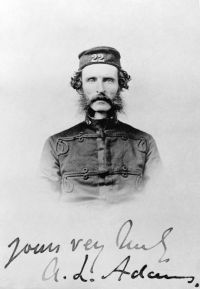
Portrait of Andrew Leith Adams Andrew Leith Adams Quarterly Journal of the Geological Society of London (1877)

The internal border is sharp, and the outer is thick and round. The circumference of the bone just below the lip of the glenoid cavity is 97 millims.
The coracoid, as in the last, was not ankylosed to the scapula, which appears to have belonged to a full-grown tortoise of much smaller dimensions than the owners of any of the bones yet described. For that reason, and, as will be shown in the sequel, from its relationship as regards relative size with other bones, I am disposed to consider that it belonged to a distinct form or species rather than to a small individual or female of T. robusta.
Source: Wikisource

Portrait of Andrew Leith Adams Andrew Leith Adams Quarterly Journal of the Geological Society of London (1877)

The following establishes their proportional greater thickness as compared with certain recent species that I have been enabled to examine:—
Thus it appears that the smallest girth of the shaft in T. robusta is greater than that of the tibia of the more slender T. ephippium, which is 2⋅2 inches longer, and that, whilst the antero-posterior diameter of the femoral articulation is 41 millimetres in T. robusta, it is 38 millimetres in T. ephippium; but their distal articulations are about equal in size.
Source: Wikisource

Portrait of Andrew Leith Adams Andrew Leith Adams Quarterly Journal of the Geological Society of London (1877)

This identification of remains of the Mammoth in Spain is, as far as I know, the first authenticated instance of the kind, and therefore important in relation to the southern distribution of the species; for although the elephant-remains found in many parts of Europe have been referred to the latter, it is well known that teeth of Elephas antiquus, Elephas meridionalis, and the so-called Elephas armeniacus have been confounded with molars of the Mammoth.
Source: Wikisource

Get perspective with Kwize: daily news enlightened by great literature