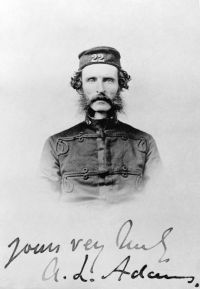
Andrew Leith Adams

Andrew Leith Adams

../../ (1879)

Summary

Portrait of Andrew Leith Adams Andrew Leith Adams,  ../../ (1879)

“ Spondylus quinquecostatus, or else a very closely allied species, is common to the Upper and Lower Limestones besides the Calcareous Sandstone. But the characteristic and most plentiful fossils, especially in the uppermost portions of the Lower Limestone, are casts of Conus, some of large size, and other genera not sufficiently preserved to admit of specific determination, among others Haliotis, of which there are apparently more than one species; indeed the genus is represented in all the formations. ”
Source: Wikisource

Portrait of Andrew Leith Adams Andrew Leith Adams,  ../../ (1879)

“ The organic remains are not, as a rule, in a good state of preservation; however, out of 25 genera and species of Mollusca belonging to the Sand bed, I have recognized as many as 13 in the Marl. The only Brachiopod of the two upper formations that I have likewise found in the Marl is Terebratula sinuosa, which is not uncommon, and is the only representative of the group I have seen from this bed. ”
Source: Wikisource

Portrait of Andrew Leith Adams Andrew Leith Adams,  ../../ (1879)

“ Sometimes the Upper Limestone gradually merges into a black indurated sand composed of particles of glauconite, felspar, topaz, &c, which forms a variegated bed made up of black, green, brown, and red sands intermixed and stratified. This variety is well seen on the scarp of the hill of Chelmus in Gozo, where it is fully 30 feet in thickness. Altogether the greatest depth attained by the Sand bed may be little less than 60 feet. ”
Source: Wikisource

Get perspective with Kwize: daily news enlightened by great literature