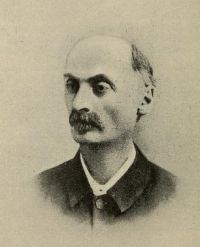
Archibald Henry Sayce

Archibald Henry Sayce

Folk-Lore (1919 (vol. 30), 1920 (vol. 31))

Summary

Portrait of Archibald Henry Sayce Archibald Henry Sayce,  Folk-Lore (1919 (vol. 30), 1920 (vol. 31))

“ First of all the owner of the donkey brought his complaint. The judge looked at his book and said: ‘The cook must restore the donkey’s tail; therefore let the owner give him the donkey until the tail is grown again. And now for my fee.’ So the man gave the judge his fee, but preferred to keep the donkey. Next one of the blind men demanded justice. So the judge looked again into his book, and said: ‘According to the divine law (sheri’) it is an eye for an eye and a tooth for a tooth. Therefore one of the blind men must mount the minaret and jump down on the cook who must sit below. ”
Source: Wikisource

Portrait of Archibald Henry Sayce Archibald Henry Sayce,  Folk-Lore (1919 (vol. 30), 1920 (vol. 31))

“ The golden bark of the Sun-god on the sacred lake of Karnak, or the heifer which was believed to ascend from the river once a year at Sharona on the eve of the festival of the Nile-gods are illustrations of the fact. The beliefs and customs of the people equally bear witness to the continuity of habit, and traditions among the inhabitants of the Sa’îd. ”
Source: Wikisource

Portrait of Archibald Henry Sayce Archibald Henry Sayce,  Folk-Lore (1919 (vol. 30), 1920 (vol. 31))

“ The sharp-witted Cairene revenged himself upon Turkish tyranny by caricaturing him and inventing stories at his expense. And the stupidity of the Turk is represented, not as the naïve stupidity of the ignorant fellaḥ, but as an innate and overwhelming stupidity which no amount of education would cure.
The folk-tales of Upper Egypt are of a different class altogether. There is nothing of the city in them, and those which I have heard are either attached to the ancient monuments of the country or can be shown to go back to the traditions and beliefs of ancient Egypt.
”
Source: Wikisource

Get perspective with Kwize: daily news enlightened by great literature