Summary

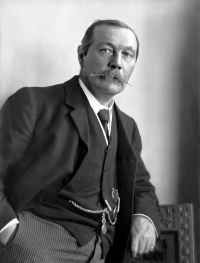
Portrait of Arthur Conan Doyle Arthur Conan Doyle The War in South Africa, Its Cause and Conduct

Is there any sane man of any nation who can contend that a British statesman could possibly have taken any other view? From the firing of the first shot the irresistible logic of events showed that either the Republics must dominate Africa or they must cease to exist. For the sparing of the Orange Free State there might, I think, be a fair argument, but they had put themselves out of court by annexing every foot of British territory which they could lay their hands upon. For the sparing of the Transvaal there could be no possible reason.
Source: Gutenberg

Portrait of Arthur Conan Doyle Arthur Conan Doyle The War in South Africa, Its Cause and Conduct

Why should they not have their own views as to the future of South Africa? Why should they not endeavour to have one universal flag and one common speech? Why should they not win over our colonists, if they can, and push us into the sea? I see no reason why they should not. Let them try if they will. And let us try to prevent them. But let us have an end of talk [71] about British aggression, of capitalist designs upon the gold fields, of the wrongs of a pastoral people, and all the other veils which have been used to cover the issue.
Source: Gutenberg

Portrait of Arthur Conan Doyle Arthur Conan Doyle The War in South Africa, Its Cause and Conduct

When we could not help them with men we helped them with money. Our fleet has crushed their enemies. And now, for the first time in history, we have had a chance of seeing who were our friends in Europe, and nowhere have we met more hatred and more slander than from the German press and the German people. Their most respectable journals have not hesitated to represent the British troops—troops every bit as humane and as highly disciplined as their own—not only as committing outrages on person and property, but even as murdering women and children.
Source: Gutenberg

Get perspective with Kwize: daily news enlightened by great literature