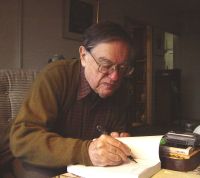
Donald Keene

Donald Keene

Summary

Portrait of Donald Keene Donald Keene Japanese Literature (1955)

People will not stand for the childish nonsense they did in the past.’ Chikamatsu answered, ‘Your view seems like a plausible one, but it is a theory which does not take into account the real methods of art. Art is something which lies in the slender margin between the real and the unreal. Of course it seems desirable, in view of the current taste for realism, to have the retainer in the play copy the gestures and speech of a real retainer, but in that case should a real retainer of a daimyō put rouge and powder on his face like an actor?
Source: Wikisource

Portrait of Donald Keene Donald Keene Japanese Literature (1955)

Or, to give an analogy drawn from Western music, the Nō is like the operas of Monteverdi or Handel—beautiful and expressive, but not particularly dramatic. The slow miming and dancing which usually so weary the foreign visitor to a Nō performance have the same function as one of Handel’s long arias; not to advance the action of the play, but to communicate to us something more than words alone can express about the character who is singing or dancing. With the jōruri we move to a world like that of the operas of Gluck or Mozart.
Source: Wikisource

Portrait of Donald Keene Donald Keene Japanese Literature (1955)

The pale hue of the flowers of the teak-tree show the truth that they who prosper must fall. The proud ones do not last long, but vanish like a spring-night’s dream. And the mighty ones too will perish in the end, like dust before the wind.”
This is the mood of the times which succeeded Murasaki’s. Less than a century after she finished The Tale of Genji with its picture of the most elegant society ever known, the country was torn by civil wars. The lovely capital was wasted by fires, plagues and famines.
Source: Wikisource

Get perspective with Kwize: daily news enlightened by great literature