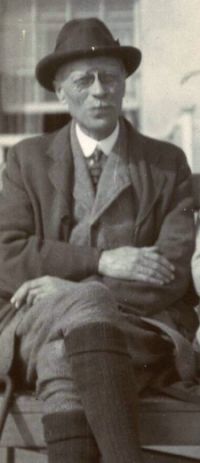
John George Robertson

John George Robertson

Summary

Portrait of John George Robertson John George Robertson 1911 Encyclopædia Britannica (1911)

It is a peculiarity of German literature that in those ages when, owing to its own poverty and impotence, it was reduced to borrowing its ideas and its poetic forms from other lands, it sank to the most servile imitation; while the first sign of returning health has invariably been the repudiation of foreign influence and the assertion of the right of genius to untrammelled expression. Thus Germany’s periods of literary efflorescence rarely coincide with those of other nations, and great European movements, like the Renaissance, passed over her without producing a single great poet.
Source: Wikisource

Portrait of John George Robertson John George Robertson 1911 Encyclopædia Britannica (1911)

Grillparzer’s brooding, unbalanced temperament, his lack of will-power, his pessimistic renunciation and the bitterness which his self-imposed martyrdom produced in him, made him peculiarly adapted to express the mood of Austria in the epoch of intellectual thraldom that lay between the Napoleonic wars and the Revolution of 1848; his poetry reflects exactly the spirit of his people under the Metternich régime, and there is a deep truth behind the description of Der Traum, ein Leben as the Austrian Faust.
Source: Wikisource

Portrait of John George Robertson John George Robertson 1911 Encyclopædia Britannica (1911)

Logau’s three thousand epigrams (Deutsche Sinngedichte, 1654) afford a key to the intellectual temper of the 17th century; they are the epitome of their age. Here are to be seen reflected the vices of the time, its aping of French customs and its contempt for what was national and German; Logau held up to ridicule the vain bloodshed of the war in the interest of Christianity, and, although he praised Opitz, he was far from prostrating himself at the dictator’s feet. Logau is an epigrammatist of the first rank, and perhaps the most remarkable product of the Renaissance movement in Germany.
Source: Wikisource

Get perspective with Kwize: daily news enlightened by great literature