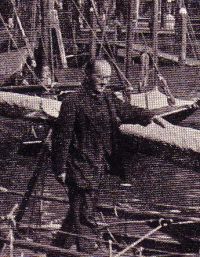
E. Keble Chatterton

E. Keble Chatterton

Summary

Portrait of E. Keble Chatterton E. Keble Chatterton Steamships and their story (1910)

After having been brought safe and sound through gales of wind, across many thousands of miles of ocean, past cruel coast, and through treacherous channels, until at last the fairway and the harbour of safety have been reached, no one who has any heart at all can step ashore without feeling that he is parting from one of the noblest and best friends that a man ever had. True, there are some people, as an officer on one of the crack liners once remarked to me, who, as soon as ever the big ship is tied up alongside the landing-stage, hurry ashore from her as if she were a plague-ship.
Source: Gutenberg

Portrait of E. Keble Chatterton E. Keble Chatterton Steamships and their story (1910)

How frequently indispensable is the tug to the big steamship, both when entering and leaving the comparatively narrow harbours! You see her at Southampton, for instance, pulling the great steel hull away from the quay; you see her at Liverpool hauling ahead to get the mighty, towering bows of the liner clear of the landing-stage out into the river. You see them in New York when the mammoth comes to enter the narrow opening alongside the pier, pressing their noses on to the mammoth’s stern and compelling her giant dimensions to move round.
Source: Gutenberg

Portrait of E. Keble Chatterton E. Keble Chatterton Steamships and their story (1910)

Nor only to the history and the glamour of the great steam-driven vessel have I confined myself. The sea is not merely a wide ocean, but contains within its mighty bosom many smaller areas such as channels and bays wherein the steamboat is able to ply as well for pleasure as for profit; and besides the big, brave sisters with their enormous displacement and their powerful engines, there are other children which run across smaller sea-ways, and these, too, are not to be passed over lightly.
Source: Gutenberg

Get perspective with Kwize: daily news enlightened by great literature