Summary

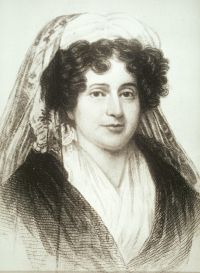
Portrait of Emma Willard Emma Willard Theory of circulation by respiration

I studied my theory anew, while I read the most approved works on cholera; and I came to the belief that imperfect respiration, caused by the want of due oxygen in the air, was the principal predisposing cause of the premonitory symptoms; while the death that supervened was often caused by the settling of carbonic acid gas, the residuum of animal combustion, in the lower air-cells of the lungs. The symptoms of the cholera, as treated by the best writers, were full of new proofs of the truth of my theory, especially of its last step, the formation of steam or vapor in the lungs.
Source: Gutenberg

Portrait of Emma Willard Emma Willard Theory of circulation by respiration

When two events are so conjoined in nature that one is the only invariable antecedent of the other, then, according to all logic, we are bound to conclude that the first is the physical cause of the second, even though we cannot understand how it should be. Of the circulation, such living respiration as produces heat is the invariable antecedent, and nothing else is. The heart’s action, as stated by our reviewer himself, is not therefore respiration, and not the heart’s action or anything else, is the cause of the circulation.
Source: Gutenberg

Portrait of Emma Willard Emma Willard Theory of circulation by respiration

Yes; this atmospheric air, when I inspire it, has oxygen combined with nitrogen; but when I expire, the oxygen has disappeared, and heavier substances—carbonic acid gas and watery vapor—are returned in its place. Thus, it must be, animal heat is evolved. It is the product of respiration; and it is because I breathe faster and deeper, that more carbon is oxidized or burned, and more heat is set free in my lungs; and therefore I grow warm as I walk up this hill, though all around me is cold.
The mind, excited by new and great thoughts, works with unwonted energy
Source: Gutenberg

Get perspective with Kwize: daily news enlightened by great literature