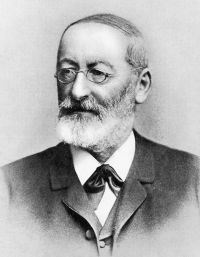
Ferdinand Julius Cohn

Ferdinand Julius Cohn

Summary

Portrait of Ferdinand Julius Cohn Ferdinand Julius Cohn Popular Science Monthly (1883)

In reality every living body is subject to an uninterrupted change, which goes on in an appointed course. Life is like a stream, which gushes out of a hidden spring; slowly increases, flows on for a time with even strength, finally with diminishing velocity, to disappear in the sea of eternity. We designate the course of changes which every living being, plant, and animal, as well as man, goes through, as its development. Development begins with the moment of birth and ends with death.
Source: Wikisource

Portrait of Ferdinand Julius Cohn Ferdinand Julius Cohn Popular Science Monthly (1883)

Now is the strength of the living wall of the plant tested: as long as it is unbroken, the assault is repelled; but the persistent enemy presses into the smallest opening. Woe to the tree from which the wind has broken a limb, or in which the careless gardener has made a bad cut! The microbes, whose spores are floating through the air in unwholesome clouds, and fall with the dust, settle upon the wounded surface, and soon its whole cell-structure is pervaded by their destructive webs.
Source: Wikisource

Portrait of Ferdinand Julius Cohn Ferdinand Julius Cohn Popular Science Monthly (1883)

Thus an unceasing activity, like that of the bee-hive, prevails in the cell-state of the plant. Gases go in and out; juices circulate up and down, absorption and evaporation, distillation and refining, forming anew, remodeling, or destroying the old, are going on all the time without rest or cessation for an instant. As long as the cells live, they are active; when they cease to work, their death is near. No one thinks, when he looks at a plant, what restless activity is at work within it, for the cells perform their artful labor in stillness, without buzzing and flying around as the bees do.
Source: Wikisource

Get perspective with Kwize: daily news enlightened by great literature