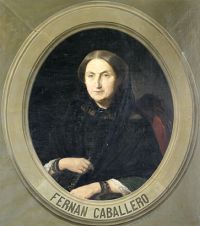
Fernán Caballero

Fernán Caballero

Summary

Portrait of Fernán Caballero Fernán Caballero La Gaviota: A Spanish novel

When Maria had ceased to speak, the young girl was silent for an instant, and then, with an air of indifference, said—
“I do not wish to marry.”
“Listen then!” exclaimed the good woman. “It is, perchance, you wish to be a nun?”
“Not at all,” replied the Gaviota.
“What then?” demanded Maria, really angry. “You do not wish to be either flesh or fish! One thing only I know—woman belongs to God or to man; if not, she does not accomplish her mission, either towards God or towards society.”
“What would you, Maria?” replied Marisalada; “I feel that neither marriage nor the convent is my vocation.”
Source: Gutenberg

Portrait of Fernán Caballero Fernán Caballero La Gaviota: A Spanish novel

Does it cause you much grief to learn that you are beloved?”
“No—certainly. We are agreed upon this axiom which you repeat so often: ‘Love does not speak enough.’ But, good Maria, make of love constancy: I would sooner give than receive.”
“They do not talk thus to me,” cried the brave woman, with impatience.
“It is still true, my dear and good mother,” answered Stein, taking and pressing the hands of old Maria, “we have a running account of affection, we two, but the balance is against me. God grant that I may some day be able to furnish the proof of my attachment and my gratitude!”
Source: Gutenberg

Portrait of Fernán Caballero Fernán Caballero La Gaviota: A Spanish novel

She professed for the world a kind of worship; she adored music, and looked with contempt on all that was Spanish.
“What, then, is the matter with me?”
“A deception,” murmured Eloise.
“A deception! I have them by hundreds; but the fact cannot be disputed,” said Raphael, “that you are most beautiful with this coiffure, and that your toilet is in perfect taste.”
“It pleases you?” cried the elegant Eloise, smirking.
“It is not extraordinary,” continued Raphael, “that this Englishman, whom you see here opposite to you, is dying for Spain and for the Spaniards.”
Source: Gutenberg

Get perspective with Kwize: daily news enlightened by great literature