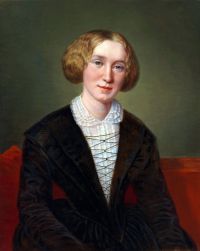
George Eliot

George Eliot

Summary

Portrait of George Eliot George Eliot,  Early Essays (1919)

“ I say to myself—this is an image of what our life should be—a series of efforts directed to the production of a contemplated whole, just as every stroke of the artist's pencil has a purpose bearing on the conception which he retains in his mind's eye. We should all be painting our picture, whether it be a home scene after Wilkie, a Paul preaching at Athens, or a Brutus passing sentence on his son. We should all have a purpose in life as perfectly recognised and definite as the painter's idea of his subject. ”
Source: Wikisource

Portrait of George Eliot George Eliot,  Early Essays (1919)

“ Doubtless such men as these have a distinct purpose in life, but they are not the men of whom my artist reminds me—who seem to me to be painting a picture. The kind of purpose which makes life resemble a work of art in its isolated majesty or loveliness is not the attempt to satisfy that inconvenient troop of wants which metamorphose themselves like the sprites of an enchantress, so that no sooner have we provided food for the linnet's beak than a huge lion's maw gapes upon us. It is to live, not for our friends, not for those hostages to fortune, wives and children ”
Source: Wikisource

Portrait of George Eliot George Eliot,  Early Essays (1919)

“ I love to think how the perfect whole exists in the imagination of the artist before his pencil has marked the canvas—to observe how every minute stroke, every dismal-looking layer of colour conduces to the ultimate effect, and how completely the creative genius which has conceived the result can calculate the necessary means. I love to watch the artist's eye, so wrapt and unworldly in its glance, scrupulously attentive to the details of his actual labour, yet keeping ever in view the idea which that labour is to fulfil. ”
Source: Wikisource

Get perspective with Kwize: daily news enlightened by great literature