“ Perhaps the pretty woman, not much younger than he, who is leaning on his arm, is more changed than her husband: the lovely bloom that used to be always on her cheek now comes but fitfully, with the fresh morning air or with some strong surprise; yet to all who love human faces best for what they tell of human experience, Nancy’s beauty has a heightened interest. Often the soul is ripened into fuller goodness while age has spread an ugly film, so that mere glances can never divine the preciousness of the fruit. But the years have not been so cruel to Nancy. ”
Summary

"Silas Marner," the third novel by George Eliot, published in 1861, is set in rural England during the early 19th century, merging realism with moral and social reflection. The narrative traces the life of Silas Marner, a weaver betrayed by his community and drawn into solitude, whose existence is transformed by the arrival of an orphaned child, Eppie.
Themes of belief, industrial progress, and social ties intertwine with the tension between material prosperity and emotional bonds. Eliot’s subtle depiction of renewal and the restoration of humanity through affection and duty highlights the novel’s lasting appeal.
Quotes from Silas Marner (George Eliot)
“ There would be a great party at the Red House on New Year’s Eve, she knew: her husband would be smiling and smiled upon, hiding her existence in the darkest corner of his heart. But she would mar his pleasure: she would go in her dingy rags, with her faded face, once as handsome as the best, with her little child that had its father’s hair and eyes, and disclose herself to the Squire as his eldest son’s wife. It is seldom that the miserable can help regarding their misery as a wrong inflicted by those who are less miserable. ”
“ Marner’s thoughts could no longer move in their old round, and were baffled by a blank like that which meets a plodding ant when the earth has broken away on its homeward path. The loom was there, and the weaving, and the growing pattern in the cloth; but the bright treasure in the hole under his feet was gone; the prospect of handling and counting it was gone: the evening had no phantasm of delight to still the poor soul’s craving. The thought of the money he would get by his actual work could bring no joy, for its meagre image was only a fresh reminder of his loss ”
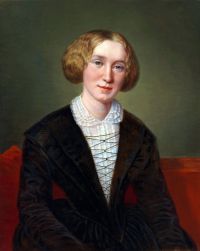 George Eliot,
Silas Marner
(1907)
George Eliot,
Silas Marner
(1907)
“ For as for rubbing furniture, when you can once see your face in a table there's nothing else to look for; but there's always something fresh with the diary; for even in the depths of winter there's some pleasure in conquering the butter, and making it come whether or no. My dear,' added Priscilla, pressing her sister's hand affectionately as they walked side by side, 'you'll never be low when you've got a dairy.' 'Ah, Priscilla,' said Nancy, returning the pressure with a grateful glance of her clear eyes, 'but it won't make up to Godfrey: a dairy's not so much to a man. ”
“ Perfect love has a breath of poetry which can exalt the relations of the least-instructed human beings; and this breath of poetry had surrounded Eppie from the time when she had followed the bright gleam that beckoned her to Silas’s hearth; so that it is not surprising if, in other things besides her delicate prettiness, she was not quite a common village maiden, but had a touch of refinement and fervour which came from no other teaching than that of tenderly-nurtured unvitiated feeling. ”
“ In the evening twilight, and later whenever the night was not dark, Silas looked out on that narrow prospect round the Stone-pits, listening and gazing, not with hope, but with mere yearning and unrest. This morning he had been told by some of his neighbours that it was New Year’s Eve, and that he must sit up and hear the old year rung out and the new rung in, because that was good luck, and might bring his money back again. This was only a friendly Raveloe-way of jesting with the half-crazy oddities of a miser, but it had perhaps helped to throw Silas into a more than usually excited state. ”
George Eliot,
Silas Marner
(1907)
“ While Silas and Eppie were seated on the bank discoursing in the fleckered shade of the ash-tree, Miss Priscilla Lammeter was resisting her sister's arguments, that it would be better to take tea at the Red House, and let her father have a long nap, than drive home to the Warrens so soon after dinner. The family party (of four only) were seated round the table in the dark wainscoted parlour, with the Sunday dessert before them, of fresh filberts, apples, and pears, duly ornamented with leaves by Nancy's own hands before the bells had rung for church. ”
George Eliot,
Silas Marner
(1907)
“ It was seven o'clock, and by this time she was not very far from Raveloe, but she was not familiar enough with those monotonous lanes to know how near she was to her journey's end. She needed comfort, and she knew but one comforter—the familiar demon in her bosom; but she hesitated a moment, after drawing out the black remnant, before she raised it to her lips. In that moment the mother's love pleaded for painful consciousness rather than oblivion—pleaded to be left in aching weariness, rather than to have the encircling arms benumbed so that they could not feel the dear burden. ”
George Eliot,
Silas Marner
(1907)
“ Instead of trying to still his fears, he encouraged them, with that superstitious impression which clings to us all, that if we expect evil very strongly it is the less likely to come; and when he heard a horse approaching at a trot, and saw a hat rising above a hedge beyond an angle of the lane, he felt as if his conjuration had succeeded. But no sooner did the horse come within sight, than his heart sank again. It was not Wildfire; and in a few moments more he discerned that the rider was not Dunstan, but Bryce, who pulled up to speak, with a face that implied something disagreeable. ”
George Eliot,
Silas Marner
(1907)
“ His first movement after the shock had been to work in his loom; and he went on with this unremittingly, never asking himself why, now he was come to Raveloe, he worked far on into the night to finish the tale of Mrs. Osgood's table-linen sooner than she expected—without contemplating beforehand the money she would put into his hand for the work. He seemed to weave, like the spider, from pure impulse, without reflection. Every man's work, pursued steadily, tends in this way to become an end in itself, and so to bridge over the loveless chasms of his life. ”
“ To the peasants of old times, the world outside their own direct experience was a region of vagueness and mystery: to their untravelled thought a state of wandering was a conception as dim as the winter life of the swallows that came back with the spring; and even a settler, if he came from distant parts, hardly ever ceased to be viewed with a remnant of distrust, which would have prevented any surprise if a long course of inoffensive conduct on his part had ended in the commission of a crime; especially if he had any reputation for knowledge, or showed any skill in handicraft. ”
“ When had the thief come? During Silas’s absence in the daytime the door had been locked, and there had been no marks of any inroad on his return by daylight. And in the evening, too, he said to himself, everything was the same as when he had left it. The sand and bricks looked as if they had not been moved. Was it a thief who had taken the bags? or was it a cruel power that no hands could reach, which had delighted in making him a second time desolate? He shrank from this vaguer dread, and fixed his mind with struggling effort on the robber with hands, who could be reached by hands. ”
George Eliot,
Silas Marner
(1907)
“ These circumstances exalted her inward drama in her own eyes, and deepened the emphasis with which she declared to herself that not the most dazzling rank should induce her to marry a man whose conduct showed him careless of his character, but that, 'love once, love always,' was the motto of a true and pure woman, and no man should ever have any right over her which would be a call on her to destroy the dried flowers that she treasured, and always would treasure, for Godfrey Cass's sake. And Nancy was capable of keeping her word to herself under very trying conditions. ”
George Eliot,
Silas Marner
(1907)
“ I'm obliged to you,' said the farrier, with a snort of scorn. 'If folks are fools, it's no business o' mine. I don't want to make out the truth about ghos'es: I know it a'ready. But I'm not against a bet—everything fair and open. Let any man bet me ten pound as I shall see Cliff's Holiday, and I'll go and stand by myself. I want no company. I'd as lief do it as I'd fill this pipe.' 'Ah, but who's to watch you, Dowlas, and see you do it? That's no fair bet,' said the butcher. 'No fair bet?' replied Mr. Dowlas, angrily. 'I should like to hear any man stand up and say I want to bet unfair. ”
“ Has Miss Nancy been cruel, and do you want to spite her by spoiling your pumps?” “Oh, everything has been disagreeable to-night. I was tired to death of jigging and gallanting, and that bother about the hornpipes. And I’d got to dance with the other Miss Gunn,” said Godfrey, glad of the subterfuge his uncle had suggested to him. The prevarication and white lies which a mind that keeps itself ambitiously pure is as uneasy under as a great artist under the false touches that no eye detects but his own, are worn as lightly as mere trimmings when once the actions have become a lie. ”
“ Even people whose lives have been made various by learning, sometimes find it hard to keep a fast hold on their habitual views of life, on their faith in the Invisible, nay, on the sense that their past joys and sorrows are a real experience, when they are suddenly transported to a new land, where the beings around them know nothing of their history, and share none of their ideas—where their mother earth shows another lap, and human life has other forms than those on which their souls have been nourished. Minds that have been unhinged from their old faith and love, have perhaps sought this Lethean influence of exile, in which the past becomes dreamy because its symbols have all vanished, and the present too is dreamy because it is linked with no memories. ”
George Eliot,
Silas Marner
(1861)
“ Yet few men could be more harmless than poor Marner. In his truthful simple soul, not even the growing greed and worship of gold could beget any vice directly injurious to others. The light of his faith quite put out, and his affections made desolate, he had clung with all the force of his nature to his work and his money; and like all objects to which a man devotes himself, they had fashioned him into correspondence with themselves. ”
“ When a young gentleman like Dunsey is reduced to so exceptional a mode of locomotion as walking, a whip in his hand is a desirable corrective to a too bewildering dreamy sense of unwontedness in his position; and Dunstan, as he went along through the gathering mist, was always rapping his whip somewhere. It was Godfrey’s whip, which he had chosen to take without leave because it had a gold handle; of course no one could see, when Dunstan held it, that the name Godfrey Cass was cut in deep letters on that gold handle—they could only see that it was a very handsome whip. ”
“ The questionable sound of Silas’s loom, so unlike the natural cheerful trotting of the winnowing-machine, or the simpler rhythm of the flail, had a half-fearful fascination for the Raveloe boys, who would often leave off their nutting or birds’-nesting to peep in at the window of the stone cottage, counterbalancing a certain awe at the mysterious action of the loom, by a pleasant sense of scornful superiority, drawn from the mockery of its alternating noises, along with the bent, tread-mill attitude of the weaver. ”
“ The tankards are on the side-table still, but the bossed silver is undimmed by handling, and there are no dregs to send forth unpleasant suggestions: the only prevailing scent is of the lavender and rose-leaves that fill the vases of Derbyshire spar. All is purity and order in this once dreary room, for, fifteen years ago, it was entered by a new presiding spirit. “Now, father,” said Nancy, “is there any call for you to go home to tea? Mayn’t you just as well stay with us?—such a beautiful evening as it’s likely to be.” ”
“ Only Aaron does want a change; and he made me cry a bit—only a bit—because he said I didn’t care for him, for if I cared for him I should want us to be married, as he did.” “Eh, my blessed child,” said Silas, laying down his pipe as if it were useless to pretend to smoke any longer, “you’re o’er young to be married. We’ll ask Mrs. Winthrop—we’ll ask Aaron’s mother what she thinks: if there’s a right thing to do, she’ll come at it. But there’s this to be thought on, Eppie: things will change, whether we like it or no; things won’t go on for a long while just as they are and no difference. ”
“ It might seem singular that Nancy—with her religious theory pieced together out of narrow social traditions, fragments of church doctrine imperfectly understood, and girlish reasonings on her small experience—should have arrived by herself at a way of thinking so nearly akin to that of many devout people, whose beliefs are held in the shape of a system quite remote from her knowledge—singular, if we did not know that human beliefs, like all other natural growths, elude the barriers of system. ”
George Eliot,
Silas Marner
(1907)
“ To adopt a child, because children of your own had been denied you, was to try and choose your lot in spite of Providence: the adopted child, she was convinced, would never turn out well, and would be a curse to those who had wilfully and rebelliously sought what it was clear that, for some high reason, they were better without. When you saw a thing was not meant to be, said Nancy, it was a bounden duty to leave off so much as wishing for it. And so far, perhaps, the wisest of men could scarcely make more than a verbal improvement in her principle. ”
“ Dunsey might betray him if he came back; but Dunsey might be won to silence. And when events turn out so much better for a man than he has had reason to dread, is it not a proof that his conduct has been less foolish and blameworthy than it might otherwise have appeared? When we are treated well, we naturally begin to think that we are not altogether unmeritorious, and that it is only just we should treat ourselves well, and not mar our own good fortune. Where, after all, would be the use of his confessing the past to Nancy Lammeter, and throwing away his happiness?—nay, hers? ”
“ And when the sunshine grew strong and lasting, so that the buttercups were thick in the meadows, Silas might be seen in the sunny midday, or in the late afternoon when the shadows were lengthening under the hedgerows, strolling out with uncovered head to carry Eppie beyond the Stone-pits to where the flowers grew, till they reached some favourite bank where he could sit down, while Eppie toddled to pluck the flowers, and make remarks to the winged things that murmured happily above the bright petals, calling “Dad-dad’s” attention continually by bringing him the flowers. ”
George Eliot,
Silas Marner
(1907)
“ He spread them out in heaps and bathed his hands in them; then he counted them and set them up in regular piles, and felt their rounded outline between his thumb and fingers, and thought fondly of the guineas that were only half-earned by the work in his loom, as if they had been unborn children—thought of the guineas that were coming slowly through the coming years, through all his life, which spread far away before him, the end quite hidden by countless days of weaving. ”
“ Bending forward, he could just discern the marks made by the little feet on the virgin snow, and he followed their track to the furze bushes. “Mammy!” the little one cried again and again, stretching itself forward so as almost to escape from Silas’s arms, before he himself was aware that there was something more than the bush before him—that there was a human body, with the head sunk low in the furze, and half-covered with the shaken snow. ”
“ So had his way of life:—he invited no comer to step across his door-sill, and he never strolled into the village to drink a pint at the Rainbow, or to gossip at the wheelwright’s: he sought no man or woman, save for the purposes of his calling, or in order to supply himself with necessaries; and it was soon clear to the Raveloe lasses that he would never urge one of them to accept him against her will—quite as if he had heard them declare that they would never marry a dead man come to life again. ”
“ Supper was his favourite meal, because it came at his time of revelry, when his heart warmed over his gold; whenever he had roast-meat, he always chose to have it for supper. But this evening, he had no sooner ingeniously knotted his string fast round his bit of pork, twisted the string according to rule over his door-key, passed it through the handle, and made it fast on the hanger, than he remembered that a piece of very fine twine was indispensable to his “setting up” a new piece of work in his loom early in the morning. ”
“ With that, Dunstan slammed the door behind him, and left Godfrey to that bitter rumination on his personal circumstances which was now unbroken from day to day save by the excitement of sporting, drinking, card-playing, or the rarer and less oblivious pleasure of seeing Miss Nancy Lammeter. The subtle and varied pains springing from the higher sensibility that accompanies higher culture, are perhaps less pitiable than that dreary absence of impersonal enjoyment and consolation which leaves ruder minds to the perpetual urgent companionship of their own griefs and discontents. ”
“ And what could be more unlike that Lantern Yard world than the world in Raveloe?—orchards looking lazy with neglected plenty; the large church in the wide churchyard, which men gazed at lounging at their own doors in service-time; the purple-faced farmers jogging along the lanes or turning in at the Rainbow; homesteads, where men supped heavily and slept in the light of the evening hearth, and where women seemed to be laying up a stock of linen for the life to come. There were no lips in Raveloe from which a word could fall that would stir Silas Marner’s benumbed faith to a sense of pain. ”
George Eliot,
Silas Marner
(1907)
“ How could they have spent the money in their own village without betraying themselves? They would be obliged to 'run away'—a course as dark and dubious as a balloon journey. So, year after year, Silas Marner had lived in this solitude, his guineas rising in the iron pot, and his life narrowing and hardening itself more and more into a mere pulsation of desire and satisfaction that had no relation to any other being. His life had reduced itself to the mere functions of weaving and hoarding, without any contemplation of an end towards which the functions tended. ”
George Eliot,
Silas Marner
(1907)
“ But when Godfrey was lifting his eyes from one of those long glances, they encountered an object as startling to him at that moment as if it had been an apparition from the dead. It was an apparition from that hidden life which lies, like a dark by-street, behind the goodly ornamented façade that meets the sunlight and the gaze of respectable admirers. It was his own child, carried in Silas Marner's arms. That was his instantaneous impression, unaccompanied by All eyes were bent on Silas Marner. ”
Common terms
Similar works
The Works of George Eliot (George Eliot…Men of Mawm (W. Riley)Jill: A Flower Girl (L. T. Meade…Two Maiden Aunts (Mary H. Debenham…Adam Bede (George Eliot)The World Before Them: A Novel…The Soul of Susan Yellam (Horace Annesley Vachell…Windyridge (W. Riley)Nicky-Nan, Reservist (Arthur Quiller-Couch…Tales and Fantasies (Robert Louis Stevenson…
