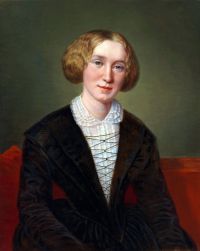
George Eliot

George Eliot

Summary

Portrait of George Eliot George Eliot The Legend of Jubal (1869)

And thus did Jubal to his race reveal Music their larger soul, where woe and weal Filling the resonant chords, the song, the dance, Moved with a wider-winged utterance. Now many a lyre was fashioned, many a song Raised echoes new, old echoes to prolong, Till things of Jubal's making were so rife, "Hearing myself," he said, "I hems in my life, And I will get me to some far-off land, Where higher mountains under heaven stand And touch the blue at rising of the stars, Whose song they hear where no rough mingling mars The great clear voices.
Source: Wikisource

Portrait of George Eliot George Eliot The Legend of Jubal (1869)

He knew not if that gaze the music sent, Or music that calm gaze: to hear, to see, Was but one undivided ecstasy: The raptured senses melted into one, And parting life a moment's freedom won From in and outer, as a little child Sits on a bank and sees blue heavens mild Down in the water, and forgets its limbs, And knoweth nought save the blue heaven that swims. "Jubal," the face said, " I am thy loved Past, The soul that makes thee one from first to last. I am the angel of thy life and death, Thy outbreathed being drawing its last breath.
Source: Wikisource

Portrait of George Eliot George Eliot The Legend of Jubal (1869)

Wouldst thou have asked aught else from any god Whether with gleaming feet on earth he trod Or thundered through the skies — aught else for share Of mortal good, than in thy soul to bear The growth of song, and feel the sweet unrest Of the world's spring-tide in thy conscious breast? No, thou hadst grasped thy lot with all its pain, Nor loosed it any painless lot to gain Where music's voice was silent; for thy fate Was human music's self incorporate: Thy senses' keenness and thy passionate strife Were flesh of her flesh and her womb of life.
Source: Wikisource

Get perspective with Kwize: daily news enlightened by great literature